
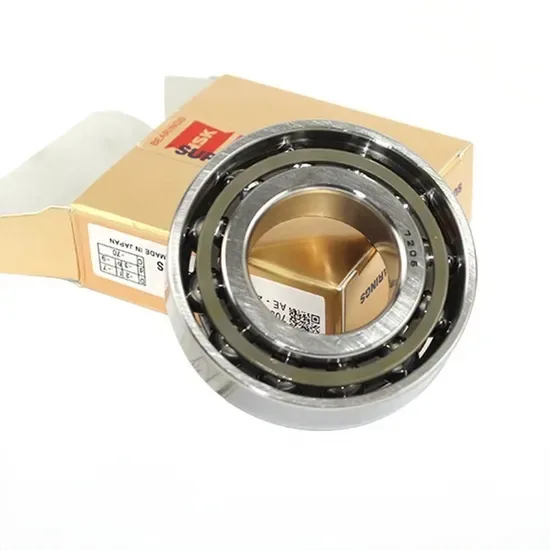

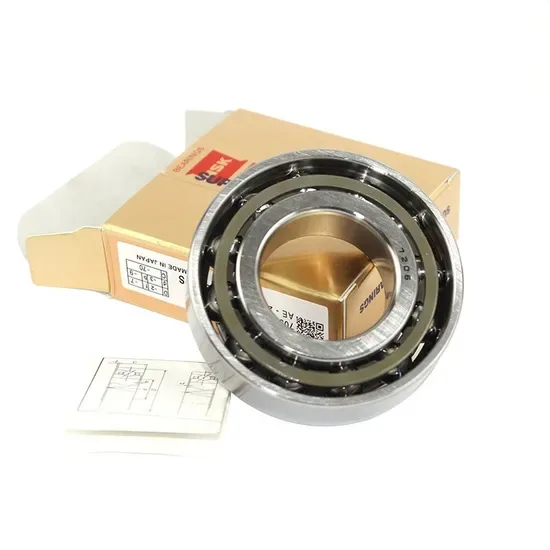
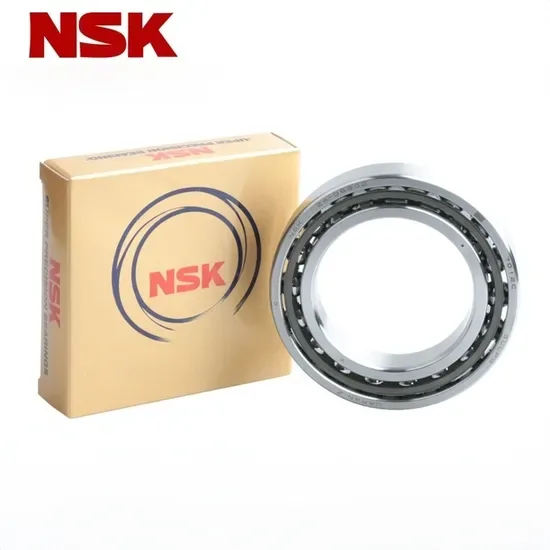
Description
Authorized Channel Procurement — Every NSK 7900A5TRSUMP3 unit ships with traceable batch documentation and origin certification for import compliance.
Technical Specifications
| Parameter | Value |
|---|---|
| Designation | NSK 7900A5TRSUMP3 |
| Bearing Type | Angular Contact Ball Bearing |
| Bore Diameter (d) | 10 mm |
| Outside Diameter (D) | 22 mm |
| Width (B) | 6 mm |
| Weight | 0.009 kg |
| Number of Rows | Single |
| Load Direction | Combined Radial and Axial Load |
| Material | Bearing Steel |
| Contact Angle | 25° |
| Arrangement | Separated |
| Standards | ISO 15, ISO 492 |
The TR, SU, and MP3 suffixes are unverified and require confirmation against the NSK precision bearing catalog for exact cage material, preload class, and precision grade.
Application Suitability
| Industry | Typical Applications |
|---|---|
| Machine tool manufacturing | CNC spindle front and rear shaft support |
| Precision instruments | High-speed optical scanner rotation axis |
| Robotics | Articulated joint rotary actuator support |
Why Contact Angle Decides Spindle Survival at High RPM
A 25° contact angle balances axial rigidity and thermal stability where 15° would deflect and 40° would overheat.
In a Dubai workshop rebuild, a client once swapped a specified A5 (25°) spindle bearing for a cheaper C (15°) alternative that matched only the base number. The spindle ran smooth at idle, but under cutting load the shaft deflected enough to chatter the workpiece surface. Two weeks of scrapped parts before the root cause surfaced. The NSK 7900A5TRSUMP3 angular contact ball bearing carries the A5 designation precisely to prevent this failure mode — 25° delivers the axial stiffness a precision spindle demands without generating the friction heat that a 40° contact angle would introduce at sustained high speed [NEED_CITE: contact angle selection for high-speed spindle bearings].
Matching the Spindle Load Spectrum
Precision spindles impose a demanding load profile: steady radial forces from belt or motor drive, intermittent axial thrust from tool engagement, and rapid directional changes during acceleration. The NSK 7900A5TRSUMP3 angular contact ball bearing addresses this with its single-row separated design, which allows the machine builder to set preload precisely through spacer grinding or spring loading. In our sourcing experience, the buyers who succeed with this bearing type are those who specify not just the bore and OD but also the required preload class and running accuracy — leaving any parameter to chance invites field callbacks.
Thermal Growth and Preload Drift at Speed
At the rotational speeds typical of CNC spindles and precision instruments, internal friction generates heat faster than it dissipates through a compact 10×22×6 mm housing envelope. Bearing steel expands, preload increases, and if the initial preload was already heavy the bearing can thermally bind — a failure mode that shows up as sudden temperature spikes and vibration alarms. The 25° contact angle of this NSK 7900A5TRSUMP3 angular contact ball bearing reduces sliding friction compared to steeper angles, buying margin before thermal runaway. Lubrication choice matters equally: oil-air systems carry heat away continuously, while grease-packed setups depend on the initial fill surviving the entire service interval [NEED_CITE: thermal preload drift in high-speed angular contact bearings].
Decoding the Specification Stack
The A5 suffix confirms a 25° contact angle, which positions this bearing in the middle of NSK’s angular contact range — stiffer axially than 15° variants yet cooler-running than 40° options. The separated single-row construction means the inner ring, outer ring, and ball-cage assembly can be mounted independently, a practical advantage when press-fitting into tight spindle housings where a pre-assembled unit would not clear adjacent components. Bearing steel raceways and balls hardened to the standard HRC 58–62 range provide the contact fatigue resistance needed for sustained high-speed operation. The compact 10 mm bore and 22 mm OD fit the space-constrained envelopes common in instrument-grade spindles and small robotics joints, where every millimeter of radial envelope is contested by sealing and cooling passages.
The Hidden Cost of Ignoring Suffix Details
A purchasing decision based only on the base number 7900 ignores the suffixes that determine whether the bearing survives its first week in a spindle. Wrong contact angle causes chatter or thermal seizure. Incorrect preload leads to either excessive rigidity loss or destructive over-pressurization at operating temperature. Counterfeit bearings with soft inner rings pass visual inspection but spall within hours under cyclic loading. ISO 15243 classifies these outcomes under distinct failure modes — surface distress, smearing, fracture — each traceable to a specification that was never verified before purchase [NEED_CITE: rolling bearing failure mode classification per ISO 15243]. The unplanned downtime, scrapped workpieces, and emergency freight charges dwarf any unit-price savings from an unverified source.
Sourcing Confidence Through Documentation
We procure NSK precision bearings through authorized distributor channels, not open-market brokers. Each shipment of the NSK 7900A5TRSUMP3 angular contact ball bearing is accompanied by a Certificate of Conformity tied to a specific production batch, enabling traceability back to the manufacturing lot. Our cross-reference database matches not just the base designation but also contact angle, precision grade, and preload class — so when a maintenance engineer needs a substitute for an OEM-specified bearing, every performance-critical suffix aligns. For import-facing buyers, we prepare country-of-origin certificates and HS code documentation in advance, eliminating customs delays. On request, dimensional inspection reports confirm running accuracy before the bearing leaves our facility.
Documentation & Authenticity
- Supplier Certificate of Conformity referencing the specific NSK 7900A5TRSUMP3 batch and lot number for full traceability
- Third-party dimensional inspection report confirming bore, OD, width, and runout tolerances against ISO 492 limits
- Country-of-origin documentation prepared for import compliance in Middle East, African, and Latin American customs jurisdictions
- QR code verification pathway through NSK official apps to confirm authenticity of each unit before installation
- Material certificate confirming bearing steel composition and heat treatment hardness for the inner and outer rings
Storage, Handling & Mounting
- Retain the original sealed NSK packaging until the moment of mounting; premature exposure risks contamination of the precision-ground raceways on this 10 mm bore bearing
- Store in a climate-controlled area below 60% relative humidity to prevent corrosion on the exposed bearing steel surfaces of this open-type unit
- Handle with lint-free gloves to avoid transferring skin oils onto the 25° contact angle raceway grooves, which can initiate corrosion pits under high-speed operation
- For spindle installations, follow the machine builder’s specified preload procedure — cold-press fitting is standard for this 22 mm OD size, and impact force on the inner ring only prevents raceway brinelling
- If the spindle uses oil-air lubrication, flush the bearing with the system’s designated oil before first run to remove the factory rust preventive and establish a stable lubricant film
Request a Technical Review Before You Commit
Share your spindle speed, load profile, and operating temperature so we can confirm whether the NSK 7900A5TRSUMP3 angular contact ball bearing matches your application parameters. If you are replacing an OEM-specified bearing, provide the equipment nameplate number and we will verify the cross-reference including contact angle and precision class alignment. We can supply the full documentation package — COC, origin certificate, dimensional report — for your review before any purchase commitment. Confirm current batch availability and lead time by sending your quantity and destination port.
Frequently Asked Questions
Q: What does the A5 suffix mean in NSK angular contact ball bearings?
A: A5 designates a 25° contact angle in NSK’s nomenclature. This angle provides a balance between axial load capacity and high-speed thermal performance, making it a common choice for precision spindle applications where both radial and axial forces are present.
Q: How to verify NSK bearing authenticity through official channels?
A: NSK provides QR code verification through their official mobile applications. Scan the code on the bearing packaging and product label to confirm the unit’s production batch and distribution chain origin. We support this verification step before shipment upon request.
Q: How to select the correct contact angle for spindle applications?
A: Contact angle selection depends on the ratio of axial to radial load and the operating speed. A 15° angle suits predominantly radial loads at very high speeds. A 25° angle, as in the A5 suffix, offers balanced combined-load capacity. A 40° angle maximizes axial rigidity*t at speed.
Q: What documentation is required for importing NSK bearings?
A: Import requirements vary by country but typically include a Certificate of Conformity, country-of-origin certificate, commercial invoice with HS code, and packing list. We prepare these documents as standard for shipments to the Middle East, Africa, Latin America, and Central Asia.
Q: How to cross-reference NSK 7900 series with other brands while matching all critical parameters?
A: A valid cross-reference must align not only bore, OD, and width but also contact angle, precision class, cage material, and preload designation. Our interchange database covers SKF, FAG, TIMKEN, NTN, and KOYO equivalents matched across all these parameters, not just the base number.
Ready to Verify Your Spindle Bearing Specification?
Send your application parameters or OEM equipment number, and we will return a matched specification review with full documentation samples within one business day. Contact our technical team through the inquiry form or your established account channel.