
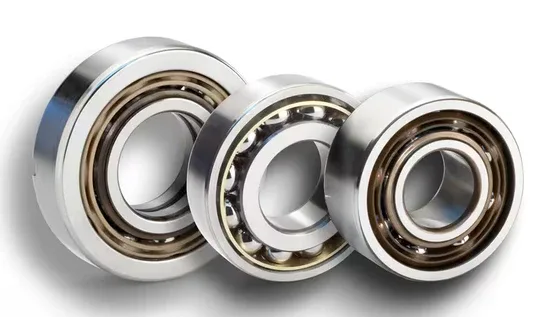
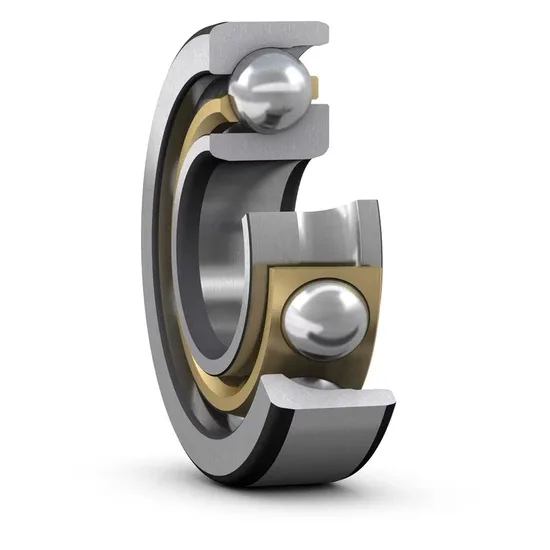
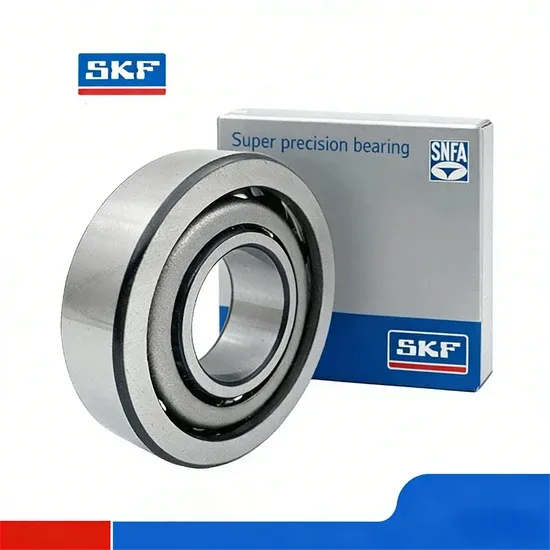
Description
Channel-Traceable Sourcing — Every SKF 7012 CE/P4A TBT triple set we supply ships with batch documentation traceable through authorized distributor records, ensuring the P4A precision grade on paper matches what arrives at your spindle assembly station.
Technical Specifications
| Parameter | Value |
|---|---|
| Designation | SKF 7012 CE/P4ATBTAP4 |
| Bearing Type | Angular Contact Ball Bearing |
| Bore Diameter (d) | 60 mm |
| Outside Diameter (D) | 95 mm |
| Width (B) | 18 mm |
| Contact Angle | 15° |
| Precision Class | P4A (ISO 492 Class 4 with enhanced running accuracy) |
| Arrangement | TBT (Triple set) |
| Number of Rows | Single Row per bearing, matched as triple set |
| Cage Material | Polyamide or Steel (application-dependent) |
| Seal or Shield Type | Open |
| Weight | 0.100 kg per bearing |
| Origin | China |
| Transport Package | Carton / Wooden Case / Vacuum Packaging |
Note: The AP4 suffix portion in the full designation requires verification against the current manufacturer catalog for exact preload or pairing specification.
Application Suitability
| Industry | Typical Applications |
|---|---|
| Machine Tool Manufacturing | High-speed milling spindle nose bearing sets, CNC lathe main spindle precision pairs |
| Precision Equipment | Coordinate measuring machine rotary tables, optical inspection stage rotation axes |
| Robotics | Articulated joint rotation assemblies requiring minimal axial runout |
What a Missing TBT Mark Costs on a Precision Spindle Assembly
A triple matched set only performs as intended when all three bearings carry coordinated preload from factory pairing — swapping one bearing from a different lot destroys the load distribution across the entire spindle stack.
I have seen machine shops receive three individually boxed 7012 bearings with matching base numbers, assume they form a matched set, and install them in a spindle designed for TBT arrangement. The result is uneven preload distribution that manifests as chatter marks on machined surfaces within the first production run. Cross-reference errors of this kind are among the most expensive mistakes in spindle maintenance because the damage cascades — a single mismatched bearing in a triple set accelerates wear on the other two, shortening the entire assembly’s service life [NEED_CITE: bearing preload distribution effects on spindle vibration per ISO 15243]. The SKF 7012 CE/P4A TBT angular contact ball bearing exists specifically to prevent this failure mode by ensuring factory-matched preload coordination across all three units.
Matching the 15° Contact Angle to Spindle Load Profiles
The 15° contact angle in the CE designation generates less friction heat than 25° or 40° variants under the predominantly radial loads typical of milling and grinding spindles. For shops running continuous high-speed operations, this thermal difference directly affects spindle growth and therefore workpiece tolerance holding. We recently supported a buyer transitioning from a 25° contact angle bearing in their grinding spindle who saw measurable improvement in surface finish consistency after switching to the SKF 7012 CE/P4A TBT angular contact ball bearing — not because the bearing was inherently superior, but because the 15° angle was the correct match for their actual load spectrum.
Thermal Stability and Speed Demands in Spindle Environments
Spindle bearings operate under combined radial and unidirectional axial loads at speeds where even minor thermal expansion changes internal clearance. The P4A precision class addresses this by imposing tighter running accuracy than standard P4, controlling inner and outer ring runout to levels that prevent the vibration amplification common at high RPM. Temperature management becomes critical here — inadequate lubrication intervals or incorrect grease selection can push operating temperatures past the point where the 15° contact angle’s thermal advantage matters. Installation practices also play a role: a triple matched set requires sequential mounting following factory pairing marks, and any deviation in axial positioning during assembly alters the preload each bearing actually carries [NEED_CITE: precision bearing mounting practices affecting preload accuracy].
Decoding the P4A and TBT Designation for Procurement Accuracy
The P4A precision grade meets ISO 492 tolerance class 4 dimensional requirements while adding enhanced running accuracy specifications that matter specifically for spindle applications where runout directly translates to workpiece surface finish. Standard P4 bearings might pass dimensional checks but still exhibit runout variation that causes chatter at high speeds. The TBT arrangement designates a triple set configured for back-to-back and tandem load sharing — this is not interchangeable with DB (back-to-back pair) or DF (face-to-face pair) configurations, and attempting to substitute a pair plus a single bearing for a factory TBT set will produce unpredictable preload distribution. The CE internal design with optimized geometry and cage options supports the speed ranges typical of precision spindle applications, where cage material selection between polyamide and steel depends on the specific speed-temperature-lubrication combination at the installation site.
The Downtime Cost of Suffix Misreading in Spindle Maintenance
When a maintenance team orders bearings by base number alone, they frequently receive standard clearance and precision grade bearings that physically fit but functionally fail within weeks. A P0 grade bearing installed where P4A was specified will produce measurable vibration increase that forces premature spindle rebuilds. Similarly, substituting a non-matched set for a TBT arrangement creates uneven load sharing that no amount of field adjustment can correct. These failures follow patterns documented in ISO 15243 failure classification — surface distress from inadequate precision, premature fatigue from incorrect preload, and cage failure from thermal overload all trace back to specification mismatches rather than bearing quality [NEED_CITE: premature bearing failure root causes in machine tool spindles].
How Our Sourcing Process Protects Your Spindle Investment
We source SKF 7012 CE/P4A TBT angular contact ball bearing sets through authorized distributor channels where batch traceability documentation accompanies each shipment. Our cross-reference database matches not just base designations but clearance class, cage material, precision grade, and arrangement suffixes — because a substitution that gets the base number right but the TBT configuration wrong still destroys spindle performance. Every set ships with supplier Certificate of Conformity tied to specific batch numbers, and we provide country-of-origin documentation for import compliance. For buyers concerned about counterfeit exposure in precision bearing supply chains, our verification pathway includes QR code confirmation against manufacturer databases before the product leaves our facility.
Documentation & Authenticity
- Supplier Certificate of Conformity with batch and lot traceability linking each bearing in the triple set to the same production run
- Third-party runout inspection confirming P4A running accuracy before shipment, with actual measurement values documented
- Country-of-origin documentation and HS code classification for import compliance in destination markets
- QR code verification pathway through manufacturer official applications for authenticity confirmation at point of receipt
- Dimensional inspection report covering bore, OD, width, and running accuracy against P4A tolerance requirements
Storage, Handling & Mounting
- Keep the TBT matched set sealed in original packaging until the moment of spindle assembly — premature opening risks contamination and loss of factory pairing identification marks
- Store vacuum-packaged sets in temperature-controlled environment below 60% relative humidity to prevent corrosion on the open bearing surfaces before mounting
- Handle with clean lint-free gloves to prevent fingerprint corrosion on P4A precision raceways where even minor surface contamination affects running accuracy
- Mount all three bearings in the set sequentially following factory TBT arrangement marks — mixing bearings from different sets or rearranging the axial order destroys the coordinated preload
- Apply specified spindle oil or grease per manufacturer recommendation after mounting; the open design requires external lubrication system integration
Technical Inquiry & Quotation Process
Share your spindle application parameters including operating speed range, load spectrum, and lubrication method so we can verify the SKF 7012 CE/P4A TBT angular contact ball bearing matches your specific configuration requirements. If you are replacing bearings in existing equipment, provide the OEM spindle model number for cross-reference verification against our interchange database. We will confirm batch availability, lead time, and provide the complete documentation package including origin certification before you commit to order.
Frequently Asked Questions
Q: Can I substitute three individual 7012 CE/P4A bearings for a factory TBT matched set?
A: No. A TBT designation indicates factory-matched preload coordination across all three bearings. Individual bearings with matching base numbers will not have the coordinated dimensional matching required for even load distribution in a triple arrangement.
Q: How does P4A precision differ from standard P4 for spindle applications?
A: P4A meets ISO 492 Class 4 dimensional tolerances with additional running accuracy specifications that control inner and outer ring runout more tightly than standard P4. This matters in spindle applications where runout directly affects workpiece surface finish at high speeds.
Q: What is the difference between 15° (CE) and 25° (ACE) contact angles for spindle use?
A: The 15° contact angle generates less friction heat under predominantly radial loads, making it suitable for high-speed spindle applications. The 25° angle provides higher axial load capacity but at the cost of increased thermal generation, which may affect spindle growth and tolerance holding.
Q: Why does the AP4 suffix portion require catalog verification?
A: The AP4 suffix in the full designation may indicate a specific preload or pairing variant that requires confirmation against current manufacturer documentation to ensure correct application matching.
Q: How do I verify authenticity of SKF precision bearings upon receipt?
A: Each bearing carries a QR code that links to manufacturer verification systems. We provide batch traceability documentation and can guide you through the verification process using official manufacturer applications before installation.
Confirm Your Spindle Bearing Specification
Share your application parameters or OEM equipment number, and we will verify configuration match and provide complete documentation before shipment.