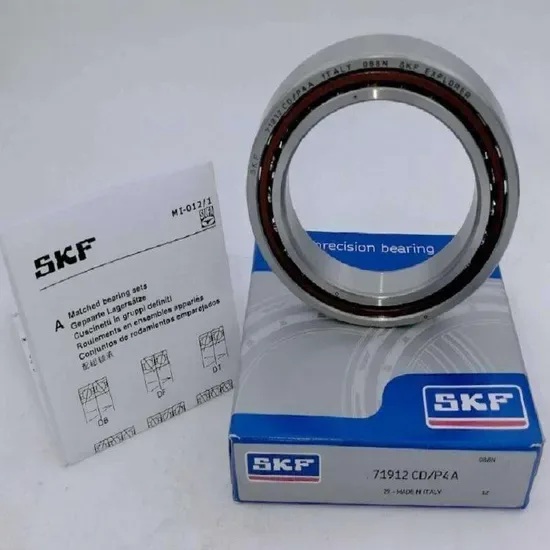
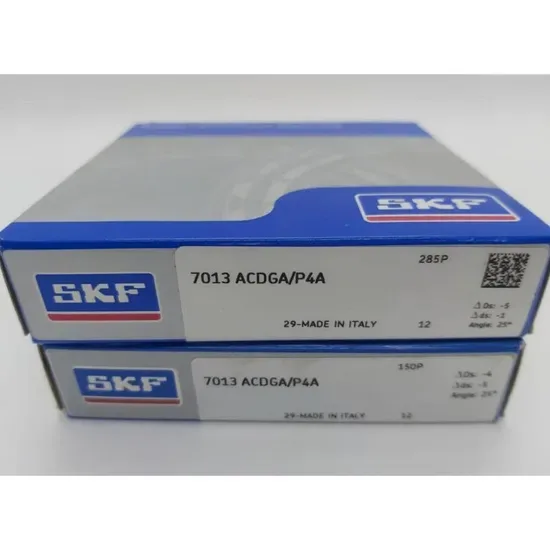
Description
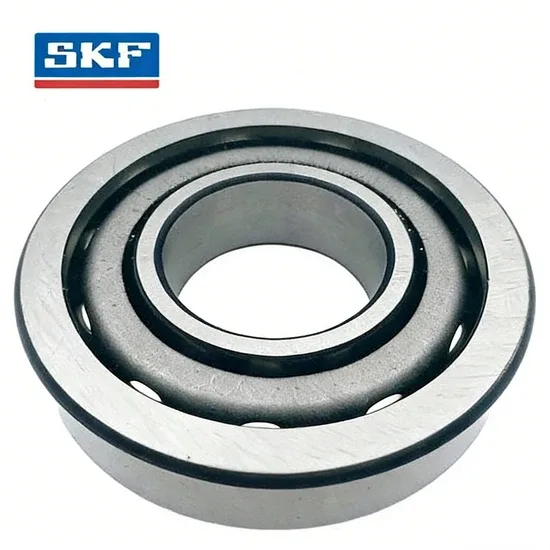
Authorized Channel Sourcing — Every SKF 7003CD/P4ADBB ships with batch-level traceability documents linked to the manufacturer’s official distribution records.
Technical Specifications
| Parameter | Value |
|---|---|
| Designation | SKF 7003CDP4ADBB |
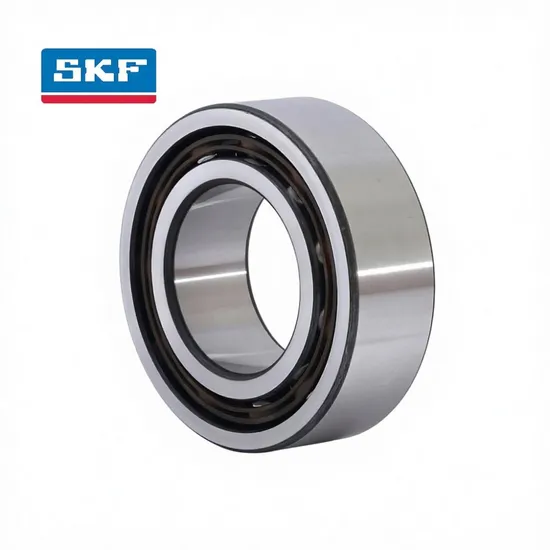
| Bearing Type | Angular Contact Ball Bearing |
| Bore Diameter (d) | 17 mm |
| Outside Diameter (D) | 35 mm |
| Width (B) | 10 mm per ring |
| Precision Class | P4 (ISO 492 tolerance class 4) |
| Contact Angle | 15° |
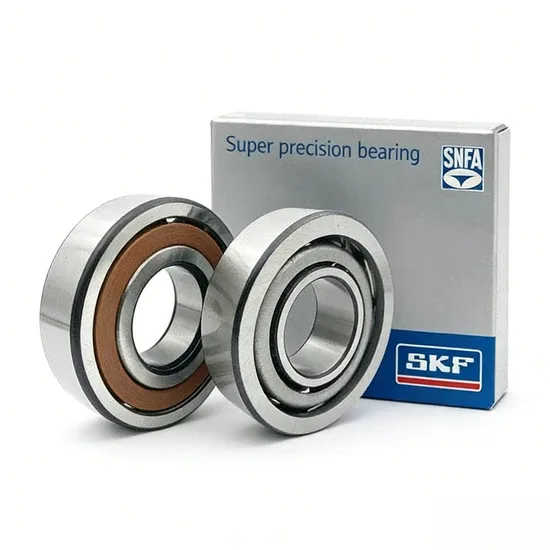
| Arrangement | Back-to-Back (DB) Matched Pair |
| Number of Rows | Single Row per bearing, paired |
| Origin | China |
The "A" suffix in P4ADBB could not be fully confirmed against the current manufacturer catalog revision; buyers should verify this sub-designation with their application engineer before final ordering.
Application Suitability
| Industry | Typical Applications |
|---|---|
| Machine Tool Manufacturing | CNC spindle front and rear support positions |
| Precision Equipment | High-speed rotary tables, indexing heads |
| Robotics | Joint actuators requiring low runout and axial rigidity |
| Industrial Automation | High-frequency pick-and-place spindle drives |
Why Spindles Fail Before the Bearings Do
Matching the SKF 7003CD/P4ADBB angular contact ball bearing to a spindle is only the first step — most catastrophic failures trace back to suffix mismatches that standard procurement checks never catch.
A spindle rated for 18,000 RPM will thermally seize within weeks if the contact angle and preload pairing do not match the original equipment specification.
I watched a workshop in Riyadh install standard-clearance angular contacts into a precision grinding spindle. Nobody at the procurement stage had checked whether the replacement set carried the same preload class or DB arrangement as the original. The bearings were dimensionally correct — same bore, same OD, same P4 precision stamp. But the internal preload and arrangement differed. Within weeks, thermal expansion locked the spindle, scrapped an entire batch of aerospace fittings, and cost far more than the bearings themselves [NEED_CITE: thermal seizure mechanisms in high-speed spindle bearings per ISO 15243]. This pattern repeats across markets where buyers match the base designation but skip the suffix chain.
Matching the SKF 7003CD/P4ADBB to Precision Spindle Duty
The 15° contact angle coded in the CD suffix keeps friction heat generation low under predominantly radial loads, which is the exact load profile most CNC and grinding spindles impose on their front support bearings. The back-to-back DB pairing resists moment loads from off-center cutting forces while providing axial rigidity in both directions. P4 tolerance class delivers the running accuracy that high-speed spindles demand to maintain surface finish tolerances. We cross-check every replacement request against the OEM equipment number — confirming not just the base 7003 size, but the full suffix string including contact angle, arrangement, and preload class — so the SKF 7003CD/P4ADBB angular contact ball bearing you receive performs identically to the unit that left the machine tool builder’s assembly line.
Thermal Growth and the Rigidity Trade-off
Spindle bearings live in a thermal balancing act. At sustained high speeds, inner ring expansion tightens the internal clearance while outer ring growth in the housing works in the opposite direction. The 15° contact angle generates less internal friction than a 25° variant, which means less self-heating at the same RPM — a meaningful advantage when the thermal margin between stable operation and runaway expansion is narrow. Back-to-back arrangement gives the spindle designer a wide effective load-center distance, maximizing overturning moment resistance without requiring a larger bearing envelope. Lubrication must be matched to the speed factor; grease-filled sealed variants suit moderate duty, while oil-air or oil-jet systems are necessary for the upper RPM range of P4 angular contact pairs [NEED_CITE: speed factor limits for angular contact ball bearings under oil-air versus grease lubrication].
Decoding What the Suffixes Actually Mean
The CD suffix locks the contact angle at 15° with an optimized internal geometry that balances load capacity against friction heat — the right choice when radial loads dominate and speed is high. P4 precision class meets ISO 492 class 4 requirements for bore, OD, width, and running accuracy, sitting one grade above P5 and delivering the tighter runout that spindle applications require to avoid chatter marks on finished surfaces. The DB arrangement means the two bearings are factory-matched in a back-to-back orientation, with their load lines diverging outward. This configuration provides high rigidity against tilting moments and handles axial loads from either direction, which is why it dominates spindle front-pair positions where cutting forces push and pull along the axis. The matched-pair concept also means the bearings share load evenly only when installed in the marked orientation — reversing one unit destroys the preload balance.
The Hidden Cost of Ignoring the Suffix String
A procurement team that sources bearings on base number alone will eventually install a CN-clearance unit where C3 was specified, or a P0-grade bearing into a spindle that demands P4 running accuracy. The consequences follow a predictable sequence described in ISO 15243: abnormal temperature rise, lubricant degradation, raceway spalling, and eventual seizure. Unplanned downtime on a production spindle rarely costs only the bearing price — it includes scrapped workpieces, missed delivery deadlines, and emergency freight for replacement parts [NEED_CITE: cost distribution of unplanned downtime in CNC machining operations]. Counterfeit units compound the problem by passing visual inspection with cloned packaging and fake QR codes, while their soft inner rings and substandard cage materials fail under loads the genuine SKF 7003CD/P4ADBB angular contact ball bearing was engineered to carry.
How We Source and Verify Before Shipment
We pull the SKF 7003CD/P4ADBB through authorized distributor channels, which means every shipment carries a documentation trail back to the manufacturer’s logistics records rather than an unverifiable trading company invoice. Batch numbers are confirmed against SKF’s official verification apps before dispatch, giving buyers a direct authenticity check independent of our own assurance. Our cross-reference database matches not just base designations across the six brands we cover, but also contact angle, cage type, precision class, and pairing configuration — so if a buyer needs an NSK or FAG equivalent, the substitute carries the same functional suffixes, not just the same bore and OD. Pre-shipment dimensional checks confirm P4 running accuracy on the specific units in the order. Country-of-origin documentation and HS code details are prepared alongside the shipment to clear customs without the delays that incomplete paperwork causes at destination ports.
Documentation & Authenticity
- Supplier Certificate of Conformity linking the batch number to the manufacturer’s distribution record for this specific SKF 7003CD/P4ADBB shipment
- QR code verification pathway enabling buyers to confirm authenticity directly through the SKF official app before installation
- Third-party runout and dimensional inspection confirming P4 running accuracy on the actual matched pair prior to dispatch
- Country-of-origin certificate and HS code documentation prepared for import compliance at the buyer’s destination port
- Material certificate covering ring and ball steel grade for the supplied batch
Storage, Handling & Mounting
- Keep the DB matched pair sealed in original packaging until the moment of mounting; premature opening risks contaminating the factory-applied lubricant and losing the pairing alignment marks critical to the back-to-back arrangement
- Store flat in a temperature-stable environment; standing the 17 mm bore P4 pair on edge for extended periods can introduce micro-deformation in the thin-section rings that compromises running accuracy
- Use clean, lint-free gloves when handling; fingerprint acids on the raceway surfaces of a P4-precision bearing initiate corrosion pits that become spalling nucleation sites under high-speed operation
- During mounting, apply force only to the ring being press-fitted; transmitting installation force through the balls and cages of a 15° contact angle bearing causes brinelling that destroys the precision surface finish
- Verify the DB orientation marks align with the spindle housing design before tightening the locknut; installing the back-to-back pair in reversed orientation inverts the preload and causes rapid thermal failure
Start Your Spindle Bearing Evaluation
Share your spindle model number and operating parameters — speed range, load profile, lubrication method — so we can confirm whether the SKF 7003CD/P4ADBB is the correct match or whether a different suffix variant suits your application. If you are replacing an existing bearing, provide the full designation printed on the original unit including all suffixes, and we will cross-verify against the OEM specification. Request the documentation package and batch availability timeline for your procurement records.
Frequently Asked Questions
Q: How do I verify that the SKF 7003CD/P4ADBB I received is genuine?
A: Every unit we supply carries a batch number that can be verified through SKF’s official mobile application. Scan the QR code on the packaging to confirm the production lot, manufacturing facility, and distribution path. We also provide a Certificate of Conformity with traceable batch documentation.
Q: What does the DB suffix mean, and why does back-to-back pairing matter for my spindle?
A: DB indicates a back-to-back matched pair where the load lines diverge outward from the bearing center. This arrangement provides maximum rigidity against moment loads and handles axial thrust from both directions — essential for spindle applications where cutting forces create tilting moments.
Q: How does P4 precision compare to P5 or P6, and does my application need it?
A: P4 meets ISO 492 class 4 tolerances, offering tighter bore, OD, width, and running accuracy than P5 or P6. High-speed spindles, precision grinding heads, and robotics joints typically require P4 or better to maintain surface finish quality and positioning accuracy.
Q: Should I choose 15° (CD) or 25° (ACD) contact angle for my spindle application?
A: The 15° CD variant generates less friction heat and suits applications where radial loads dominate and speed is high. The 25° ACD option provides higher axial load capacity but at the cost of increased friction — suitable when heavy axial thrust is the primary load.
Q: What cross-reference pitfalls should I watch for when substituting brands?
A: Matching the base number (7003) alone is insufficient. The contact angle suffix (CD vs. ACD), precision class (P4 vs. P5), cage material, and pairing configuration (DB vs. DF) must all align. A mismatch in any suffix can lead to thermal issues, reduced rigidity, or premature failure.
Confirm Your SKF 7003CD/P4ADBB Specification and Lead Time
Send us your OEM equipment number or full application parameters — we will verify the suffix match, confirm batch availability, and return a quotation with documentation details for your review.