
Description
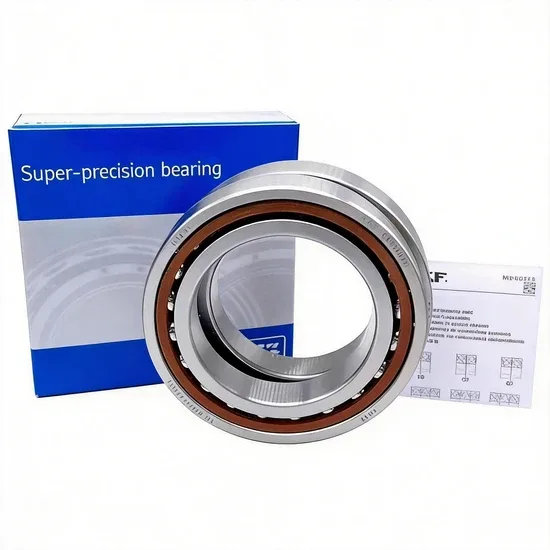
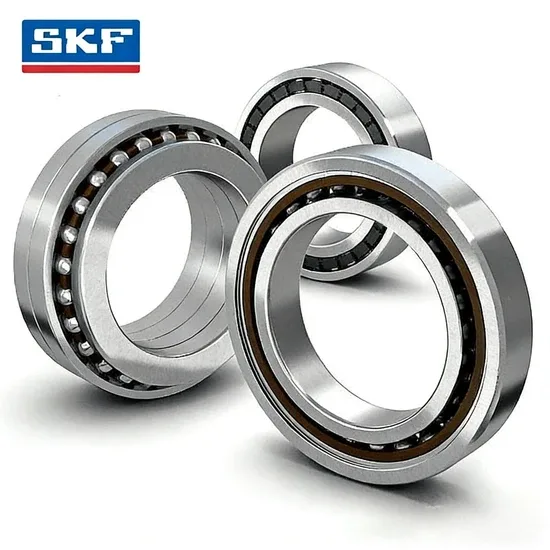
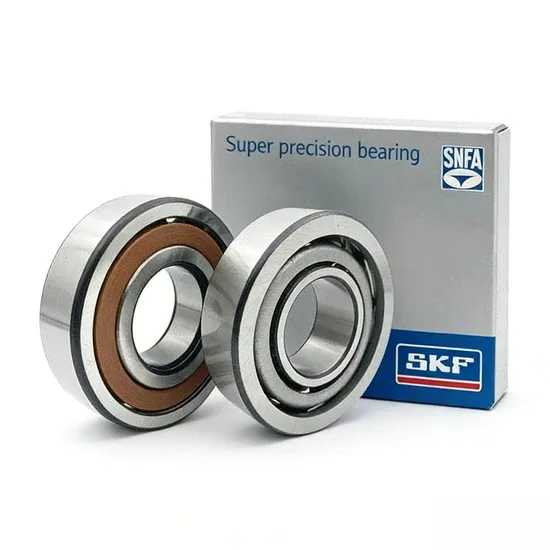
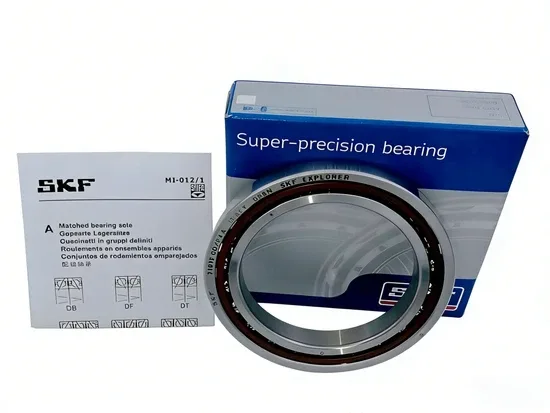
Authorized Channel Sourcing — Every SKF 7014ACDGA/HCP4AL angular contact ball bearing we ship carries batch-level traceability back to the manufacturer’s distribution network, complete with origin documentation for customs clearance.
Technical Specifications
| Parameter | Value |
|---|---|
| Designation | SKF 7014ACDGA/HCP4AL |
| Bearing Type | Angular Contact Ball Bearing |
| Bore Diameter (d) | 70 mm |
| Outside Diameter (D) | 110 mm |
| Width (B) | 20 mm |
| Contact Angle | 25° |
| Precision Class | P4 |
| Number of Rows | Single Row |
| Arrangement | Universal Matching, Light Preload (GA) |
| Origin | China |
| Weight | 0.100 kg |
The /HCP4AL suffix remains unverified against the current manufacturer catalog and should be confirmed with engineering documentation prior to final specification lock-in.
Application Suitability
| Industry | Typical Applications |
|---|---|
| Machine Tool Manufacturing | High-speed spindle nose bearing, precision grinding head |
| Robotics | Joint actuator support, rotary positioning stage |
| Precision Equipment | Optical inspection table rotation, semiconductor wafer handling arm |
What Happens When a 25° Contact Angle Meets a 15° Spindle Design
Mismatched contact angles in angular contact bearings silently destroy spindle accuracy long before catastrophic failure appears.
A Midwest spindle rebuilder once swapped a specified 25° bearing into a housing designed around 15° geometry. The contact ellipse shifted, edge loading concentrated on one rib, and within weeks the spindle ran hot enough to thermally growth the tooling interface out of tolerance. The machine wasn’t down — it was worse. It was producing scrap parts that passed visual inspection but failed CMM checks. [NEED_CITE: angular contact bearing contact angle effect on load distribution and thermal behavior] That’s the trap with the SKF 7014ACDGA/HCP4AL angular contact ball bearing — its ACD suffix locks in 25° geometry with optimized internal raceway profiling, and substituting it into an application expecting 15° behavior changes the entire stiffness and heat generation profile.
Matching Spindle Demands to the ACD Internal Geometry
Machine tool spindles demand the kind of axial stiffness and running accuracy that only a properly specified angular contact arrangement delivers. The SKF 7014ACDGA/HCP4AL angular contact ball bearing brings 25° contact geometry that balances axial load capacity with radial stiffness — a compromise that suits most belt-driven and direct-drive spindle configurations where combined loading is the norm rather than the exception. When we cross-reference this model against competing designs, we verify not just the base bore and OD but the preload class, cage type, and precision grade together, because a P4 bearing with the wrong preload defeats the purpose of specifying P4 in the first place.
Thermal Growth, Preload Drift, and Why GA Matters at Speed
Spindle bearings live in a thermal nightmare. As the inner ring heats faster than the housing, radial clearance closes and preload climbs. The GA designation on this bearing signals universal matching with light preload — deliberately conservative so that thermal expansion at operating speed doesn’t push the balls into excessive contact stress. At sustained high RPM, a heavier GB or GC preload could cross into thermal runaway territory. [NEED_CITE: bearing preload thermal runaway mechanism in high-speed spindle applications] Lubrication choice compounds this: oil-air systems manage heat better at extreme speeds, while grease-packed arrangements suit intermittent duty or lower RPM ranges where maintenance simplicity matters more than peak thermal headroom.
Decoding the Suffix Stack: ACD, GA, and P4 Explained
The ACD designation combines 25° contact angle with SKF’s optimized internal geometry — modified raceway curvatures that spread contact stress across a wider ellipse, reducing localized heating under combined loads. GA universal matching means this single-row bearing ships with controlled bore and OD deviations so that any two GA bearings can be stacked back-to-back (DB) or face-to-face (DF) and achieve the specified light preload without selective fitting. P4 precision class, defined under ISO 492, governs both dimensional tolerances and running accuracy — tighter bore and OD variation than P5, with controlled radial and axial runout that keeps spindle nose TIR within acceptable bounds for precision machining operations.
The Hidden Invoice Behind a Wrong Preload Spec
Here’s what nobody quotes you upfront: when a maintenance team replaces a specified GA light-preload bearing with whatever GB medium-preload stock happens to be on the shelf, the spindle doesn’t fail immediately. It runs hotter, the grease degrades faster, cage wear accelerates, and six months later the spindle gets pulled for rebuild — blamed on "normal wear." [NEED_CITE: rolling bearing failure mode classification per ISO 15243] ISO 281 life calculations show that preload directly affects the equivalent dynamic load, and a single class jump can cut calculated L10 life significantly. The real cost isn’t the bearing. It’s the unplanned downtime, the scrapped workpieces produced during the degradation window, and the warranty arguments about whether the failure was operational or component-related.
How We Keep Your Spindle Order Honest
Our procurement chain for the SKF 7014ACDGA/HCP4AL angular contact ball bearing runs through authorized distributor channels, not gray-market brokers who swap suffixes on invoices. Every shipment carries a Certificate of Conformity tied to the production batch, and we guide buyers through QR code verification using the manufacturer’s official app before the box ever gets opened. When a cross-reference request comes in, we don’t just match bore and OD — we pull the competing brand’s full suffix breakdown to confirm contact angle, cage material, and preload class align, because a base-number match with mismatched internals is how field failures get born.
Documentation & Authenticity
- Supplier Certificate of Conformity referencing the specific production batch and lot number for this P4 precision bearing
- QR code verification pathway through the manufacturer’s official mobile application to confirm genuine origin
- Country-of-origin documentation formatted for import customs compliance in destination markets
- Third-party runout inspection available upon request to confirm P4 running accuracy before the bearing leaves our facility
Storage, Handling & Mounting
- Keep the matched GA set in original sealed packaging until the moment of mounting — premature exposure risks contamination that compromises the light preload pairing accuracy
- Store flat in a temperature-stable environment away from direct sunlight to prevent differential thermal expansion across the 110 mm outer ring
- Handle with clean, lint-free gloves; fingerprint acids on P4-grade raceway surfaces create corrosion initiation sites invisible until the bearing heats up under load
- For universal-matched arrangements, verify the V-marks on the outer ring faces before stacking into DB or DF configuration — misaligned marks mean the preload direction is inverted
- Use induction heating for inner ring fitting on the 70 mm bore rather than press force, which risks brinelling the balls against the 25° contact angle raceways
Initiating Your Technical Inquiry
Share your spindle speed range, expected axial thrust, and operating temperature envelope so we can confirm whether GA light preload is the correct specification for your duty cycle, or whether the application demands a different arrangement. If you’re replacing an existing bearing, send us the OEM equipment number and the full marking string from the current bearing’s outer ring — we’ll run the cross-reference against all six major brands with clearance and cage verification included. Documentation packages and batch availability can be confirmed within one business day of inquiry.
Frequently Asked Questions
Q: What does each suffix in 7014ACDGA/HCP4AL represent?
A: ACD indicates a 25° contact angle with optimized internal geometry. GA designates universal matching with light preload for flexible DB or DF pairing. P4 is the precision class per ISO 492. The /HCP4AL portion requires catalog confirmation and should be verified against manufacturer documentation for your specific application.
Q: How do GA, GB, and GC preload classes differ in practice?
A: GA delivers light preload for applications where thermal growth at speed must not push contact stress too high. GB provides medium preload for higher static stiffness needs at moderate speeds. GC offers heavy preload for maximum rigidity in low-speed, high-precision positioning. Selecting the wrong class directly affects operating temperature and bearing life.
Q: Why must clearance, cage material, and precision all align during cross-referencing?
A: A base-number match only confirms bore, OD, and width. If the replacement bearing carries a different contact angle, preload class, or cage design, the installed stiffness, heat generation, and speed capability all change — even though the bearing physically fits the housing. This is how cross-reference errors produce field failures that get blamed on the brand rather than the selection.
Q: How can I verify authenticity before installation?
A: Each genuine bearing carries a QR code that links to the manufacturer’s verification system. Scanning with the official app confirms production batch, origin facility, and distribution chain legitimacy. We provide this verification pathway with every shipment and guide buyers through the process.
Q: What DB versus DF arrangement should I specify for a spindle application?
A: DB (back-to-back) handles moment loads better and accommodates shaft thermal growth away from the bearing set. DF (face-to-face) suits applications where housing thermal growth exceeds shaft growth. The choice depends on your specific thermal profile and load direction — share your operating parameters and we’ll confirm the correct arrangement.
Confirm Your SKF 7014ACDGA/HCP4AL Specification
Send your application parameters or OEM part number, and our engineering team will return a verified cross-reference with full documentation package within one business day.