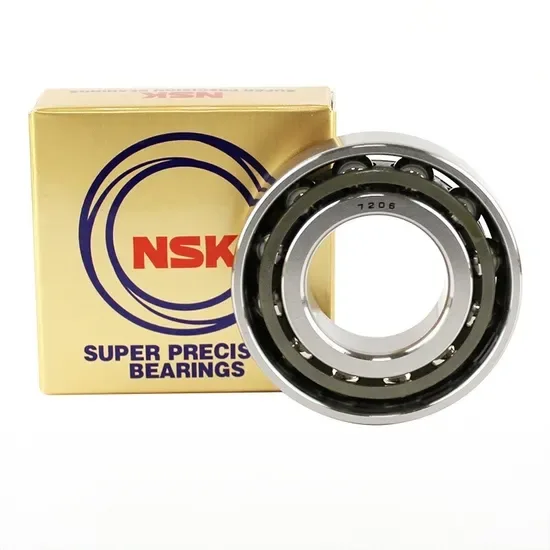
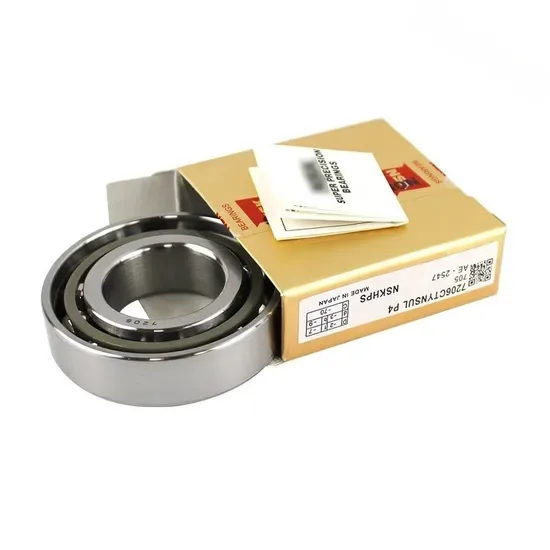
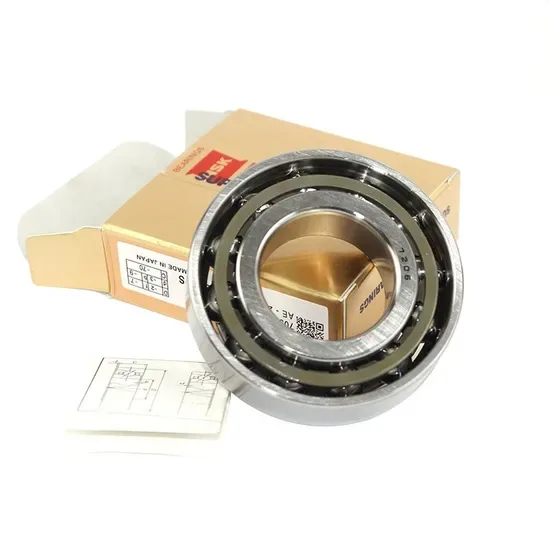
Description
Traceable Batch Sourcing — Every NSK 7900A5TRSULP5 angular contact ball bearing we ship carries full lot traceability from authorized distributor channels, backed by a Certificate of Conformity tied to the production batch.
Technical Specifications
| Parameter | Value |
|---|---|
| Designation | NSK 7900A5TRSULP5 |
| Bearing Type | Single Row Angular Contact Ball Bearing |
| Bore Diameter (d) | 10 mm |
| Outside Diameter (D) | 22 mm |
| Width (B) | 6 mm |
| Weight | 0.009 kg |
| Precision Class | P5 (ISO 492) |
| Number of Rows | Single |
| Load Direction | Combined Radial and Axial Load |
| Material | Bearing Steel |
| Separated | Yes |
| Contact Angle | 25° (A5 suffix) |
| Arrangement | Single unit, universal matching (SU suffix) |
Suffixes T, R, L, and SU relate to cage type, arrangement, and preload configuration — exact definitions for this variant should be confirmed against the current NSK precision catalog before final application sign-off.
Application Suitability
| Industry | Typical Applications |
|---|---|
| Machine Tool Manufacturing | High-frequency spindle nose bearings, grinding wheel headstocks |
| Robotics & Automation | Compact joint actuators, harmonic drive preload stages |
| Precision Equipment | Optical positioning stages, semiconductor wafer handling arms |
| High-Speed Pumps | Miniature impeller shaft support, seal housing guide bearings |
Why a P5 Precision Mismatch Can Stall a Spindle Retrofit
Most spindle failures traced to replacement bearings come down to one skipped suffix check.
When a maintenance team sources a 7900-series angular contact bearing by base number alone, the precision class often goes unverified. A P0 or P6 part may physically fit the housing, but the dimensional tolerances fall outside what the spindle cartridge was designed to stack. The result shows up as thermal drift during warm-up cycles, chatter marks on finished surfaces, and a service call that could have been avoided by confirming the ISO 492 class on the box label [NEED_CITE: spindle bearing replacement failure modes per ISO 15243 classification].
Matching the NSK 7900A5TRSULP5 to Compact Precision Assemblies
This bearing sits at the small end of the 79 thin-section series — 10 mm bore, 22 mm OD, just 6 mm wide — which puts it squarely in the territory of micro-spindles, instrument gimbals, and robotic wrist joints where envelope constraints rule out standard diameter series. The 25° contact angle (A5) balances axial stiffness against friction heat, a trade-off that matters when the spindle runs above mid-range speeds and the axial load comes from a preloaded ball screw or magnetic thrust collar. When we cross-check an NSK 7900A5TRSULP5 angular contact ball bearing against a competitor’s drawing, we verify not just the boundary dimensions but the contact angle and precision class together, because a 15° substitute would shift the stiffness balance and compromise the original design intent.
Spindle Thermal Behavior and the Role of Precision Tolerances
In a high-speed spindle, the inner ring runs hotter than the housing, expanding radially and eating into internal clearance. A P5 tolerance band keeps bore and OD deviations tight enough that the designer’s calculated preload survives that thermal gradient without binding. Lubrication choice compounds the effect — grease-packed thin-section bearings at this size often rely on the initial fill for life, so any overheating from excess preload degrades the grease film and accelerates cage wear. Mounting practice matters equally: a 10 mm bore leaves little room for induction heating, so cold press or adhesive retention is typical, and any misalignment during fitting transfers directly into the raceway as an uneven load zone [NEED_CITE: angular contact bearing mounting misalignment effects on fatigue life].
What the A5 Contact Angle and P5 Class Mean in Practice
The 25° contact angle designated by A5 sits between the 15° high-speed option and the 40° heavy-thrust option. For a 10 mm bore spindle, that middle ground delivers enough axial rigidity to resist cutting forces while keeping friction torque low enough to avoid thermal runaway during continuous duty. P5 precision, defined under ISO 492, controls bore diameter, outside diameter, width, and running accuracy to tighter bands than P6 — the practical effect is that when two single-row bearings are stacked in a spindle cartridge, the cumulative stack-up error stays within the preload spring’s compensation range. The SU arrangement suffix indicates this unit is ground for universal matching, meaning it can be paired back-to-back or face-to-face with another SU unit to build a duplex set with predictable preload — a flexibility that saves lead time when the OEM specifies a custom pair.
The Hidden Cost of Ignoring Suffix Verification
A buyer who substitutes a generic 7900A bearing without confirming the precision suffix may receive a P0 part that physically fits but introduces runout beyond the spindle designer’s tolerance stack. Under ISO 281 life calculations, even a modest increase in internal stress from uneven load distribution shortens the L10 fatigue life noticeably. In field terms, that translates to unplanned downtime during a production run, scrap parts from surface finish violations, and in the worst case, a seized spindle cartridge that takes the motor rotor with it [NEED_CITE: rolling bearing fatigue life calculation per ISO 281]. Authenticity compounds the risk — counterfeit angular contacts with soft inner rings may pass a casual dimensional check but fail under preload, and the resulting debris contaminates the entire lubrication system.
How Our Sourcing Process Protects Your Spindle Build
We procure NSK 7900A5TRSULP5 angular contact ball bearings through authorized distributor channels, so every shipment carries a Certificate of Conformity linked to the manufacturer’s production lot. Before dispatch, we can arrange third-party runout inspection to confirm P5 running accuracy on the inner and outer rings — a check that catches mislabeled or mixed-precision stock before it reaches your assembly bench. For import buyers, we compile country-of-origin documentation and HS code details so customs clearance proceeds without hold-ups. Our cross-reference database aligns not just base numbers but contact angle, cage material, and precision class, so if an alternate brand is needed for lead-time reasons, the substitute matches on every parameter that affects fit and function.
Documentation & Authenticity
- Supplier Certificate of Conformity referencing the NSK production batch and lot number for full upstream traceability
- QR code verification pathway via the NSK official app, enabling receiving inspectors to scan and confirm authenticity on the dock
- Third-party dimensional inspection report confirming P5 bore, OD, width, and runout tolerances before the bearing leaves our facility
- Country-of-origin certificate and HS code classification package prepared for import customs documentation
- Material test certificate available on request, tracing the bearing steel grade back to the mill heat number
Storage, Handling & Mounting
- Keep the NSK 7900A5TRSULP5 in its original sealed packaging until the moment of mounting — the thin-section 19 series is susceptible to raceway brinelling from mishandling during bench storage
- Maintain storage humidity below 60% and avoid temperature swings that could cause condensation inside the package, particularly critical for open-type bearings without seal protection
- Use lint-free gloves when handling; fingerprint acids on the 10 mm bore surface can initiate corrosion pits that propagate under P5 running accuracy demands
- For cold press fitting on this small bore, use a drift sleeve that contacts only the inner ring face — any force transmitted through the balls or outer ring will damage the 25° contact angle raceway profile
- If building a duplex pair from two SU units, keep both sealed until pairing; opening one early risks contamination that undermines the matched preload ground into the set at the factory
Request a Technical Verification Package
Share your spindle drawing or OEM equipment number so we can confirm whether the NSK 7900A5TRSULP5 angular contact ball bearing matches your clearance, preload, and arrangement requirements — or identify the correct variant if the suffix differs. We will return a cross-reference check, availability confirmation, and a documentation preview covering origin and traceability before you commit to a purchase order.
Frequently Asked Questions
Q: How do I verify the authenticity of an NSK 7900A5TRSULP5 bearing upon receipt?
A: Scan the QR code on the packaging using the NSK official verification app, which links the code to the production batch. Cross-check the lot number on the box against the Certificate of Conformity included with your shipment. Any mismatch between the app data and the physical markings warrants a hold and investigation before installation.
Q: What does each suffix in NSK 7900A5TRSULP5 signify?
A: The A5 designates a 25° contact angle. P5 indicates ISO 492 tolerance class 5. The SU relates to universal single-unit matching for flexible duplex pairing. The remaining suffixes T, R, and L pertain to cage design, arrangement specifics, and preload configuration — we confirm these against the current NSK precision catalog for each order to ensure the shipped variant matches your application parameters exactly.
Q: Can I pair two SU bearings in any arrangement — back-to-back, face-to-face, or tandem?
A: SU (single universal) bearings are ground so their faces are flush within a tight tolerance, allowing back-to-back (DB), face-to-face (DF), or tandem (DT) arrangements depending on the load and stiffness requirements. The correct pairing depends on whether your spindle needs moment rigidity (DB), axial compliance (DF), or pure thrust capacity (DT).
Q: What import documentation comes with a shipment from China?
A: Each order includes a Certificate of Conformity, country-of-origin certificate, and HS code classification. We prepare these documents to support customs clearance in your destination market and can format them to match your freight forwarder’s requirements.
Q: How does P5 precision compare to P4 for spindle applications?
A: P5 provides tighter dimensional and running accuracy than P6 and is suitable for many general-precision spindles. Applications requiring ultra-fine surface finishes or sustained high-speed operation may need P4 or P4A class. We can review your speed, load, and tolerance stack to confirm whether P5 is sufficient or if a higher class is warranted.
Secure Your Spindle Bearing Supply
Send us your application parameters or OEM part number, and we will return a verified match with full documentation and lead-time confirmation within one business day.