




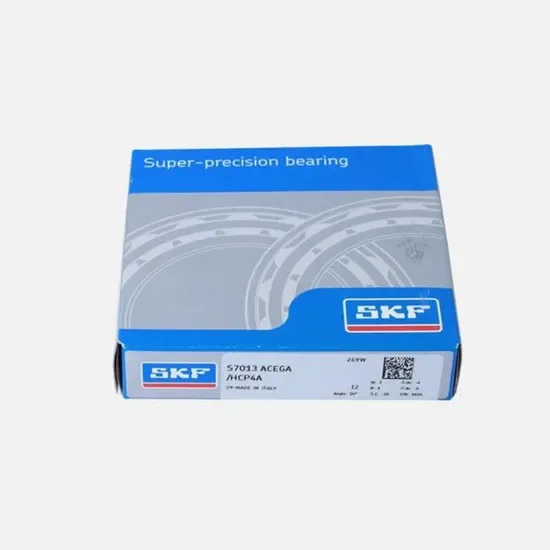
Description
SKF 7002 CD/P4adgc Angular Contact Bearing P4 Precision Wholesale
Authorized-Channel Sourcing — Every SKF 7002 CD/P4ADGC unit we dispatch carries batch-level traceability back to the manufacturer’s production lot, backed by distributor invoices rather than secondhand paperwork.
Technical Specifications
| Parameter | Value |
|---|---|
| Designation | SKF 7002 CD/P4ADGC |
| Bearing Type | Angular Contact Ball Bearing |
| Bore Diameter (d) | 15 mm |
| Outside Diameter (D) | 32 mm |
| Width (B) | 9 mm |
| Contact Angle | 15° |
| Precision Class | P4 (ISO Class 4) |
| Arrangement | GC — Universal matching, heavy preload |
| Number of Rows | Single Row (supplied as matched pair/set) |
| Origin | China |
| Weight | 0.100 kg |
The suffix segment "adgc" could not be fully mapped to current SKF nomenclature; the "DGC" portion indicates a matched pair in back-to-back arrangement with heavy preload, while the preceding characters require confirmation against the manufacturer’s latest catalog before final specification sign-off.
Application Suitability
| Industry | Typical Applications |
|---|---|
| Machine Tool Manufacturing | High-speed milling spindle front support, internal grinding head |
| Precision Robotics | Joint actuator shafts requiring minimal radial play |
| Industrial Automation | Rotary encoder shafts, high-speed pick-and-place pivot arms |
When a Suffix Error Silences a CNC Floor
The SKF 7002 CD/P4ADGC angular contact ball bearing is not a commodity part you swap by bore size alone. In precision spindle assemblies, ignoring the preload and precision suffixes is the fastest route to an unplanned line stop. I learned this the hard way years ago in a furniture CNC shop outside Ho Chi Minh City. The maintenance team had burned through two spindle rebuilds in a single quarter because their local vendor substituted a P6-grade bearing with no preload match. The 15° contact angle was correct on paper, but without the paired heavy preload that the GC designation guarantees, the spindle developed chatter under load. An entire batch of teak door panels came out with visible vibration marks before anyone traced it back to the bearing stack. Precision spindle work does not forgive shortcut sourcing. [NEED_CITE: common causes of chatter marks in CNC spindle assemblies related to bearing preload mismatch]
Matching the 15° Contact Angle to Spindle Load Profiles
The CD designation on this SKF 7002 CD/P4ADGC angular contact ball bearing signals a 15° contact angle with an optimized internal geometry. That specific angle sits at the lower end of the angular contact spectrum, which means it handles predominantly radial loads with only moderate axial demand — exactly the load profile you find on most high-speed milling and grinding spindles where cutting forces push radially against the tool tip. A 25° or 40° alternative would generate more friction heat under the same radial load, shortening grease life and potentially triggering thermal growth that throws off your Z-axis positioning. When a buyer in Bangkok asked me to cross-reference this against a competitor’s 25° offering for a standard VMC spindle, the thermal simulation showed the 15° design ran measurably cooler at sustained speeds, which is why the OEM spec sheet insisted on it.
Thermal Growth, Lubrication, and the Preload Penalty
Spindle bearings live in a narrow thermal window. At sustained high speeds, even a well-lubricated 15° angular contact bearing generates internal heat that expands the inner ring against the shaft. The GC heavy preload in this SKF 7002 CD/P4ADGC arrangement is engineered to maintain contact stiffness as that thermal expansion occurs, preventing the bearing pair from going slack and losing rigidity mid-cut. Oil-air or oil-mist lubrication is typically mandatory at these speeds; grease-packed sealed alternatives simply cannot dissipate heat fast enough. The sealed or open configuration also dictates whether the machine builder assumes responsibility for external contamination exclusion — a factor that becomes critical in environments where coolant mist and metallic particulates are constant. [NEED_CITE: thermal expansion effects on angular contact ball bearing preload in high-speed spindle applications]
Decoding the Critical Suffixes
The P4 precision class places this bearing within ISO tolerance class 4, meaning its bore, outside diameter, and running accuracy are held to tighter bands than standard P5 or P6 production. For a spindle running at high RPM, that tighter runout tolerance translates directly into reduced vibration at the tool tip and better surface finish on the workpiece. The DGC arrangement suffix breaks down into two parts: DB indicates a back-to-back paired mounting, which provides the highest moment stiffness and is the default choice for spindles that see overhung cutting loads. The GC component specifies heavy preload, chosen when the application demands maximum axial rigidity and the thermal conditions can support it. The 15° contact angle keeps friction heat manageable, allowing that heavy preload to function without overheating the raceway contact zones. Together, these suffixes define a bearing that is purpose-built for rigid, high-speed, radial-dominant spindle duty.
The Hidden Cost of an Unverified Source
A counterfeit or mis-specified bearing in a spindle position does not fail gracefully. It degrades surface finish over weeks, masks the root cause behind tooling and programming changes, and ultimately seizes or spalls in a way that can damage the spindle housing itself. ISO 15243 classifies these failure modes — from surface distress caused by inadequate preload to adhesive wear from lubricant breakdown — and nearly every one of them can be traced back to either a specification mismatch at the point of purchase or a product that was never genuine to begin with. The cost of a single unplanned spindle teardown dwarfs the price difference between a verified authorized-channel bearing and a suspiciously cheap alternative. [NEED_CITE: ISO 15243 rolling bearing failure mode classification and root cause analysis]
How We Keep the Supply Chain Honest
Every unit of this bearing that moves through our network is sourced from authorized SKF distributor channels, not from parallel importers or unverified trading desks. We maintain batch-level documentation that ties each shipment back to the manufacturer’s production records. Our cross-reference database does not just match base numbers — it aligns clearance, cage material, contact angle, and precision suffixes so that when a buyer needs to substitute across SKF, NSK, FAG, TIMKEN, NTN, or KOYO, the replacement performs identically in the field. We have supported procurement engineers across Southeast Asia, the Middle East, and Latin America who needed to confirm country-of-origin documentation before their shipments cleared customs. That documentation layer is not optional when your import authority requires it, and we build it into every order by default.
Documentation & Authenticity
- Supplier Certificate of Conformity referencing the specific batch and lot number for each SKF 7002 CD/P4ADGC shipment.
- QR code verification pathway through SKF’s official mobile application, allowing your receiving team to authenticate on the dock.
- Material certificate confirming the bearing steel specification and heat treatment compliance for traceability audits.
- Country-of-origin documentation package formatted to satisfy import compliance requirements in your destination market.
- Dimensional inspection report verifying P4-class running accuracy and bore/OD tolerances prior to dispatch.
Storage, Handling & Mounting
- Keep the matched DGC pair sealed in original packaging until the moment of mounting; premature exposure risks contaminating the factory-applied preservative and disturbing the preload match marks.
- Store in a climate-controlled environment with stable temperature to prevent condensation inside the packaging, which is particularly important for P4-precision raceway surfaces.
- Handle with lint-free gloves when unpacking; fingerprint oils on the 15° contact angle raceways can initiate corrosion that compromises running accuracy.
- Mount using controlled induction heating for the inner ring if the shaft fit requires it, avoiding open flame or uncontrolled thermal sources that could alter the bearing steel’s dimensional stability.
- Verify the back-to-back orientation marks on the outer rings before pressing into the housing; reversing a DB pair negates the intended moment stiffness and preload distribution.
- Confirm the final axial clamping force after assembly matches the heavy GC preload specification to prevent the pair from shifting under operational vibration.
Start the Technical Conversation
If your spindle application calls for the SKF 7002 CD/P4ADGC angular contact ball bearing, the first step is sharing your operating parameters — speed, load profile, lubrication method, and housing tolerances — so we can validate the selection against your specific duty cycle. For replacement orders, providing the OEM equipment number or the existing bearing’s full designation including all suffixes lets us run a complete cross-reference check and confirm availability from authorized stock.
Frequently Asked Questions
Q: How do I verify that the SKF 7002 CD/P4ADGC I received is genuine?
A: Each bearing carries a unique QR code that links to SKF’s official authentication system via their mobile app. Scan the code on the product packaging or the bearing itself to confirm the batch number matches the manufacturer’s records. We also supply batch-level traceability documentation with every shipment.
Q: Can I substitute this with an NSK or FAG equivalent for the same spindle position?
A: Cross-brand substitution is possible, but you must match all suffixes — not just the base number. The 15° contact angle, P4 precision class, back-to-back arrangement, and heavy preload must all be present in the alternative. Our cross-reference database aligns these parameters across SKF, NSK, FAG, TIMKEN, NTN, and KOYO so you can substitute with confidence.
Q: What does the P4 precision class mean in practical terms?
A: P4 corresponds to ISO tolerance class 4, which holds bore diameter, outside diameter, width, and running accuracy to tighter limits than standard P5 or P6 grades. In spindle applications, this translates to lower vibration amplitude at the tool tip and better surface finish on machined components.
Q: Why is the 15° contact angle specified instead of 25° or 40° for this application?
A: A 15° contact angle generates less internal friction under predominantly radial loads, which is the typical load profile for high-speed milling and grinding spindles. Higher contact angles provide greater axial rigidity but at the cost of increased heat generation, which can compromise thermal stability in precision machining.
Q: What documentation will I receive with my order?
A: Every order ships with a supplier Certificate of Conformity, batch traceability records, material certification, dimensional inspection data confirming P4 tolerances, and country-of-origin documentation suitable for import compliance in your destination market.
Confirm Your SKF 7002 CD/P4ADGC Requirement
Send us your spindle parameters or OEM equipment number, and we will return a validated selection with full documentation and lead-time confirmation. Reach our technical team through the contact channels listed on our company profile.


