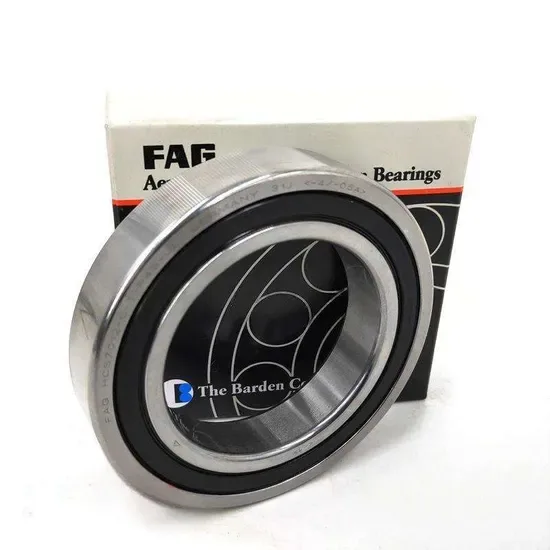
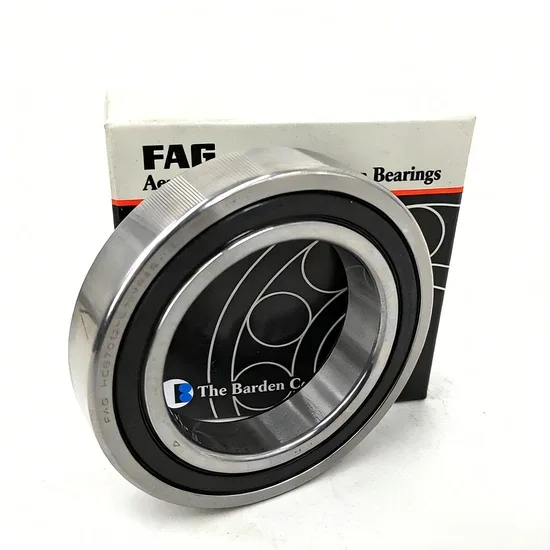
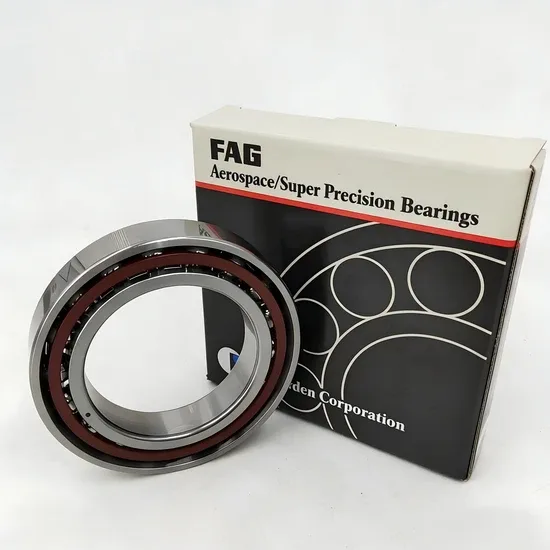
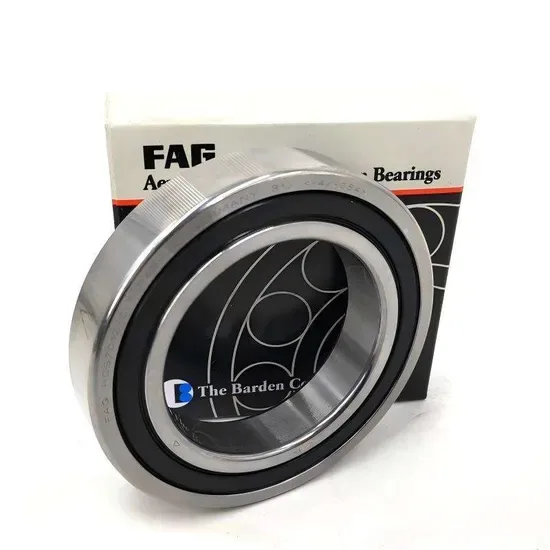

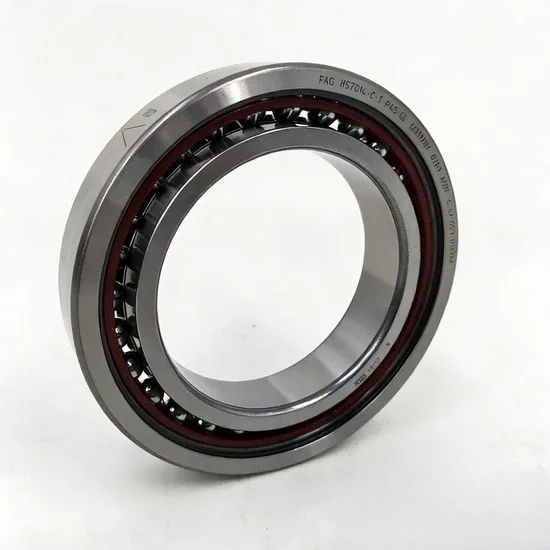
Description
Traceable Supply Chain — Every FAG XCB71900-E-T-P4S angular contact ball bearing ships with Certificate of Conformity linked to its production batch, enabling full traceability from the manufacturer’s facilities to your spindle assembly floor.
Technical Specifications
| Parameter | Value |
|---|---|
| Designation | FAG XCB71900-E-T-P4S |
| Bearing Type | Angular Contact Ball Bearing |
| Bore Diameter (d) | 10 mm |
| Outside Diameter (D) | 22 mm |
| Width (B) | 6 mm |
| Number of Rows | Single Row |
| Contact Angle | 25° (E suffix) |
| Precision Class | P4S (ISO 492) |
| Weight | 0.100 kg |
| Origin | China |
Note: The XCB and T suffixes within this designation fall outside standard FAG catalog nomenclature and require manufacturer catalog confirmation before finalizing dimensional interchange or preload specifications.
Application Suitability
| Industry | Typical Applications |
|---|---|
| Machine Tool Manufacturing | High-speed milling spindle nose bearings / CNC lathe headstock precision pairs |
| Robotics & Automation | Joint actuator harmonic drive support / collaborative robot wrist axes |
| Precision Equipment | Optical grinding spindle / CMM air bearing backup supports |
| Semiconductor Manufacturing | Wafer dicing spindle / wire bonder Z-axis guide |
What a Precision Mismatch Really Costs on a 10 mm Bore Spindle
A P0 bearing swapped for a P4S at 60,000 RPM doesn’t just wear out — it scatters chatter marks across every finished surface.
I’ve walked into shops where the scrap bin told the story before the maintenance log did. A CNC grinding operation in Foshan replaced their spindle bearings with a cross-reference that matched the base number perfectly. The old suffix stack included P4 precision and a specific contact angle; the replacement carried P0 tolerance with a different cage. Within a week, three bearings showed thermal discoloration on the raceway, and surface finish on hardened steel parts dropped two Ra grades overnight. The shop had saved a few dollars on the purchase and lost thousands in scrapped workpieces and unplanned downtime. [NEED_CITE: spindle bearing precision class impact on surface finish per ISO 230]
How the 25° Contact Angle Fits Combined-Load Spindle Duty
The FAG XCB71900-E-T-P4S angular contact ball bearing carries a 25° contact angle encoded in its E suffix, which positions it squarely between pure radial duty and heavy thrust applications. In a typical high-speed milling spindle, cutting forces arrive at the nose from multiple vectors simultaneously — radial pressure from the cutter engagement and axial thrust from the feed direction. A 15° angle (C suffix) would prioritize radial rigidity at the expense of axial stiffness, while a 40° angle (B suffix) would over-constrain the axial plane and generate excess friction heat at sustained high RPM. The 25° geometry balances both planes, letting the bearing absorb compound loading without thermal runaway during extended cutting cycles.
When a medical device manufacturer in Dongguan needed to retrofit a small-format grinding spindle originally specified with a different brand, matching not just the bore and OD but also the contact angle and precision class proved critical. Our cross-reference database confirmed the 25° / P4S combination, preventing the preload mismatch that would have caused either excessive stiffness or harmful play in the spindle stack.
Thermal Growth and Speed Demands at the Spindle Nose
Spindle nose bearings operate under a punishing combination of high rotational speed, concentrated load zones, and heat generation from both internal friction and the cutting process itself. At the speeds typical for a 10 mm bore angular contact bearing, lubricant film thickness narrows to micrometer scale, and any precision shortfall amplifies into vibration and thermal feedback loops. The P4S tolerance class provides tighter dimensional control over bore, OD, and running accuracy than standard P5 or P4 grades, directly reducing the internal vibration sources that drive temperature upward.
Oil-air or oil-jet lubrication systems commonly paired with these spindles depend on consistent internal geometry to distribute lubricant evenly across the contact ellipse. [NEED_CITE: high-speed angular contact bearing lubrication regime and film thickness] Temperature differentials between the inner ring (mounted on a rotating shaft that heats from cutting energy) and the outer ring (seated in a housing that may be water-cooled) create differential thermal expansion that affects internal clearance in real time. Engineers must account for this when specifying preload for paired arrangements — an oversight that leads to either thermal binding or loss of rigidity mid-shift.
Decoding the Suffix Stack on XCB71900-E-T-P4S
The E suffix confirms the 25° contact angle and an optimized internal geometry that FAG designed for the specific ball count and curvature ratio needed at this size. This contact angle directly governs the load-sharing ratio between axial and radial components — change it, and you change how the bearing behaves under the compound cutting forces at the spindle nose.
The P4S designation references ISO 492 tolerance class 4 with supplementary running accuracy requirements beyond standard P4. In practice, this means tighter control on radial runout of the inner ring, axial runout, and bore/OD dimensional tolerances — parameters that directly influence the TIR (total indicated runout) measurable at the spindle nose. For precision grinding or high-speed milling, where workpiece surface finish correlates directly to bearing runout, P4S provides the dimensional discipline that separates acceptable performance from chatter-marked rejects.
The single-row angular contact architecture means this bearing must be used in a paired arrangement (back-to-back, face-to-face, or tandem) to handle bidirectional axial loads. The preload applied during mounting — whether light, medium, or heavy — interacts with the P4S tolerance to determine final stiffness and operating temperature.
The Hidden Expense of Ignoring Suffix Details
A purchasing decision based on the base number 71900 alone, without verifying the E contact angle and P4S precision, creates a cascade of costs that don’t appear on the purchase order. Wrong contact angle means the bearing cannot support the intended axial loads, leading to premature raceway spalling documented under ISO 15243 fatigue failure modes. [NEED_CITE: bearing failure classification modes per ISO 15243] Substituted precision class introduces excess clearance or preload error, accelerating cage wear and generating vibration that migrates through the spindle into the workpiece. Counterfeit bearings with cloned packaging but soft inner rings fail catastrophically — sometimes taking the spindle shaft and housing with them, converting a bearing replacement into a full spindle rebuild. These are not hypothetical risks; they show up in warranty voidance letters and unplanned downtime logs across machine shops every week.
How Procurement Engineers Verify Before They Commit
Sourcing through authorized distributor channels means every FAG XCB71900-E-T-P4S angular contact ball bearing we supply arrives with batch-linked documentation that traces back to the manufacturer’s production records. We don’t ask you to trust a label — we provide the Certificate of Conformity with lot number, the QR verification pathway through FAG’s official authentication tools, and dimensional data that confirms the P4S tolerances before the bearing reaches your receiving dock.
When a buyer needs to cross-reference this bearing against an existing spindle specification from another manufacturer, we match all three critical parameters simultaneously: clearance class, cage material, and precision grade. A base-number match that ignores these variables is exactly how the failures described above happen. Our cross-reference database captures the suffix-level detail that catalog searches often miss.
For import compliance, we supply country-of-origin documentation and correct HS coding so customs clearance doesn’t become an unexpected delay. Material certificates and dimensional inspection reports travel with the shipment, not as after-the-fact requests.
Documentation & Authenticity
- Supplier Certificate of Conformity tied to the specific production batch of each FAG XCB71900-E-T-P4S, confirming the P4S precision class and E contact angle specifications
- QR code verification pathway via FAG’s official mobile authentication tools, allowing receiving inspectors to confirm provenance before inventory shelving
- Country-of-origin documentation prepared for import compliance, including the correct HS code classification for angular contact ball bearings
- Dimensional inspection data confirming bore, OD, width, and running accuracy within P4S tolerance bands prior to shipment
- Material certification documenting the steel grade and heat treatment parameters used in raceway and ball production
Storage, Handling & Mounting
- Keep each FAG XCB71900-E-T-P4S in its original sealed packaging until the moment of spindle assembly; the anti-corrosion coating on the 10 mm bore and precision-ground raceways degrades once exposed to shop-floor humidity
- Store matched pairs in temperature-stable conditions away from direct sunlight; thermal cycling before mounting can alter the factory-applied preload relationship between paired P4S bearings
- Handle with lint-free clean gloves during mounting — fingerprints on the P4S-precision bore surface introduce localized corrosion sites that compromise the interference fit on the spindle shaft
- For paired arrangements, confirm the factory etched alignment marks on the outer rings before separating the set; misaligned mounting positions reverse the intended preload direction and generate immediate thermal binding at operating speed
- Verify spindle shaft and housing seating dimensions against the bearing’s P4S tolerance requirements before pressing; out-of-round seats multiply runout regardless of bearing precision grade
Start Your Technical Review
Share your spindle’s operating parameters — speed range, load spectrum, lubrication type, and required precision class — so we can confirm whether the FAG XCB71900-E-T-P4S angular contact ball bearing matches your application or whether a different suffix combination serves better. If you’re replacing an existing bearing, send us the OEM equipment number or the full designation printed on the current bearing’s packaging, and we’ll run a complete cross-reference check covering clearance, cage, contact angle, and precision alignment.
Frequently Asked Questions
Q: How do I verify the authenticity of a FAG bearing through official channels?
A: FAG provides mobile authentication tools that scan the QR code on product packaging and link to production batch records. We supply the verification pathway with each order so your receiving team can confirm authenticity at the dock, not after installation.
Q: What does P4S precision mean compared to standard P4 or P5?
A: P4S meets ISO 492 class 4 dimensional tolerances with additional running accuracy requirements — tighter radial and axial runout control than standard P4. For spindle applications, this translates to measurably lower TIR at the tool nose and improved surface finish on workpieces.
Q: Why must clearance, cage material, and precision all align during cross-referencing?
A: A base-number match that ignores these parameters creates fit and performance mismatches. Wrong clearance causes thermal binding or excessive play; incorrect cage material changes speed capability and lubrication behavior; lower precision introduces vibration. All three must align to maintain the spindle’s designed performance envelope.
Q: When should I specify a 25° contact angle instead of 15° or 40°?
A: The 25° contact angle (E suffix) suits applications with combined radial and axial loading, such as milling spindles where cutting forces arrive from multiple directions. A 15° angle favors radial-dominant loads at extreme speeds, while 40° handles heavy axial thrust but generates more friction heat.
Q: What documentation do I need for importing precision bearings?
A: A complete import package includes the supplier Certificate of Conformity, material certificates, country-of-origin proof, and correct HS code classification. We prepare all of these for each shipment to prevent customs delays.
Secure Your Spindle Precision — Request a Technical Review
Send us your bearing designation, OEM equipment number, or spindle operating parameters. Our team will confirm specification alignment, verify cross-reference compatibility, and return a quotation with full documentation and lead time.