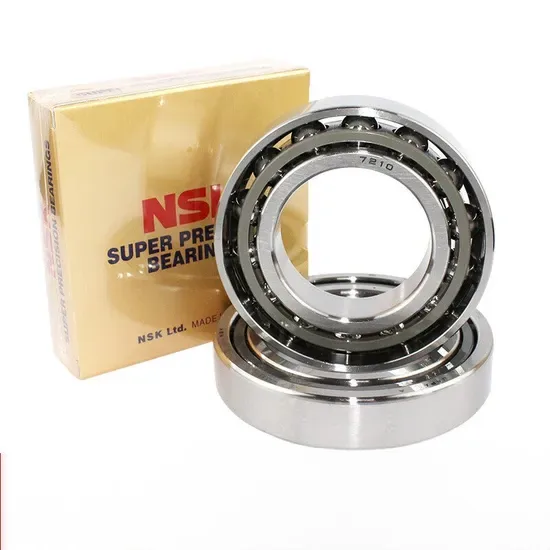
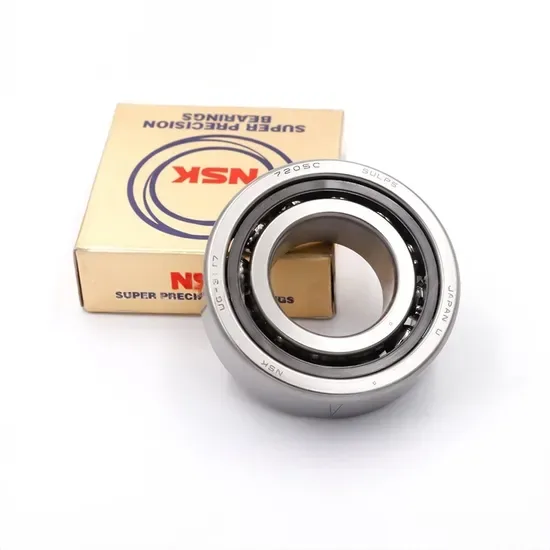
Description
Authorized Channel Sourcing — Every Original NSK 7900A5TRSUHP3 Super Precision Angular Contact Ball Bearing ships with batch-level traceability back to the manufacturer’s distribution network.
Technical Specifications
| Parameter | Value |
|---|---|
| Designation | NSK 7900A5TRSUHP3 |
| Bearing Type | Angular Contact Ball Bearing |
| Number of Rows | Single |
| Contact Angle | 15° (A suffix) |
| Load Direction | Combined Radial and Axial Load |
| Material | Bearing Steel |
| Weight | 0.009kg |
| Separated | Separated |
| Bore Diameter (d) | 10 mm (series 79 standard) |
| Outside Diameter (D) | 22 mm (series 79 standard) |
| Arrangement | SU — Single, universal ground for flush mounting |
Certain trailing suffix segments in this designation require confirmation against the manufacturer’s current catalog for exact cage material, precision class, and preload rating.
Application Suitability
| Industry | Typical Applications |
|---|---|
| Machine Tool | High-frequency spindle nose bearing, grinding wheelhead cartridge |
| Precision Equipment | Coordinate measuring machine rotary axis, optical inspection stage |
| Robotics | Harmonic drive input shaft support, lightweight articulated joint |
What Happens When Spindle Bearings Are Matched Only by Base Number
A single overlooked suffix can shift thermal equilibrium enough to destroy surface finish on a precision grinding line.
I once traced a recurring thermal drift issue at a CNC shop in Binh Duong to a "7900 series" replacement that matched the base designation but carried a pressed steel cage and P5 running accuracy instead of the required phenolic cage and P4 grade. The wrong cage material altered the speed-temperature curve, and the looser tolerance stack-up let the spindle nose wander under grinding forces. Within weeks, surface finish on hardened die steel had degraded past tolerance. That failure was not a quality defect — it was a cross-reference error. [NEED_CITE: bearing substitution errors as leading root cause in spindle field failures]
When sourcing the Original NSK 7900A5TRSUHP3 Super Precision Angular Contact Ball Bearing, verifying the full suffix string is the difference between predictable spindle behavior and unplanned downtime masked as a "mystery vibration."
Matching This Bearing to High-Speed Spindle Duty
The 7900 series occupies NSK’s extra-thin-section envelope, which means lower mass at the rolling contact and reduced centrifugal loading on the outer race at sustained high rpm. For machine tool spindles running above typical belt-driven speeds, that lower sectional mass helps keep frictional heat generation within the capacity of standard oil-air or oil-mist lubrication circuits. We routinely confirm dimensional envelope and preload class against the spindle builder’s cartridge drawing before releasing stock, so the replacement bearing seats with the same axial position and clamping geometry as the factory-original component.
Load Spectrum, Speed Envelope, and Thermal Behavior
Spindle nose positions experience predominantly radial cutting forces with a steady axial thrust component from tool engagement — a combined load profile that aligns with the 15° contact angle specified by the A suffix. A 15° angle generates less friction heat under radial-dominant loading compared to 25° or 40° alternatives, at the trade-off of lower axial stiffness. [NEED_CITE: contact angle selection criteria for high-speed spindle bearings per ISO 15243] At sustained high speed, heat input at the contact ellipse is the primary driver of preload drift and cage degradation. The separated design allows the inner ring to expand independently under thermal load, which is essential when the spindle shaft runs hotter than the housing — a condition that would induce preload gain and accelerate fatigue if the bearing were non-separable. Ambient temperature swings in un-air-conditioned shops further compound thermal growth, making the original clearance and precision class non-negotiable.
Decoding the Suffix Stack
The A suffix confirms a 15° contact angle, placing this bearing in the low-friction, high-speed end of NSK’s angular contact range — the standard choice for belt-driven and direct-drive spindle nose positions where radial stiffness dominates the load case. The 79 series designation indicates an extra-thin cross section, which directly reduces the mass of the rotating inner ring assembly and lowers centrifugal force on the cage pockets at elevated rpm. The SU arrangement code signals a single bearing ground for universal flush mounting, meaning it can be paired in back-to-back, face-to-face, or tandem configuration at assembly without selective matching — a critical feature for shops that stock one part number to cover multiple spindle cartridge geometries. [NEED_CITE: NSK universal-ground single bearing pairing conventions] Lightweight construction at 0.009 kg further supports the high-speed suitability by minimizing the inertia load during rapid spindle acceleration and deceleration cycles common in machining center tool-change sequences.
The Hidden Cost of a Suffix Shortcut
Correct selection with verified documentation costs marginally more at the purchase order stage and delivers predictable L10 life. A substituted bearing with mismatched clearance or a downgraded precision class may seat physically but will drift thermally, generating chatter marks that appear as random scrap events weeks into production. Catastrophic cage failure under preload mismatch can score the spindle taper bore, turning a bearing replacement into a cartridge rebuild. [NEED_CITE: ISO 281 bearing life calculation sensitivity to clearance and misalignment] Warranty voidance from undocumented substitution compounds the loss when the spindle builder refuses claim liability on third-party components.
Why Procurement Engineers Route Spindle Bearings Through Our Supply Chain
Every Original NSK 7900A5TRSUHP3 Super Precision Angular Contact Ball Bearing we supply enters through authorized distributor channels, not gray-market aggregators. Batch-level traceability documentation accompanies each shipment, linking the physical bearing to the manufacturer’s production lot. When buyers need to cross-reference to another of the six major brands we cover, our interchange database aligns cage material, contact angle, and precision class simultaneously — not just the base bore-and-OD number. Origin documentation and HS code details are prepared at the quotation stage so import compliance is confirmed before the purchase order is issued, not scrambled at the shipping dock. For buyers managing counterfeit risk, we walk through QR code verification pathways using the brand’s own mobile application on every batch.
Documentation & Authenticity
- Supplier Certificate of Conformity referencing the NSK batch and lot number for full production traceability.
- Material certificate confirming bearing steel grade consistent with super-precision angular contact requirements.
- Dimensional inspection report verifying bore, OD, width, and running accuracy against P-class tolerances before shipment.
- Country-of-origin documentation package prepared for customs and import duty classification.
- QR code verification pathway guidance via NSK’s official authentication application.
- HS code and import regulation support for destination-country compliance.
Storage, Handling & Mounting
- Retain original sealed packaging until the moment of cartridge assembly; premature exposure risks moisture ingress on the bearing steel raceways of this 0.009 kg thin-section component.
- Store flat in a climate-controlled area with stable temperature to prevent thermal cycling from drawing condensation into the extra-thin-section rings.
- Use lint-free gloves when handling; fingerprint residue on the 15° contact angle raceway acts as a contamination nucleus under high-speed oil-air lubrication.
- For SU universal-ground single bearings intended for paired mounting, confirm flush-mount orientation marks and clamping sequence with the spindle cartridge drawing before applying axial preload.
- Do not wash or re-lubricate separated angular contact bearings; solvent residue trapped in the cage pockets will vaporize at operating temperature and contaminate the oil-air supply.
Request a Technical Review Before Ordering
Share the spindle cartridge drawing or OEM equipment number so we can verify the full suffix string — including cage, clearance, and precision class — against the original specification. If cross-referencing from another brand, provide the existing bearing’s complete designation with all suffixes so we can confirm interchange alignment across contact angle and preload. Request the documentation package and country-of-origin confirmation with your quotation to ensure import requirements are met before committing to lead time.
Frequently Asked Questions
Q: How can I verify the authenticity of an NSK bearing after delivery?
A: NSK provides QR code labels on packaging that link to their official mobile authentication application. Scan the code to confirm the batch matches NSK’s production records. We supply the packaging intact and can walk your receiving team through the verification steps on arrival.
Q: What must align when cross-referencing this bearing to another brand?
A: Base bore, OD, and width are necessary but insufficient. Contact angle, cage material, clearance class, and precision grade must all match simultaneously. A substitution that aligns only the base number will alter thermal behavior and preload response in a spindle cartridge.
Q: What is the difference between ISO P4 and P5 precision for spindle applications?
A: P4 specifies tighter bore, OD, width, and running accuracy tolerances than P5. In a high-speed spindle, P5 looseness allows greater thermal drift and vibration amplitude, degrading surface finish on ground or milled workpieces. Super-precision spindle positions generally require P4 or higher.
Q: What does the 15° contact angle mean for my application compared to 25° or 40°?
A: A 15° contact angle produces lower friction heat under predominantly radial loads, making it suitable for high-speed spindle nose positions. Higher angles increase axial stiffness but generate more heat at speed, requiring different lubrication and preload strategies.
Q: Can this SU-designated bearing be paired with another identical unit?
A: Yes. The SU suffix indicates universal grinding for flush mounting, so matched pairs can be assembled in back-to-back, face-to-face, or tandem arrangements. Confirm the required arrangement and resulting preload class with the spindle cartridge specification.
Source Genuine NSK 7900A5TRSUHP3 — Start With Your Spindle Specification
Send us your OEM equipment number or full existing bearing designation. We will return a cross-reference verification, documentation package preview, and confirmed lead time.