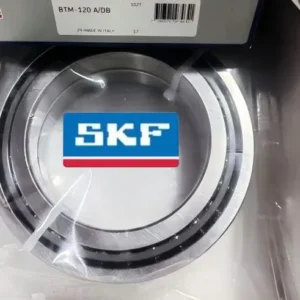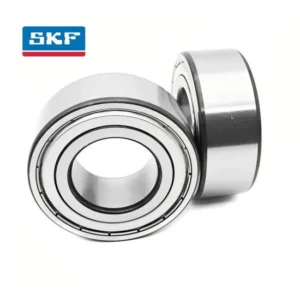
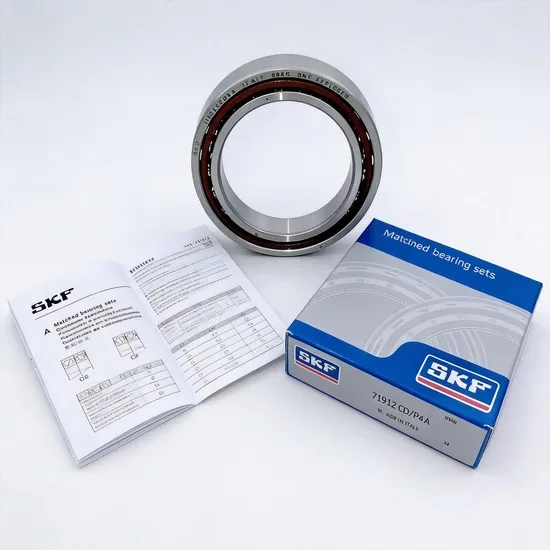
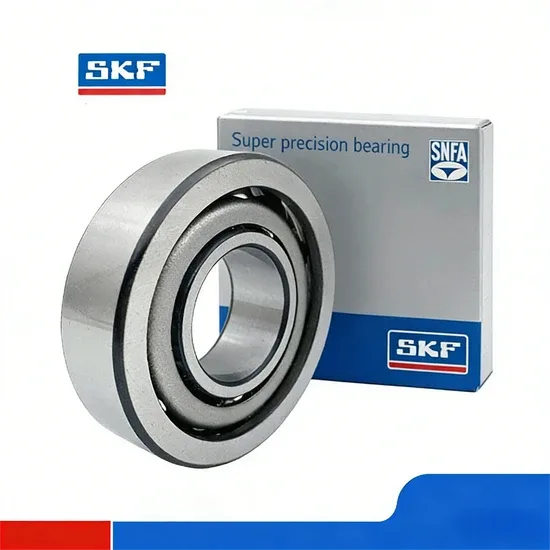
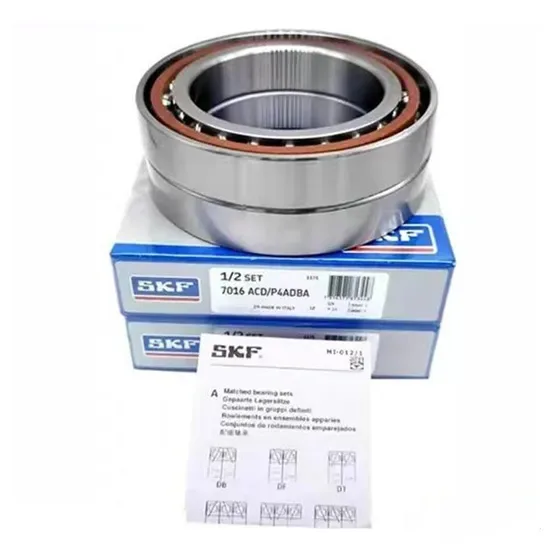
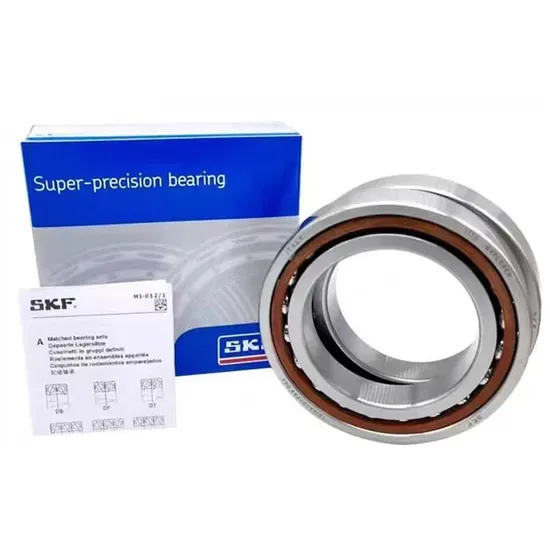
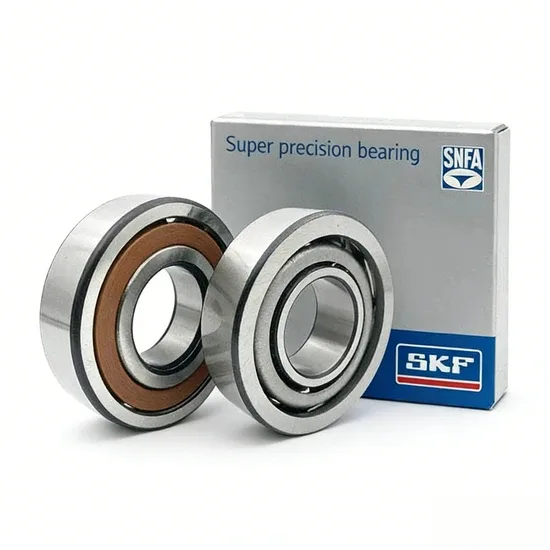
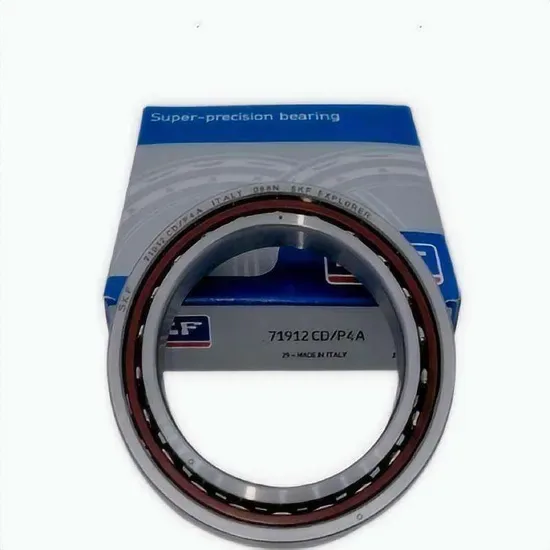
Description
Authorized Channel Sourcing — Every SKF 7015 angular contact ball bearing ships with distributor-channel traceability and batch-level documentation for import compliance.
Technical Specifications
| Parameter | Value |
|---|---|
| Designation | SKF 7015 |
| Bearing Type | Angular Contact Ball Bearing |
| Bore Diameter (d) | 75 mm |
| Number of Rows | Single Row |
| Arrangement | Single (universal or separable mounting) |
| Origin | China |
| Structure | Angular Contact |
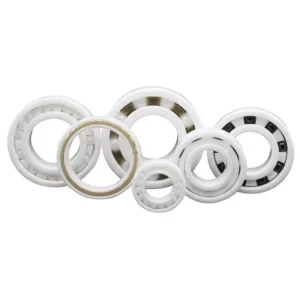
| Rolling Element | Ball (ceramic option available) |
| Application Focus | Machine tool spindles, precision equipment, robotics |
Note: Suffix designations (cage material, precision class, clearance, contact angle) are not present in the base identifier 7015 and must be confirmed against the manufacturer catalog before final specification.
Application Suitability
| Industry | Typical Applications |
|---|---|
| Industrial Machinery | CNC spindle main shaft positioning |
| Precision Equipment | High-speed rotary table axial support |
| Robotics | Joint actuator precision rotation |
| General MRO | Replacement for OEM spindle rebuilds |
When a Base Number Match Destroys a CNC Spindle
Matching the bore and outer diameter is never enough for angular contact bearings in spindle service.
Years back on the Latin American route, I watched a Monterrey machine shop press a standard steel-ball 7015 into a CNC spindle because the base designation matched the OEM tag. Nobody checked whether the application demanded ceramic rolling elements or a P4 precision class. The spindle seized within days at high RPM — thermal binding warped the housing, and the repair bill dwarfed what a correctly specified unit would have cost [NEED_CITE: spindle bearing failure modes due to specification mismatch]. That pattern repeats constantly: buyers source the SKF 7015 ceramic angular contact ball bearing for CNC spindle applications on base number alone, skipping the suffix stack that governs contact angle, cage material, clearance, and running accuracy. Counterfeit units with soft inner rings and cloned QR codes compound the problem, passing visual inspection but failing catastrophically under sustained high-speed load.
How the SKF 7015 Ceramic Angular Contact Ball Bearing for CNC Spindle Fits the Application
Spindle duty demands simultaneous radial and axial load control with minimal runout at sustained high RPM. The SKF 7015 ceramic angular contact ball bearing for CNC spindle applications addresses this through its single-row angular contact geometry, which resolves axial thrust in one defined direction while maintaining radial positioning. A 75 mm bore diameter aligns with standard CNC spindle shaft interfaces, and the ceramic rolling element option reduces centrifugal loading on the outer raceway at elevated speeds — a meaningful advantage when the spindle runs continuously through multi-hour production cycles. We once cross-referenced a buyer’s existing Japanese-brand spindle bearing to this SKF platform, matching not just the envelope dimensions but the cage type and precision grade to avoid the thermal drift that had been causing tolerance violations on their finishing passes.
Spindle Operating Environment and the Demands It Places
CNC spindle environments combine high rotational speed with moderate-to-high axial cutting forces, often reversing direction during tool changes. Temperature at the raceway contact zone climbs steadily, making clearance selection critical — too tight and thermal expansion eliminates internal clearance, leading to thermal runaway [NEED_CITE: thermal binding in high-speed angular contact spindle bearings]. Lubrication strategy typically involves oil-air or oil-mist systems rather than grease packing, demanding a cage material that tolerates marginal film conditions. Open bearing configurations dominate spindle installations because external pressurized lubrication is mandatory, which means the machine builder assumes responsibility for contamination sealing at the housing level. Installation practice matters equally: these units are typically mounted in matched sets with controlled preload, and incorrect clamping force during assembly can introduce axial displacement that defeats the precision class entirely.
What the Specifications Mean for Spindle Performance
The single-row angular contact structure provides axial load capacity in one direction — standard practice for spindle pairs mounted back-to-back or face-to-face to handle bidirectional thrust. Ceramic rolling elements carry substantially lower mass than steel balls, reducing centrifugal force on the outer raceway contact and lowering friction-generated heat at the speeds common in machining centers. This directly supports longer L10 life under sustained high-RPM operation. Cage selection governs high-speed stability: machined brass or phenolic resin cages each occupy different niches depending on speed factor and lubrication method, and substituting one for the other without checking the OEM spindle manual invites vibration problems. Precision class determines the running accuracy envelope — P0 or P6 grade introduces runout that manifests as chatter marks on finished surfaces, while P4 or P4A maintains the tight bore-to-OD concentricity that finishing spindles require [NEED_CITE: ISO 492 precision class tolerances for angular contact bearings].
The Hidden Expense of a Specification Shortcut
Correctly specifying the SKF 7015 ceramic angular contact ball bearing for CNC spindle use from a verified source protects against costs that never appear on the purchase order. A clearance mismatch — standard CN installed where the spindle’s thermal profile demands a non-standard internal clearance — causes thermal binding that damages not just the bearing but the spindle housing itself. A precision class below what the application requires introduces runout that forces scrap rates up on precision machining operations. Counterfeit units with cloned markings and substandard metallurgy fail unpredictably, and ISO 15243 classifies such material-origin failures distinctly from normal fatigue [NEED_CITE: ISO 15243 bearing failure mode classification]. The downtime cost from a seized spindle — lost production hours, emergency shipping for replacement parts, housing re-machining — dwarfs the price difference between a properly specified genuine bearing and the shortcut alternative.
How Procurement Engineers Verify Before They Commit
Every unit we source travels through authorized distributor channels, meaning the chain of custody is documented from the manufacturer’s production facilities to your dock. For the SKF 7015 ceramic angular contact ball bearing for CNC spindle applications, we provide batch-level traceability that maps to the original manufacturing lot, not just a reseller invoice. Our cross-reference database matches clearance, cage material, contact angle, and precision class simultaneously — not just the base designation — so substitution between SKF, NSK, FAG, and NTN platforms happens without field surprises. We supply country-of-origin documentation for import compliance, which matters when customs authorities require verifiable provenance. Pre-shipment dimensional verification confirms running accuracy against the specified precision class, and we walk buyers through QR code verification via the brand’s official app as a final authenticity gate before installation.
Documentation & Authenticity
- Supplier Certificate of Conformity tied to the specific SKF 7015 batch and lot number for full traceability
- Pre-shipment dimensional and runout inspection confirming the unit meets the specified precision class before release
- QR code verification pathway through SKF official app for on-site authenticity confirmation at receiving
- Country-of-origin documentation and HS code classification for import clearance and customs compliance
- Material certificates available for metallurgical verification of raceway and rolling element composition
Storage, Handling & Mounting
- Keep the SKF 7015 in original sealed packaging until the moment of mounting; early exposure risks contamination on the open raceway surfaces critical for spindle precision
- Store horizontally in a climate-controlled environment — temperature swings can cause condensation on the exposed bearing steel of this open-configuration unit
- Handle with clean, lint-free gloves to prevent skin-contact corrosion on the precision-ground raceways before the spindle’s oil-air lubrication takes over
- Matched sets must remain sealed together; separating units before installation risks losing factory pairing orientation marks required for correct preload application
- Mounting should follow induction heating or hydraulic press methods with controlled axial force — excessive clamping during press-fit distorts the thin-section raceway and introduces runout
Request a Technical Review Before You Order
Share your spindle operating parameters — speed, load spectrum, lubrication method, and required precision class — so we can confirm the correct suffix configuration for your SKF 7015 application. If you are replacing an existing bearing, provide the OEM equipment number or the full designation from the nameplate, and we will run a cross-reference that includes cage, clearance, and precision alignment. We can prepare a documentation package with origin and batch traceability before you commit to a production order. Confirm current lead time and batch availability by reaching out with your project timeline.
Frequently Asked Questions
Q: How do I verify the authenticity of an SKF 7015 through official channels?
A: SKF provides an official mobile app that reads the QR code or barcode on the bearing packaging. Scan the code upon receipt to confirm the batch number matches manufacturer records. We also supply distributor-channel documentation so the procurement trail is traceable from origin to delivery.
Q: What must align when cross-referencing angular contact bearings across brands?
A: The base designation is only the starting point. Contact angle, cage material, clearance class, and precision grade must all match simultaneously. A 75 mm bore angular contact bearing from one brand may carry a 25° contact angle and brass cage, while the same base number from another uses 15° and a polyamide cage — these are not interchangeable in spindle service.
Q: When should I specify ceramic balls over steel for spindle applications?
A: Ceramic rolling elements reduce mass at the contact point, lowering centrifugal loading and friction heat at high rotational speeds. For CNC spindles running sustained high RPM with precision surface finish requirements, ceramic balls support longer intervals between rebuilds and tighter thermal stability.
Q: What precision class is appropriate for a CNC spindle bearing?
A: Most machining center spindles require P4 or P4A precision to maintain surface finish quality and dimensional accuracy on workpieces. Standard P0 or P6 grades introduce runout that manifests as chatter or tolerance drift, particularly in finishing operations. Confirm the requirement against the spindle OEM manual before ordering.
Q: What documentation accompanies a bulk order?
A: Bulk shipments include a supplier Certificate of Conformity, batch and lot traceability records, dimensional inspection reports, country-of-origin documentation, and HS code support for import processing. Pre-shipment inspection can be arranged for additional verification.
Start Your SKF 7015 Spindle Bearing Inquiry
Send your spindle speed, load data, and OEM equipment number — we will return a cross-referenced specification with full documentation and current availability.
Contact our technical sales team through your existing channel or submit your application parameters for review.