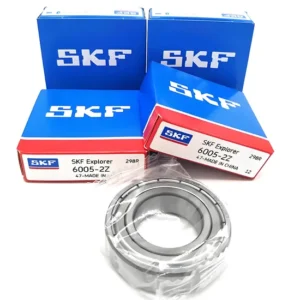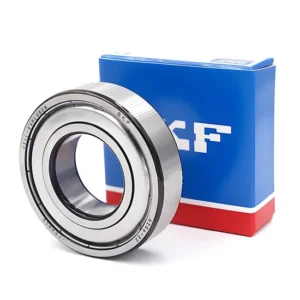


Description
Original Factory Batch Traceability — Every SKF 6205-RSH 6205-2RSH 6205-2Z/C3 deep groove ball bearing shipped includes unbroken manufacturer lot documentation for complete supply chain transparency.
Technical Specifications
| Parameter | Value |
|---|---|
| Designation | SKF 6205-RSH 6205-2RSH 6205-2Z/C3 |
| Bearing Type | Deep Groove Ball Bearing |
| Bore Diameter (d) | 25 mm |
| Outside Diameter (D) | 52 mm |
| Width (B) | 15 mm |
| Seal or Shield Type | RSH (Single contact seal), 2RSH (Double contact seals), 2Z (Double steel shields) |
| Clearance Class | C3 (for 2Z variant), Standard (implied for others) |
| Precision Class | P0, P6, P5, P4, P2 |
| Material | Bearing Steel |
| Origin | Sweden |
Application Suitability
| Industry | Typical Applications |
|---|---|
| Electric Motors | Rotor shaft support in high-efficiency AC/DC motors |
| Pumps | Centrifugal pump impeller shaft radial support |
| Conveyors | Idler roller end caps and drive pulley bearings |
| Gearboxes | High-speed input shaft and intermediate shaft mounting |
Thermal Expansion Traps in the SKF 6205-RSH 6205-2RSH 6205-2Z/C3 deep groove ball bearing
Misaligned internal clearance inevitably leads to catastrophic thermal seizure under continuous motor operation.
Deploying standard clearance variants in high-ambient environments often results in premature locking. I witnessed this exact failure mode early in my career when standard CN clearance units seized inside Middle Eastern motor housings due to unmanaged heat buildup. The ambient desert temperatures combined with internal motor heat completely eliminated the internal radial gap. Selecting the correct internal geometry prevents these costly unplanned downtimes and protects the surrounding stator windings from catastrophic collateral damage [NEED_CITE: rolling bearing failure mode classification per ISO 15243]. Maintenance teams frequently misdiagnose this thermal seizure as a lubrication failure, leading to repeated replacements of incorrectly specified parts.
Matching Seal Configurations to Motor and Pump Environments
The SKF 6205-RSH 6205-2RSH 6205-2Z/C3 deep groove ball bearing lineup offers distinct sealing architectures to match specific contamination levels encountered in industrial drive systems. Single or double contact rubber seals effectively block moisture ingress in humid pump stations and agricultural machinery, ensuring the internal grease remains uncontaminated. Conversely, non-contact steel shields minimize friction torque for high-speed electric motor applications where heat generation must be strictly controlled. Our engineering team cross-references your exact operational environment, including dust concentration and washdown frequencies, to specify the optimal suffix combination that balances friction and protection.
Managing Radial Loads and Thermal Gradients in Drive Systems
Electric motors, conveyors, and gearboxes subject these components to sustained radial loads combined with significant internal heat generation from electromagnetic losses and mechanical friction. Elevated operating temperatures directly impact the internal geometry, demanding adequate clearance to accommodate the differential thermal expansion of the inner ring, outer ring, and rolling elements. Furthermore, continuous rotation requires factory-sealed grease formulations that resist oxidation and structural degradation over extended service intervals without the possibility of relubrication [NEED_CITE: lubrication lifecycle limits in sealed deep groove bearings]. Ignoring these thermal gradients during the initial specification phase guarantees accelerated fatigue and unpredictable maintenance schedules.
Decoding Suffix Impacts on Friction and Internal Geometry
Understanding the specific suffix designations is absolutely critical for preventing costly field failures in rotating equipment. The RSH and 2RSH suffixes indicate single or double nitrile rubber contact seals, providing superior exclusion of fine dust and liquid moisture at the cost of slightly higher friction torque and speed limitations. Conversely, the 2Z designation features non-contact steel shields that maintain exceptionally low friction for high-speed motor shafts but offer less protection against direct liquid ingress. The C3 clearance suffix specifically denotes a larger-than-normal internal radial gap. This expanded geometry is essential for accommodating thermal expansion in high-temperature motor applications, preventing the rolling elements from binding under heat-induced preload and ensuring smooth rotation throughout the operational temperature range.
The Financial Drain of Incorrect Clearance and Seal Selection
Specifying a standard clearance variant for a high-temperature gearbox inevitably causes thermal preload, leading to accelerated subsurface fatigue and catastrophic cage failure. Similarly, deploying open or shielded variants in wet pump environments allows corrosive liquid ingress that rapidly degrades the raceways and compromises the structural integrity of the bearing steel. These misapplications result in severe unplanned downtime, voided equipment warranties, and cascading mechanical damage to adjacent motor windings and shaft seals [NEED_CITE: economic impact of premature bearing failure in industrial drive systems]. The true cost extends far beyond the replacement part, encompassing lost production hours, emergency freight charges, and extensive labor for teardown and reassembly.
Securing Authentic Traceability for Critical Motor Components
Sourcing genuine components requires rigorous verification protocols that extend far beyond simple visual inspection of the packaging. We provide complete manufacturer batch traceability for every single unit shipped, ensuring the metallurgical integrity and dimensional tolerances perfectly match original factory specifications. Our inventory specifically stocks the precise C3 and 2RSH variants that are frequently mismatched or substituted by generalist suppliers lacking technical expertise. Furthermore, our technical team validates cross-reference equivalencies and verifies seal material compatibility against your specific chemical exposure before dispatch. This rigorous approach eliminates the risk of receiving counterfeit stock or incorrectly labeled variants that could trigger immediate field failures.
Documentation & Authenticity
- Certificate of Conformity validating the Swedish origin and specific production batch for each shipment.
- Original manufacturer lot traceability documents linking the physical unit to the factory test records.
- Official authentication QR codes enabling immediate field verification via the manufacturer’s mobile application.
- Dimensional and running accuracy inspection reports confirming P-class tolerances prior to dispatch.
Storage, Handling & Mounting
- Retain the original moisture-barrier packaging until installation to protect the 2RSH rubber seals from ozone degradation.
- Store the C3 clearance variants in a climate-controlled environment to prevent condensation inside the 2Z shielded units.
- Use induction heaters with precise temperature controls when mounting the 25mm bore onto motor shafts to avoid damaging the contact seals.
- Never wash the factory-greased RSH or 2RSH sealed units with solvents, as this strips the internal lubrication and compromises the seal lips.
Engineering Review for Motor and Pump Applications
To ensure optimal lifecycle performance and prevent premature degradation, please provide your specific radial and axial load profiles, operational speeds, and ambient temperature ranges. Sharing the exact OEM equipment model numbers allows our technical team to perform precise cross-reference validation and recalculate the L10 fatigue life under your actual operating conditions. This detailed engineering data enables us to definitively confirm whether the C3 clearance and specific seal type perfectly align with your mechanical constraints and thermal environment, ensuring a reliable and maintenance-free installation.
Frequently Asked Questions
Q: How do I verify the authenticity of these units using official tools?
A: You can authenticate the SKF 6205-RSH 6205-2RSH 6205-2Z/C3 deep groove ball bearing by scanning the QR code on the packaging using the manufacturer’s official mobile application. Additionally, we supply original batch traceability documentation that cross-references the physical lot number with the factory’s production database, ensuring complete supply chain transparency and eliminating counterfeit risks.
Q: What are the functional differences between RSH, 2RSH, and 2Z seals?
A: The RSH and 2RSH suffixes denote single or double rubber contact seals, which provide excellent protection against moisture and dust ingress but generate slightly higher friction. The 2Z designation indicates double steel shields that offer lower friction for high-speed electric motor applications but provide less sealing effectiveness against liquid contamination compared to the rubber contact variants.
Q: When must C3 clearance be selected over standard internal geometry?
A: The C3 internal clearance is mandatory when the bearing operates under elevated temperatures or high speeds where thermal expansion reduces the internal gap. If a standard clearance unit is used in a hot motor housing, thermal expansion will eliminate the internal play, causing excessive preload, extreme friction, and eventual thermal seizure of the rolling elements.
Q: How should I interpret the precision and vibration class suffixes?
A: Precision classes like P6, P5, or P4 dictate the dimensional and running accuracy tolerances, which are critical for minimizing vibration in high-speed electric motors. Vibration classes such as Z1V1 or Z3V3 specify the acceptable noise and vibration limits during operation, ensuring smooth performance and reducing acoustic emissions in sensitive household appliance or precision gearbox applications.
Q: What are the relubrication intervals for these sealed configurations?
A: Bearings equipped with RSH, 2RSH, or 2Z seals are pre-lubricated at the factory and designed to be maintenance-free for their entire operational lifecycle. Attempting to relubricate these sealed units is not recommended, as breaking the seal integrity introduces contamination and damages the sealing lips, which ultimately compromises the internal grease and accelerates premature failure.