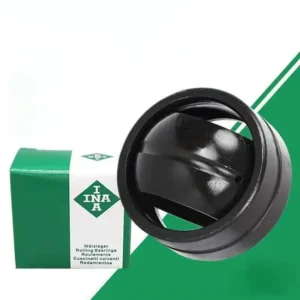


Description
Traceable Sourcing Channels — Every INA GE50-DO-2TS radial spherical plain bearing ships with batch documentation and country-of-origin paperwork verified before dispatch.
Technical Specifications
| Parameter | Value |
|---|---|
| Designation | INA GE50-DO-2TS |
| Bearing Type | Radial Spherical Plain Bearing |
| Bore Diameter (d) | 50 mm |
| Ball Diameter | 66 mm |
| Eye Thickness | 35 mm |
| Weight | 0.530 kg |
| Ball Material | Bearing Steel |
| Body Material | Bearing Steel |
| Precision Class | P2 |
| Seal or Shield Type | 2TS (unverified suffix — requires manufacturer catalog confirmation) |
| Origin | China |
Note: The suffixes DO and 2TS on the INA GE50-DO-2TS radial spherical plain bearing have not been verified against the manufacturer catalog and should be confirmed prior to order placement.
Application Suitability
| Industry | Typical Applications |
|---|---|
| Construction & Earthmoving | Excavator boom pivot joints / loader linkage articulation points |
| Material Handling | Forklift tilt cylinder clevis pins / conveyor tensioner arms |
| Agricultural Machinery | Tractor three-point hitch linkages / harvester header pivot mounts |
| Industrial Hydraulics | Hydraulic cylinder rod-end bearings / pneumatic actuator clevis joints |
What Happens When a Seal Suffix Gets Overlooked on a Hydraulic Cylinder
A missing or misread seal suffix turns a two-year service interval into a two-week shutdown.
Years ago in Nigeria, a crushing plant maintenance manager replaced a seized spherical plain bearing on a hydraulic cylinder. The liner was shredded, dust packed into every sliding surface gap. His purchase order had specified an open-type cross-reference, completely ignoring the 2RS seal suffix on the original part. That one missing detail meant the replacement had zero contamination protection in one of the dustiest environments on a mine site. The INA GE50-DO-2TS radial spherical plain bearing exists precisely to prevent this kind of failure — the seal suffix matters as much as the bore diameter when the application involves particulate exposure. Cross-reference errors where buyers match the base designation but overlook seal type, clearance, or precision class remain a significant share of premature field failures across heavy industry [NEED_CITE: rolling bearing failure mode classification per ISO 15243].
Matching the GE50 to Oscillating Hydraulic and Linkage Loads
Spherical plain bearings operate under fundamentally different kinematics than rolling element bearings. The INA GE50-DO-2TS radial spherical plain bearing accommodates oscillating and slow-rotating motion where sliding contact between the inner ring ball and outer ring bore carries the entire radial load. In hydraulic cylinder rod-end applications, this means the 50 mm bore and 66 mm ball diameter must sustain repeated directional reversals under full system pressure without galling. When sourcing replacements for construction equipment or agricultural linkages, matching the sliding contact material pair and seal configuration to the actual contamination level determines whether the bearing survives one season or several. Our cross-reference process verifies not just the base number but the seal type and material specification against the OEM equipment drawing.
Dust, Moisture, and the Seal Interface in Field Equipment
The operating environment for spherical plain bearings in earthmoving and agricultural equipment combines heavy radial loads with severe contamination exposure. Fine silica dust infiltrates unsealed sliding surfaces and acts as lapping compound, accelerating wear on the inner ball and outer ring bore. Moisture ingress during wash-down cycles promotes corrosion on the sliding contact surfaces, increasing friction and eventually causing stick-slip seizure. The seal configuration on the INA GE50-DO-2TS radial spherical plain bearing must therefore balance contamination exclusion against friction torque — contact lip seals provide better sealing but generate more heat during continuous oscillation. Temperature swings between day and night operation also affect internal clearance and the interference fit between the outer ring and housing bore, making precision class relevant even in heavy-duty applications [NEED_CITE: spherical plain bearing wear mechanisms under contaminated lubrication].
Reading the Specification Sheet: What P2 and Bearing Steel Actually Deliver
The P2 precision class on this bearing corresponds to ISO tolerance class 2, the tightest standard grade for spherical plain bearings. In practice, this means the ball diameter and outer ring bore are held to narrower dimensional bands than standard-class parts, producing more predictable sliding contact pressure distribution. For hydraulic cylinder applications where the bearing must maintain consistent friction characteristics across thousands of stroke cycles, tighter precision reduces the variation in breakaway torque that causes jerky actuator motion. The bearing steel construction for both ball and body provides the hardness and compressive strength needed for sustained radial loads without surface deformation. The 35 mm eye thickness determines the axial envelope available for the housing design, and any deviation from the OEM specification during cross-referencing can cause misalignment that concentrates stress on one edge of the sliding surface.
The Downtime Cost of Ignoring Suffix and Precision Details
Correctly specified spherical plain bearings from verified sources deliver predictable service intervals aligned with equipment maintenance schedules. Substituting an open bearing where a sealed version is required, or accepting a standard-precision part where P2 was specified, shifts the failure mode from predictable wear to sudden seizure. Under ISO 281 life framework principles, even sliding contact bearings have calculable service lives that depend on load, speed, lubrication, and contamination — deviating from any of these parameters voids the calculation entirely. The hidden costs include unplanned equipment downtime, secondary damage to adjacent housing bores and shafts, expedited freight for emergency replacements, and potential warranty disputes when failure analysis reveals the wrong specification was installed [NEED_CITE: unplanned downtime cost impact on industrial maintenance budgets].
Sourcing Integrity from Inquiry to Installation
Every inquiry we handle begins with application parameter review — load magnitude, oscillation frequency, contamination level, and ambient temperature range. For the INA GE50-DO-2TS radial spherical plain bearing, we cross-reference the OEM equipment number against our interchange database, verifying bore, ball diameter, eye thickness, seal type, and precision class simultaneously rather than matching only the base designation. Sourcing through authorized distributor channels means batch and lot traceability is maintained from manufacturer to final delivery. We provide country-of-origin documentation for import clearance, material certificates confirming bearing steel composition, and dimensional inspection reports verifying P2 tolerance compliance before shipment. When buyers need to confirm authenticity, we guide them through QR code verification pathways via brand official apps rather than relying on visual inspection alone [NEED_CITE: bearing counterfeit detection methods through official verification channels].
Documentation & Authenticity
- Supplier Certificate of Conformity referencing the specific batch and lot number for this INA spherical plain bearing
- Material certificate confirming bearing steel composition for both inner ball and outer body
- Third-party dimensional inspection report verifying 50 mm bore, 66 mm ball diameter, and P2 tolerance class
- Country-of-origin documentation supporting import clearance and customs compliance
- QR code verification pathway guidance for authenticity confirmation through official channels
Storage, Handling & Mounting
- Retain original packaging until mounting to protect the seal lips on the 2TS configuration from deformation during shelf storage
- Store in a dry environment below 60% relative humidity to prevent corrosion on the exposed bearing steel sliding surfaces
- Use clean gloves when handling to avoid transferring moisture or particulate onto the P2 precision sliding contact surfaces
- For hydraulic cylinder installations, verify housing bore tolerance matches the 66 mm ball diameter interference fit requirement before pressing the outer ring
- Never apply direct flame heating during mounting — induction heaters with temperature monitoring preserve seal integrity and bearing steel hardness
- After installation, confirm oscillation range does not exceed the bearing’s angular misalignment capacity specified for the GE50 series
Request Technical Selection Support
Share your application parameters — load type, oscillation frequency, operating temperature, and contamination level — so we can verify whether the INA GE50-DO-2TS radial spherical plain bearing matches your specific duty cycle. If you have the OEM equipment number or existing bearing part number, provide it for a complete cross-reference check including seal type, precision class, and dimensional envelope confirmation. We can prepare a documentation package with country-of-origin paperwork and material certificates for your import and procurement records.
Frequently Asked Questions
Q: How can I verify the authenticity of an INA spherical plain bearing before installation?
A: Authenticity verification involves checking the QR code or marking against the brand’s official app and confirming batch traceability documentation. We source through authorized distributor channels and provide Certificate of Conformity with lot numbers that can be cross-referenced. Visual inspection alone is insufficient because counterfeit bearings often replicate external markings while using softer inner ring materials that fail prematurely.
Q: What must align when cross-referencing a spherical plain bearing from another brand?
A: Cross-referencing requires matching bore diameter, ball diameter, and eye thickness simultaneously — not just the base designation number. Seal configuration, precision class, and sliding contact material must also correspond to the OEM specification. A base number match with the wrong seal suffix or standard precision instead of P2 can cause rapid field failure in contaminated or high-cycle applications.
Q: What does P2 precision class mean for spherical plain bearing applications?
A: P2 corresponds to ISO tolerance class 2, the tightest standard precision grade for spherical plain bearings. It ensures the ball and outer ring bore are manufactured to narrow dimensional tolerances, producing consistent sliding contact pressure and predictable friction behavior. This is critical in hydraulic cylinder and linkage applications where variable breakaway torque causes jerky or uncontrolled motion.
Q: Why do the DO and 2TS suffixes require catalog confirmation?
A: Suffix conventions for spherical plain bearings vary between manufacturers and product generations. The DO and 2TS designations on this bearing should be confirmed against the current INA catalog to establish exact seal type, material specification, and any design-specific features. We assist buyers in obtaining this confirmation before order placement to avoid specification mismatches.
Q: How does bearing steel material affect spherical plain bearing performance?
A: Bearing steel provides the surface hardness and compressive strength required for sustained sliding contact under radial load. The hardened inner ball and outer ring resist surface deformation and wear, maintaining dimensional accuracy over the service life. Material verification through certificates confirms the steel composition meets bearing industry standards rather than commercial-grade alternatives that deform under heavy oscillating loads.
Send Your Application Details for Specification Verification
Provide your OEM equipment number or operating parameters, and we will confirm the correct bearing configuration including suffix interpretation and cross-reference alignment.