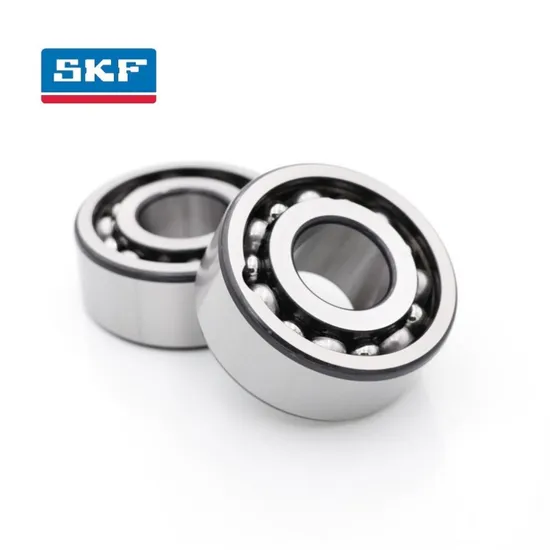


Description
Authorized Channel Sourcing — Every SKF 7012 ACD/P4AQBCD we supply ships with batch-level traceability documents tied to authorized distributor invoices.
Technical Specifications
| Parameter | Value |
|---|---|
| Designation | SKF 7012 ACD/P4AQBCD |
| Bearing Type | Angular Contact Ball Bearing |
| Bore Diameter (d) | 60 mm |
| Outside Diameter (D) | 95 mm |
| Precision Class | P4 |
| Contact Angle | 25° (ACD) |
| Number of Rows | Single Row |
| Structure | Angular Contact |
| Origin | China |
Note: The AQBCD suffix could not be fully decoded from available reference material; pairing arrangement and preload class should be confirmed against the manufacturer catalog before finalizing procurement.
Application Suitability
| Industry | Typical Applications |
|---|---|
| Industrial Machinery | CNC lathe main spindle front support |
| Precision Equipment | High-speed machining center spindle cartridge |
| Robotics | Rotary axis joint actuator bearing |
Why the Suffix String After 7012 Decides Whether Your Spindle Survives the First Shift
A single mismatched suffix in a P4 angular contact bearing can shut down a machining line before the first production run finishes.
I once watched a Vietnam spindle rebuild fail within days because the supplier matched the base number but ignored the pairing and preload designation. The replacement ran hot, vibration spiked past acceptable limits, and three CNC centers went idle while the team scrambled for the correct set. That pattern repeats constantly in precision bearing procurement — buyers compare the digits before the slash and treat everything after it as secondary. With the SKF 7012 ACD/P4AQBCD angular contact ball bearing, the suffix string carries the engineering decisions that determine thermal stability, rigidity, and fatigue life under real spindle loads [NEED_CITE: angular contact bearing pairing and preload selection impact on spindle thermal behavior].
Matching 25° Contact Geometry to Spindle Load Profiles
The 25° contact angle in this bearing balances axial rigidity with acceptable radial load capacity — a compromise that suits the combined loading found in most belt-driven and direct-drive machining spindles. Where a 15° design might deflect excessively under thrust loads from drilling cycles, and a 40° design would generate excess friction heat at high RPM, the ACD geometry holds its position. When we cross-reference this SKF 7012 ACD/P4AQBCD angular contact ball bearing against equivalent designs from other major brands, we verify that the contact angle, precision class, and preload arrangement all align — not just the envelope dimensions.
Thermal Growth, Speed Envelopes, and Lubrication Realities
Spindle bearings live in a narrow thermal window. Run too cool and the preload collapses; run too hot and the lubricant degrades faster than the replenishment interval. At P4 tolerance, the dimensional variation between inner and outer rings is tight enough that thermal expansion of the shaft and housing becomes the dominant factor in operating clearance. Oil-air or oil-jet lubrication is typical at the speed ranges this size class encounters in machining centers, and the 25° contact angle generates less friction torque than a steeper alternative, helping keep the thermal equilibrium within bounds. Sealed variants would introduce contact friction that works against speed capability, which is why open designs remain standard for high-frequency spindle applications [NEED_CITE: spindle bearing lubrication method selection by speed factor].
Decoding the Critical Suffixes
The ACD designation specifies a 25° contact angle with an optimized internal geometry that distributes load across a larger contact ellipse, reducing surface stress at the ball-raceway interface. The P4 precision class meets ISO 492 tolerance class 4 requirements, controlling bore and outside diameter deviations along with radial and axial runout to levels necessary for precision metalworking. Single-row angular contact bearings carry combined radial and axial loads in one direction, which is why they must be mounted in opposition or tandem — the pairing suffix governs that arrangement and the preload applied during mounting.
What a Wrong Preload or Pairing Costs in Real Downtime
Correct preload selection maintains stiffness without overloading the contact zones. Too light, and the bearing skids under axial thrust; too heavy, and friction heat shortens lubricant life and accelerates raceway fatigue. When a counterfeit or mislabeled set enters the supply chain, the consequences follow ISO 15243 failure classification patterns — surface distress from inadequate lubrication film, smearing from skidding, or early spalling from excessive preload stress [NEED_CITE: rolling bearing failure mode classification per ISO 15243]. Unplanned downtime on a machining center extends far beyond the bearing replacement itself; scrapped workpieces, missed delivery windows, and recalibration labor compound the initial loss.
How We Reduce Procurement Risk on Precision Spindle Bearings
Every unit we source passes through authorized distributor channels with paperwork that traces back to the manufacturer’s production lot. We provide cross-reference comparisons that match contact angle, precision class, cage material, and pairing arrangement simultaneously — not just envelope dimensions. Buyers receive a documentation package that supports import clearance and end-customer verification, including Certificate of Conformity and dimensional inspection data. For maintenance teams replacing OEM spindle cartridges, we confirm interchange compatibility across the six major brands we cover, so substitution decisions are made on verified parameters rather than catalog guesswork.
Documentation & Authenticity
- Supplier Certificate of Conformity referencing the SKF 7012 ACD/P4AQBCD batch and lot number
- Third-party runout inspection report confirming P4 class running accuracy before shipment
- Country-of-origin documentation supporting import customs clearance and buyer verification requirements
- Material certificate covering ring and ball steel specification
- QR code verification pathway through the brand’s official authentication application
Storage, Handling & Mounting
- Retain the original sealed packaging until the moment of mounting to protect P4-grade raceway surfaces from particulate contamination
- Store in a climate-controlled environment with stable temperature to prevent condensation on the precision-ground surfaces of this 60×95 mm bearing
- Use lint-free gloves during handling to avoid transferring skin oils onto the cage and rolling elements
- For paired arrangements, verify the factory-applied alignment marks on the inner and outer rings before mounting to maintain the intended preload relationship
- Confirm shaft and housing seat tolerances match ISO recommendations for P4 class angular contact bearings to avoid distorting the thin-section rings during press fitting [NEED_CITE: ISO shaft and housing tolerance recommendations for angular contact spindle bearings]
Technical Inquiry and Lead-Time Confirmation
Share your spindle application parameters — speed range, expected axial and radial loads, lubrication method, and operating temperature — so we can verify whether this bearing’s contact angle and precision class match your design envelope. If you are replacing an existing OEM bearing, provide the equipment model and original bearing marking for cross-reference validation. Request the documentation package and country-of-origin confirmation early in the inquiry to align with your import schedule. We will confirm batch availability, minimum order quantities, and lead time once the technical fit is verified.
Frequently Asked Questions
Q: What does the ACD suffix mean for contact angle and load capacity?
A: ACD indicates a 25° contact angle with an optimized internal design. This angle provides balanced axial and radial load capacity suitable for spindle applications where combined loading is present, offering greater axial stiffness than a 15° design while generating less friction heat than a 40° alternative.
Q: How do P4 and ABEC precision classes correspond?
A: P4 is an ISO 492 tolerance class. The approximate ABEC equivalent is ABEC 7, though the two standards measure some parameters differently. Always confirm the specific tolerance requirements of your spindle design rather than assuming a direct one-to-one mapping.
Q: Can I substitute another brand if the SKF lead time is too long?
A: We cross-reference across SKF, NSK, FAG, TIMKEN, NTN, and KOYO. For angular contact spindle bearings, we match contact angle, precision class, pairing arrangement, and preload — not just the base number — to ensure the substitute performs identically in your application.
Q: What pairing and preload considerations apply to this bearing?
A: Single-row angular contact bearings must be mounted in a defined arrangement. The pairing suffix on the identifier indicates the factory-matched configuration. Always confirm the full pairing designation and preload class against the manufacturer catalog before ordering, as these parameters directly affect spindle stiffness and thermal behavior.
Q: What documentation accompanies the shipment?
A: Each order ships with a Certificate of Conformity, material certificate, dimensional inspection data, batch traceability records, and country-of-origin documentation. Additional inspection reports are available upon request.
Confirm Your Spindle Bearing Specification
Send us your application parameters or OEM equipment number, and we will return a verified cross-reference with full documentation and lead-time details.