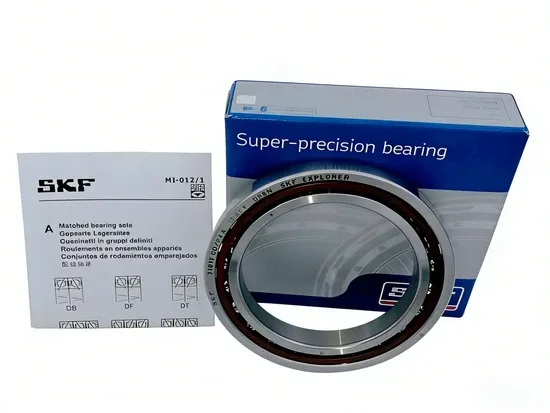
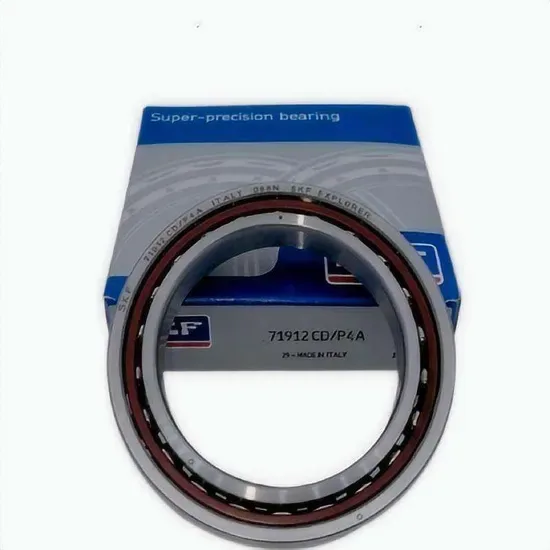
Description
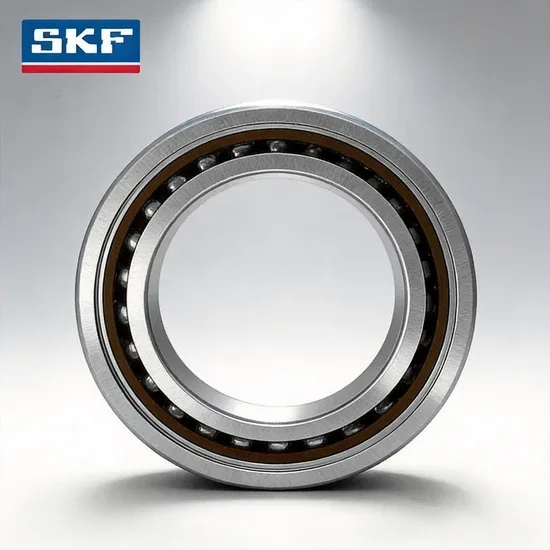
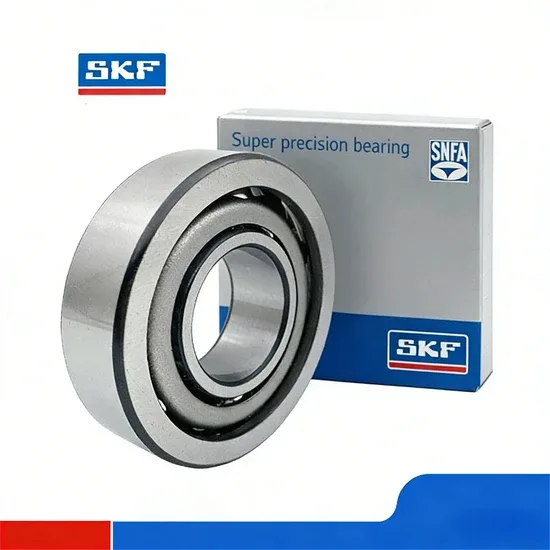
Authorized Channel Sourcing — Every SKF 7020 Cehcp4adga P4 angular contact ball bearing we supply ships with batch-level traceability back to the manufacturer’s distribution records, so your spindle rebuild starts with verified provenance.
Technical Specifications
| Parameter | Value |
|---|---|
| Designation | SKF 7020 Cehcp4adga P4 |
| Bearing Type | Angular Contact Ball Bearing |
| Number of Rows | Single Row |
| Bore Diameter (d) | 100 mm |
| Outside Diameter (D) | 150 mm |
| Width (B) | 24 mm |
| Contact Angle | 15° |
| Precision Class | P4 (ISO 492) |
| Arrangement | Universal Matching, Light Preload (GA) |
| Cage Material | Polyamide or Steel (CE design) |
| Origin | China |
Note: Suffixes H, C (in mid-position), and AD appear in this designation string but their exact meanings require confirmation against the current SKF super-precision catalog. Contact us for full decoding before finalizing your order.
Application Suitability
| Industry | Typical Applications |
|---|---|
| Machine Tool Manufacturing | High-speed milling spindle front support, grinding wheel head bearing set |
| Robotics | Joint actuator precision positioning, collaborative robot wrist axis |
| Precision Equipment | Optical measurement table rotary stage, coordinate measuring machine spindle |
| Industrial Pumps | High-speed centrifugal pump shaft support, compressor rotor positioning |
What Happens When a 15° Contact Angle Meets a 40° Load Profile
A 15° bearing under heavy axial thrust will shed preload within hours, and the spindle it supports will chatter itself into scrap.
I once walked into a workshop where a CNC lathe was producing out-of-tolerance parts on every shift. The maintenance team had replaced the spindle bearings with 7020 units that matched the bore and OD perfectly. What they missed was the contact angle — the OEM drawing specified a 25° variant to handle the combined cutting forces, but the replacement stock was a 15° design. Under sustained axial cutting loads, the contact ellipse migrated to the edge of the raceway, generating localized stress concentrations that accelerated fatigue. Within weeks, vibration levels had doubled and surface finish degraded beyond acceptance [NEED_CITE: angular contact ball bearing failure modes under axial overload per ISO 15243]. The SKF 7020 Cehcp4adga P4 angular contact ball bearing carries a 15° contact angle, which excels in predominantly radial or moderate combined loads at high speeds — but selecting it for heavy thrust applications without verifying the load profile is a shortcut that ends in unplanned downtime.
Spindle Loads, Thermal Growth, and the GA Preload Decision
Machine tool spindles operate across a narrow but punishing envelope: radial cutting forces dominate at high rpm, with axial thrust appearing intermittently during plunge cuts or contouring passes. The SKF 7020 Cehcp4adga P4 angular contact ball bearing delivers its 15° contact geometry specifically for this load spectrum — lower friction heat generation than 25° or 40° alternatives means the spindle reaches thermal equilibrium faster, reducing warm-up cycle time. The GA suffix tells you this unit arrives with universal matching and light preload, which means you can pair it back-to-back or face-to-face without custom shimming. When a customer rebuilding a high-speed machining center sent us their OEM equipment number, we cross-referenced not just the base 7020 designation but confirmed the CE internal design, the P4 tolerance class, and the GA preload matched the original spindle builder’s specification exactly. That level of detail is where substitution errors hide.
Thermal Expansion, Lubrication Decay, and What P4 Tolerance Actually Demands
At sustained spindle speeds, the inner ring expands faster than the outer ring because it sits closer to the heat source. This differential growth consumes internal clearance — and if the bearing started with standard CN clearance in an application that needed C3, you get thermal binding, a rapid temperature spike, and cage failure before the operator notices anything beyond a strange sound [NEED_CITE: thermal expansion effects on bearing internal clearance in high-speed spindle applications]. The P4 precision class of the SKF 7020 Cehcp4adga P4 angular contact ball bearing demands tight control of bore and OD tolerances, but it also assumes the mating shaft and housing are machined to matching precision. A P4 bearing pressed into a housing with P0-grade roundness will not deliver P4-grade running accuracy. Lubrication adds another layer: oil-air or oil-mist systems must be calibrated for the bearing’s speed factor, and grease-lubricated sealed variants need re-lubrication intervals matched to actual operating temperature, not catalog defaults.
Decoding CE, P4, and GA: Why Each Suffix Carries Weight
The CE internal design specifies a 15° contact angle with optimized raceway geometry, balancing load capacity against friction for high-speed rotation. This geometry produces a smaller contact ellipse than higher-angle variants, which reduces sliding friction and keeps operating temperatures lower during sustained high-rpm operation. The P4 tolerance class, defined under ISO 492, governs dimensional accuracy of the bore, OD, and width, as well as running accuracy including radial and axial runout — critical parameters when the bearing sits at the front of a spindle where any deviation transfers directly to the cutting tool tip. The GA designation indicates universal matching with light preload, meaning the bearing pair is manufactured so that any two units can be assembled in back-to-back, face-to-face, or tandem configuration and achieve the specified preload without selective fitting. Light preload suits applications where speed generates significant centrifugal force on the rolling elements, as heavier preload would compound the internal loading and accelerate fatigue.
The Hidden Expense of Ignoring the Suffix String
Procurement teams often match the base number — 7020 — and consider the job done. But a 7020 with a polyamide cage rated for moderate speeds is not interchangeable with a 7020 carrying a machined brass cage built for sustained high-speed thermal loading. A P5 bearing substituted where P4 was specified may fit the housing, but its running accuracy will not hold the tolerances the spindle designer relied on for surface finish and dimensional control. Counterfeit bearings compound this problem: soft inner rings that pass visual inspection but deform under load, cloned QR codes that redirect to fraudulent verification pages, and packaging that mimics authorized distribution materials down to the holographic seals [NEED_CITE: counterfeit bearing identification methods and supply chain infiltration risks]. The real cost is not the bearing price — it is the scrapped workpieces, the missed delivery deadlines, and the spindle rebuild that takes a machine offline for days.
How Our Sourcing Process Protects Your Spindle Rebuild
Every SKF 7020 Cehcp4adga P4 angular contact ball bearing we supply enters through authorized distributor channels, not parallel imports or surplus stock of unknown provenance. We provide batch and lot traceability documentation that links your specific units back to the manufacturer’s production records, so you can verify origin independently. Our cross-reference database does not stop at the base designation — we align clearance class, cage material, precision grade, and preload specification before confirming interchangeability with NSK, FAG, or NTN equivalents. When a mining equipment MRO manager needed to substitute a discontinued variant, we mapped the full suffix string and identified a compatible alternative that maintained the 15° contact angle and P4 precision without compromising the preload arrangement. Country-of-origin documentation accompanies every shipment for customs clearance and buyer-side verification, and we guide customers through the QR code verification pathway using the brand’s official mobile application before installation begins.
Documentation & Authenticity
- Certificate of Conformity issued through authorized SKF distribution channels, referencing the specific batch and lot numbers assigned to your SKF 7020 Cehcp4adga P4 angular contact ball bearing units
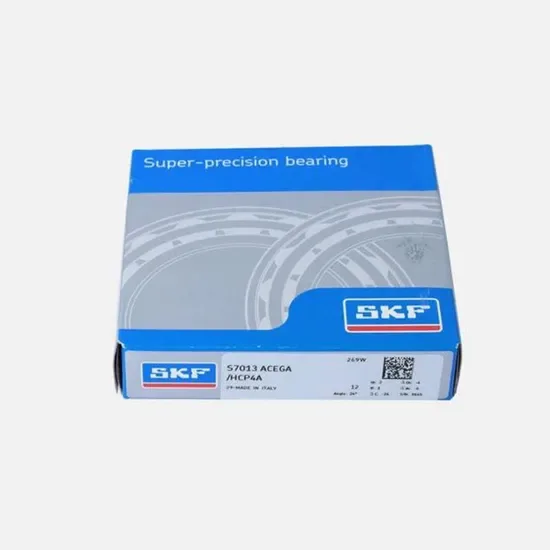
- QR code verification guidance using SKF’s official mobile application, confirming authenticity before the bearing leaves the storeroom
- Dimensional inspection reports verifying P4-class running accuracy including radial and axial runout measurements for each unit in the matched set
- Country-of-origin documentation with HS code classification supporting import clearance for buyers in the Middle East, Africa, Latin America, and Central Asia
- Material certificates confirming bearing steel specification and heat treatment compliance for the rings and rolling elements
Storage, Handling & Mounting
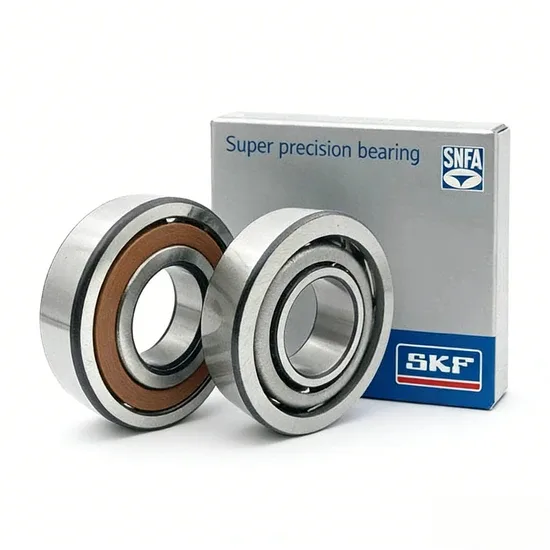
- Keep the GA-matched set in its original sealed packaging until the moment of mounting — premature opening exposes the factory-lapped contact faces to particulate contamination that compromises the light preload interface
- Store P4-precision angular contact bearings in a temperature-stable environment away from direct sunlight, as thermal cycling before installation can affect the residual preload established during universal matching
- Handle the 100 mm bore inner ring with clean, lint-free gloves to prevent fingerprint corrosion on the precision-ground raceway surface, which is especially vulnerable during the window between unboxing and press fitting
- During back-to-back or face-to-back assembly, align the V-markings etched on the outer ring faces by the manufacturer — these indicate the high points of eccentricity and must be positioned 180° apart in DB arrangement or coincident in DF arrangement to minimize assembled runout
- For oil-air lubricated spindle installations, confirm the air pressure and oil flow rate match the speed factor demands of the CE internal design before first startup, as insufficient lubricant delivery at high rpm will cause cage wear within the first operating shift
Start Your Technical Verification
Share your spindle model number or application parameters — speed range, load spectrum, operating temperature, and lubrication method — so we can confirm the SKF 7020 Cehcp4adga P4 angular contact ball bearing is the correct match for your rebuild. If you are cross-referencing from a competitor designation, provide the full suffix string so we can verify contact angle, cage type, precision class, and preload alignment before quoting. Request the documentation package including Certificate of Conformity and country-of-origin papers to satisfy your procurement audit requirements.
Frequently Asked Questions
Q: How do I verify that my SKF 7020 Cehcp4adga P4 angular contact ball bearing is genuine before installation?
A: Scan the QR code on the packaging using the SKF Authenticate app, which connects to the manufacturer’s database and confirms the product’s origin and distribution path. Cross-check the batch number printed on the box against the Certificate of Conformity provided with your shipment. Look for consistent print quality on the bearing marking — genuine P4-class bearings show laser-etched designation text with sharp, uniform character depth.
Q: What does the GA preload mean for my spindle assembly process?
A: GA indicates universal matching with light preload, which means any two bearings from the same GA production set can be paired in back-to-back or face-to-face arrangement without selective fitting or custom shimming. This simplifies spindle rebuilds significantly, but the light preload class is specifically chosen for applications where high rotational speed generates centrifugal loading on the balls — substituting a heavier preload (GB or GC) in the same speed range would overload the contact zone.
Q: Why can’t I just match the 7020 base number when cross-referencing to another brand?
A: The base number defines only the bore, OD, and width. The suffixes carry the engineering decisions: contact angle, cage material, precision class, and preload. A 7020 with a 25° contact angle and brass cage behaves entirely differently from the SKF 7020 Cehcp4adga P4 angular contact ball bearing with its 15° CE design and P4 tolerance — installing the wrong variant in a high-speed spindle will produce thermal imbalance and premature failure.
Q: What does the CE suffix tell me about this bearing’s internal geometry?
A: CE designates a 15° contact angle with optimized internal geometry designed for high-speed operation under predominantly radial loads. The raceway curvature and ball-to-groove conformity are tuned to reduce friction heat compared to standard C-design bearings, making the CE variant suitable for machine tool spindles where thermal stability directly affects machining accuracy.
Q: Is P4 precision necessary for every angular contact bearing in my equipment?
A: No. P4 is specified where running accuracy directly affects product quality — typically spindle front bearings, precision rotary tables, and measurement equipment. For support bearings on the non-tool end of a shaft, or for general industrial gearboxes, P5 or P0 may be entirely adequate. Overspecifying precision adds cost without improving system performance.
Confirm Your Spindle Bearing Specification Today
Send us your OEM equipment number or application parameters and we will return a full technical verification with cross-reference comparison and documentation package within one business day. Contact our engineering team through your existing supplier channel or submit an inquiry with your load, speed, and temperature data for immediate review.