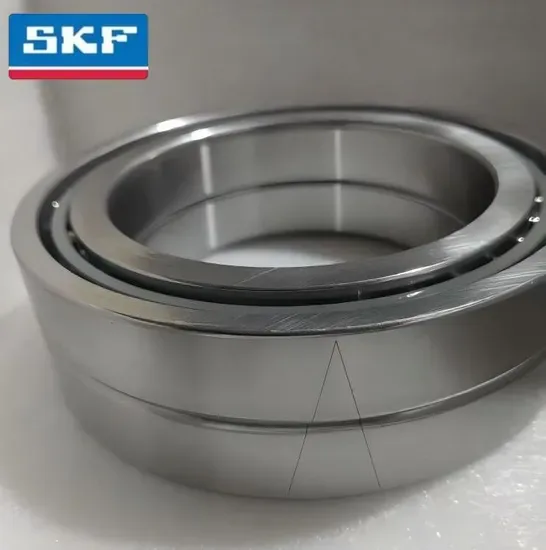
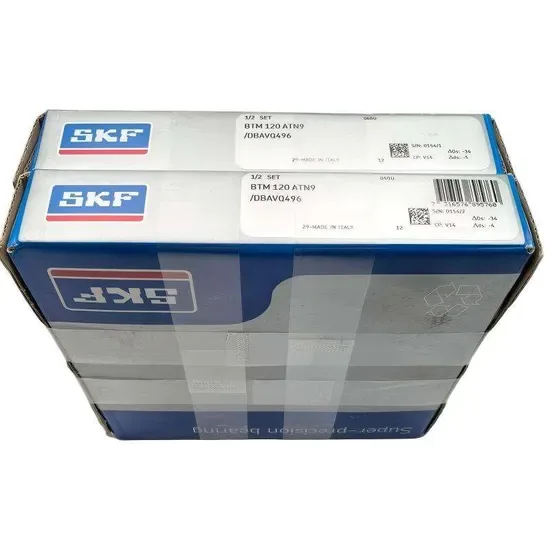
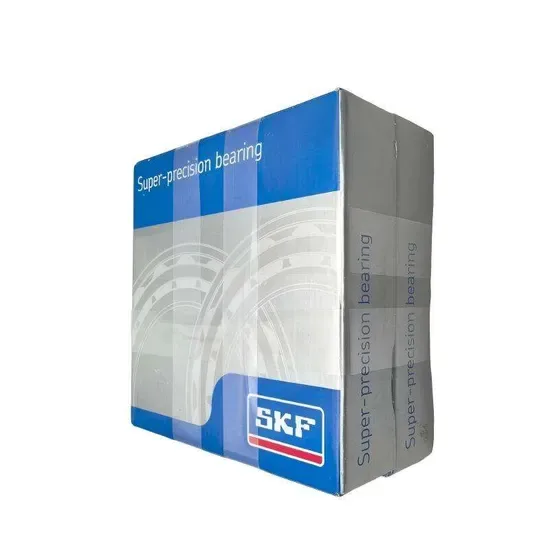
Description
Traceable Precision Lots — Every SKF BTW 65 CTN9/SP we ship carries batch-level paperwork back to the manufacturer’s production run, so your spindle rebuilds stay documented from crate to commissioning.
Technical Specifications
| Parameter | Value |
|---|---|
| Designation | SKF BTW 65 CTN9/SP |
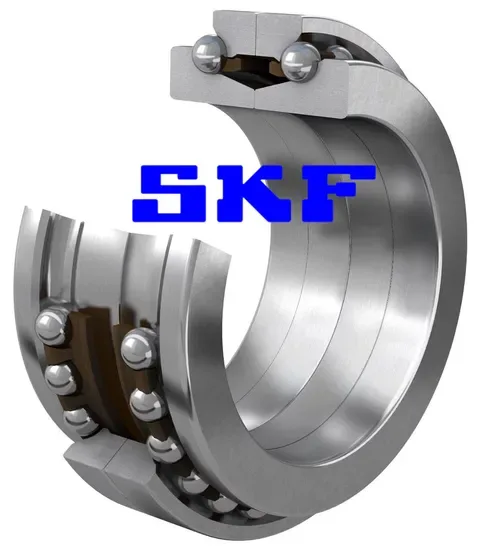
| Bearing Type | Double Direction Angular Contact Thrust Ball Bearing |
| Bore Diameter (d) | 65 mm |
| Outside Diameter (D) | 100 mm |
| Width (H) | 44 mm |
| Dynamic Load Rating (C) | 31900 N |
| Static Load Rating (C₀) | 90000 N |
| Fatigue Load Limit (Pu) | 4300 N |
| Limiting Speed (Grease) | 7000 r/min |
| Limiting Speed (Oil-air) | 8500 r/min |
| Cage Material | Glass Fiber Reinforced Polyamide 6,6 (TN9) |
| Contact Angle | 15° |
| Precision Class | SP |
| Arrangement | Double Direction, Non-Separable |
| Number of Rows | Two |
| Weight | 1.900 kg |
| Origin | China |
The BTW prefix and /SP suffix denote SKF’s super-precision spindle thrust series; confirm application-specific preload and pairing requirements against the manufacturer catalog before final mounting.
Application Suitability
| Industry | Typical Applications |
|---|---|
| Industrial Machinery | CNC lathe spindle thrust support |
| Precision Equipment | High-speed grinding head axial positioning |
| Robotics | Articulated arm joint axial constraint |
| Material Handling | Automated guided vehicle drive spindle |
What Happens When a BTW 65 Gets Swapped for a Standard Thrust Bearing
A 65 mm spindle running a standard-grade thrust bearing where an SKF BTW 65 CTN9/SP was specified will vibrate its way through workpiece surfaces long before the bearing itself fails audibly.
Precision spindle rebuilds demand more than the right bore and outside diameter. Maintenance teams sourcing replacement thrust bearings frequently match the base designation and stop there, ignoring the SP precision class and the TN9 cage specification. The result is not an obvious seizure — it is chatter marks on aerospace housings, out-of-round tool paths on CNC lathes, and thermal drift that quality inspectors trace back weeks later to a bearing that was dimensionally correct but precision-wrong [NEED_CITE: spindle vibration modes caused by bearing running accuracy deviations per ISO 281]. The counterfeit problem compounds this: soft inner rings pass caliper checks, cloned QR codes scan clean, and the spindle runs fine at idle. Under cutting loads, the runout multiplies.
How This Bearing Fits Spindle Service Cycles
The SKF BTW 65 CTN9/SP sits at the intersection of axial stiffness and rotational speed that defines modern spindle design. A 65 mm bore carrying a 31900 N dynamic rating in a double-direction layout handles the reversing axial loads typical of turning centers where the spindle accelerates, decelerates, and reverses through rigid tapping cycles. The polyamide TN9 cage keeps weight down at the ball-race interface, which matters when oil-air lubrication pushes limiting speeds toward 8500 r/min. When cross-referencing from NSK or FAG equivalents, we match the contact angle, cage type, and precision class simultaneously — not just the 65 × 100 × 44 envelope.
Thermal Load and Lubrication Reality in Spindle Housings
Spindle thrust bearings live inside sealed housings where ambient shop temperature and cutting-fluid heat soak combine unpredictably. The 15° contact angle in this BTW design generates less friction heat than a 25° or 40° variant under predominantly radial-dominant combined loads, but the trade-off is reduced pure axial capacity — a deliberate engineering choice for applications where axial loads are significant but not extreme. Grease lubrication at 7000 r/min limiting speed means regreasing intervals must respect the TN9 cage’s temperature ceiling; polyamide degrades silently above sustained thresholds, and cage pocket wear shows up as intermittent vibration rather than catastrophic failure [NEED_CITE: polyamide cage temperature limits and degradation modes in angular contact bearings]. Oil-air systems extend the envelope but demand clean, dry air supply to prevent moisture ingress through the lubrication port.
Reading the Suffix Stack on a BTW 65
The TN9 cage — injection molded, glass fiber reinforced polyamide 6,6 — is the correct choice for high-speed, moderate-load spindle positions where cage weight directly affects ball guidance stability. A brass cage would handle higher temperatures and shock loads but add mass at the ball-race interface, increasing friction heat at 8500 r/min oil-air speeds. The SP precision class sits between P5 and P4 in SKF’s super-precision hierarchy, delivering tighter bore and outside diameter tolerances plus running accuracy that standard grades cannot reach. The 15° contact angle encoded in the C suffix balances axial rigidity against friction generation — swapping to a higher angle without recalculating the preload stack invites either thermal binding or axial float, depending on direction.
The Downtime Math Behind a Wrong Suffix
An unplanned spindle teardown on a CNC turning center does not just cost the bearing. It costs the fixture re-qualification, the scrapped batch that ran between the last good part and the first chatter-marked one, and the expedited freight on the replacement. ISO 15243 classifies bearing failures into six root-cause categories, and a significant share of premature spindle failures trace back to material and manufacturing defects in counterfeit components or to selection errors where the base number matched but the suffix did not [NEED_CITE: rolling bearing failure mode classification per ISO 15243]. A standard-precision thrust bearing installed in an SP-specified position may survive commissioning but will not survive a production audit.
How We Source and Verify This Bearing
Every SKF BTW 65 CTN9/SP we supply enters through authorized distributor channels with lot-level traceability, not from open-market traders. Our cross-reference database aligns cage material, contact angle, and precision class — not just the numeric envelope — so substitutions from NSK, FAG, or NTN equivalents carry matched suffix logic. When origin documentation matters for import clearance, we provide country-of-origin certificates and HS code support before shipment, not after customs flags the paperwork. Dimensional inspection reports confirm SP-class tolerances on bore, OD, and running accuracy before the crate closes.
Documentation & Authenticity
- Supplier Certificate of Conformity referencing the specific production batch of each BTW 65 CTN9/SP unit shipped
- QR code verification pathway through SKF official mobile applications for on-site authenticity confirmation
- Dimensional inspection report covering bore, outside diameter, and running accuracy consistent with SP precision requirements
- Country-of-origin certificate and HS code documentation packaged for import compliance at destination customs
- Material certificate confirming bearing steel specification and cage material composition
Storage, Handling & Mounting
- Keep the double-direction matched set in original sealed packaging until the spindle housing is prepped and clean; premature exposure risks contamination of the TN9 polyamide cage pockets
- Mount using controlled induction heating of the housing rather than press-fitting on the inner ring, protecting the 15° contact angle geometry from axial distortion during interference fit
- Verify shaft and housing seat tolerances against SP precision requirements before assembly; a standard-machined seat will compromise running accuracy regardless of bearing grade
- For oil-air lubricated spindles, confirm supply line cleanliness and moisture separation before connecting; water contamination degrades polyamide cages silently over hundreds of hours
- Store flat in original packaging at stable temperature; vertical stacking of large-diameter precision bearings risks raceway brinelling under static load
Request a Matched Quotation
Share your spindle model, operating speed range, and lubrication method so we can confirm whether the SKF BTW 65 CTN9/SP fits your application or whether a different contact angle or cage specification is warranted. If you are cross-referencing from an OEM equipment number, provide that alongside your current bearing marking and we will return a suffix-verified interchange recommendation with lead time and documentation scope.
Frequently Asked Questions
Q: What does the SP precision class mean compared to standard P5 or P4 bearings?
A: SP is SKF’s designation for super-precision bearings designed specifically for machine tool spindles, with tolerance zones on bore, outside diameter, and running accuracy that fall between ISO P5 and P4. The distinction matters in spindle applications where thermal growth and vibration amplitude are directly tied to bearing manufacturing precision.
Q: Can I substitute a 40° contact angle bearing in place of this 15° BTW 65 CTN9/SP?
A: A higher contact angle increases axial load capacity but raises friction heat generation at speed. In a spindle originally designed around 15° geometry, swapping to 40° without recalculating preload and lubrication intervals risks thermal binding during sustained high-speed operation.
Q: How do I verify this bearing is genuine SKF and not a counterfeit?
A: Genuine SKF bearings carry scannable QR codes that link to the manufacturer’s official verification system. We supply each unit with batch-level traceability documentation and can guide your receiving team through the verification process using SKF’s official mobile application.
Q: What are the temperature limits for the TN9 polyamide cage?
A: Glass fiber reinforced polyamide 6,6 cages have upper continuous operating temperature thresholds above which mechanical properties degrade. For specific temperature limits and derating guidance in your spindle’s thermal environment, request the manufacturer’s application data sheet with your inquiry.
Q: Do you provide cross-reference recommendations from NSK or FAG for this bearing?
A: Yes. Our cross-reference matching covers SKF, NSK, FAG, TIMKEN, NTN, and KOYO equivalents, aligning not just the base dimensions but the contact angle, cage material, clearance, and precision class so the substitution performs identically in your spindle application.
Send Us Your Spindle Parameters
Share your application speed, load profile, and OEM equipment number — we return a suffix-verified recommendation with full documentation scope and current batch availability.