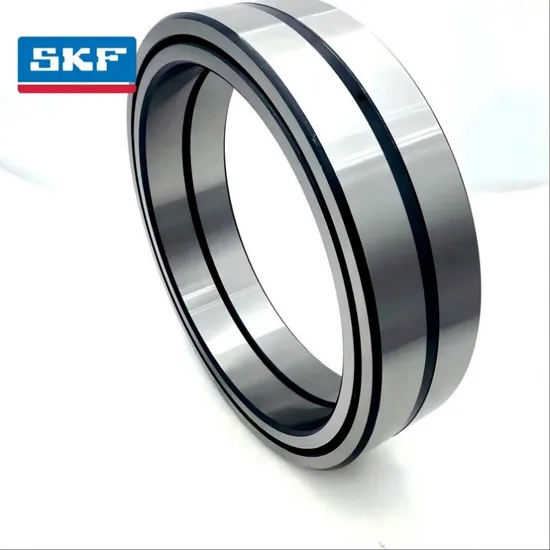
Description
Authorized Sourcing — Traceable procurement channels verified by batch-specific documentation accompanying every SKF NN3017 TN9/SPW33 double row cylindrical roller bearing dispatched from our facility.
Technical Specifications
| Parameter | Value |
|---|---|
| Designation | SKF NN3017 TN9/SPW33 |
| Bearing Type | Double Row Cylindrical Roller Bearing |
| Bore Diameter (d) | 85 mm |
| Outside Diameter (D) | 130 mm |
| Width (B) | 34 mm |
| Number of Rows | Double Row |
| Cage Material | TN9 — injection molded glass fiber reinforced polyamide 6,6 |
| Precision Class | SP (Super Precision) |
| Lubrication Features | W33 — lubrication groove and three holes in outer ring |
| Bore Type | Cylindrical |
| Origin | China |
| Weight | 0.100 kg |
Note: The SPW33 suffix combination includes W33 for lubrication features; specific dimensional variations beyond standard catalog data require manufacturer catalog confirmation before final application approval.
Application Suitability
| Industry | Typical Applications |
|---|---|
| Machine Tool Manufacturing | High-speed spindle radial support requiring thermal stability |
| Industrial Machinery | Precision gearbox shaft positioning under combined loading |
| Steel and Metallurgy | Continuous caster roll guide positions with sustained radial loads |
What a Precision Mismatch Costs on a High-Speed Spindle
The digits match the drawing, but the suffix tells a different story.
I watched a steel mill in the Middle East install a standard NN 3017 into a continuous caster roll position that specified SP precision with W33 lubrication. Same base number, wrong suffix. Three weeks later, vibration readings spiked, temperature alarms triggered, and the line shut down for unplanned maintenance. The mill lost more production tonnage in that single outage than the cost difference between the correct and incorrect bearing would have been. This happens because procurement teams match the base designation but overlook clearance class, cage material, and precision suffixes — leading to thermal binding or premature cage failure in field conditions where tolerance stackup matters. [NEED_CITE: rolling bearing failure mode classification per ISO 15243]
Matching the SKF NN3017 TN9/SPW33 to Spindle Operating Conditions
This bearing’s double row cylindrical roller design delivers the radial stiffness that high-speed machine tool spindles demand, while the TN9 polyamide cage reduces weight and friction heat generation compared to brass alternatives. When a European gearmotor manufacturer needed to upgrade their precision grinding spindle bearings, we cross-referenced their OEM equipment number, verified the SP precision requirement against their speed envelope, and confirmed the W33 lubrication groove matched their oil-air delivery system. The SKF NN3017 TN9/SPW33 double row cylindrical roller bearing arrived with complete batch traceability, eliminating the guesswork that causes field failures in critical applications.
Operating Environment and Performance Demands
The radial loads in spindle and gearbox applications remain relatively constant, but thermal expansion from sustained high-speed operation demands careful clearance selection. Standard CN clearance can close up dangerously when inner ring expansion outpaces housing growth, while excessive clearance introduces vibration and reduces stiffness. The SP precision class provides tighter running accuracy than P5 grade bearings, which matters when spindle runout directly affects workpiece surface finish. Lubrication through the W33 outer ring groove ensures consistent oil distribution to both roller rows without requiring disassembly for re-greasing. Installation requires attention to shaft and housing fit tolerances — interference fits that are too tight can collapse the internal clearance entirely. [NEED_CITE: bearing internal clearance reduction due to interference fit]
Decoding the TN9 Cage and SP Precision Designation
The TN9 suffix indicates an injection molded, glass fiber reinforced polyamide 6,6 cage — a material choice that reduces cage weight and inertia, allowing faster acceleration and lower friction heat generation compared to machined brass cages. This makes TN9 cages particularly suited to applications where speed matters more than extreme shock loads. The SP precision class sits above P5 and approaches P4 levels of dimensional and running accuracy, which translates to reduced vibration signatures and improved rotational precision in spindle applications. The W33 lubrication feature — a groove with three radial holes in the outer ring — solves the problem of getting lubricant to both roller rows in double row designs where space constraints prevent traditional re-lubrication paths.
The Hidden Cost of Substituting Standard Precision for SP Class
When maintenance teams substitute a standard P0 or P6 precision bearing for an SP-specified position to save cost or reduce lead time, they invite failures that don’t show up immediately. The bearing spins, loads carry, and initial vibration readings look acceptable. But within weeks or months, the accumulated runout errors generate heat, accelerate cage wear, and create particle contamination that cascades into catastrophic spindle damage. ISO 281 life calculations assume proper precision matching — when you install a bearing that doesn’t meet the original specification, you void those life predictions entirely. The unplanned downtime, emergency freight for replacement parts, and scrapped workpieces from out-of-tolerance machining dwarf any initial savings. [NEED_CITE: ISO 281 bearing life calculation assumptions]
Why Procurement Engineers Source Through Our Authorized Channels
Every SKF NN3017 TN9/SPW33 double row cylindrical roller bearing we supply comes with documentation that traces back to the manufacturer’s authorized distributor network — not secondary market sources where authenticity becomes questionable. We provide Certificate of Conformity paperwork with batch and lot numbers that you can verify through SKF’s official QR code validation tools, not just supplier-issued certificates that can be cloned. Our cross-reference database doesn’t just match base numbers; we verify that clearance class, cage material, precision grade, and lubrication features all align with your application requirements. When import documentation requires country-of-origin certification for customs clearance, we provide the paperwork proactively rather than scrambling after your shipment gets held at port. For applications where thermal expansion, vibration limits, or speed envelopes push standard selections, our technical team reviews your operating parameters before quoting — catching specification mismatches before they become field failures.
Documentation & Authenticity
- Certificate of Conformity (COC) with batch and lot traceability numbers that cross-reference to SKF’s production records, not generic supplier paperwork.
- QR code verification pathway through SKF official mobile applications, allowing your receiving inspection to confirm authenticity before the bearing leaves the shipping box.
- Country-of-origin documentation prepared for import compliance, including HS code classification support to prevent customs delays at your destination port.
- Third-party dimensional inspection reports available upon request, confirming bore diameter, outside diameter, width, and radial internal clearance meet SP precision tolerances before shipment.
- Material certificates documenting the steel grade and heat treatment condition of inner and outer rings, traceable to the original mill test reports.
Storage, Handling & Mounting
- Maintain original sealed packaging until mounting — the TN9 polyamide cage can absorb moisture from humid storage environments, which affects dimensional stability during the critical installation phase.
- Control storage temperature between 10°C and 30°C to prevent condensation inside the packaging; thermal cycling can compromise the corrosion protection on the precision-ground SP class surfaces.
- Use clean, lint-free gloves when handling the bearing — fingerprint acids and particulate contamination on the SP precision raceways create initiation points for surface distress under load.
- Verify shaft and housing fit tolerances before installation — the cylindrical bore requires specific interference fit ranges to maintain internal clearance without collapsing the roller-to-raceway contact geometry.
- Confirm W33 lubrication groove orientation during mounting to ensure the oil delivery system aligns with the outer ring holes; misalignment blocks lubricant flow to one roller row.
- Avoid impact loading during installation — polyamide cages, while durable in operation, can crack if subjected to hammer blows or improper pressing forces during the mounting process.
Technical Inquiry and Cross-Reference Verification
Share your application parameters — operating speed, radial and axial loads, temperature range, and lubrication method — so we can confirm the SKF NN3017 TN9/SPW33 double row cylindrical roller bearing matches your requirements or identify if a different suffix combination serves better. If you’re replacing an existing bearing, provide the OEM equipment number or the full designation from the bearing you’re replacing, including all suffixes, so we can cross-reference against our interchange database and verify dimensional compatibility. Request our documentation package sample to review the Certificate of Conformity format, QR verification process, and country-of-origin paperwork before committing to a production order. Confirm current batch availability and lead time for your required quantity, as precision class bearings often have longer procurement cycles than standard grades.
Frequently Asked Questions
Q: How do I verify the authenticity of an SKF bearing using the QR code?
A: Download SKF’s official mobile application, scan the QR code on the bearing packaging or the bearing itself if marked, and the app will confirm whether that batch number exists in SKF’s production database. Counterfeit bearings often have cloned QR codes that lead to fake verification websites rather than SKF’s official validation servers.
Q: What’s the difference between TN9 polyamide cages and brass cages in cylindrical roller bearings?
A: TN9 cages are lighter, generate less friction heat, and allow higher speed operation compared to brass cages. However, brass cages tolerate higher shock loads, elevated temperatures above 120°C continuous, and certain aggressive lubricants better than polyamide. The choice depends on your specific speed, temperature, and load profile.
Q: Why does precision class matter if the bearing fits and spins?
A: Standard P0 precision bearings have wider dimensional tolerances that create runout, vibration, and uneven load distribution across rollers. In precision spindle applications, this translates to poor surface finish, accelerated wear, and thermal growth that closes internal clearance — none of which appear immediately but cause premature field failures.
Q: Can I substitute a different brand bearing if SKF lead times are too long?
A: Cross-brand substitution requires matching not just the base number but also clearance class, cage material, precision grade, and lubrication features. We maintain interchange databases that verify these parameters align across SKF, NSK, FAG, NTN, and other major brands before recommending alternatives.
Q: What documentation do I need for customs clearance when importing bearings?
A: Requirements vary by country, but typically include Certificate of Origin, commercial invoice with HS code classification, packing list, and sometimes material certificates or conformity declarations. We prepare country-specific documentation packages based on your destination port requirements.
Technical Review Request for Your Application
Provide your operating parameters or OEM equipment number to initiate technical selection review and cross-reference verification.
Contact: sales@company.com | WeChat: +86-xxx-xxxx-xxxx