


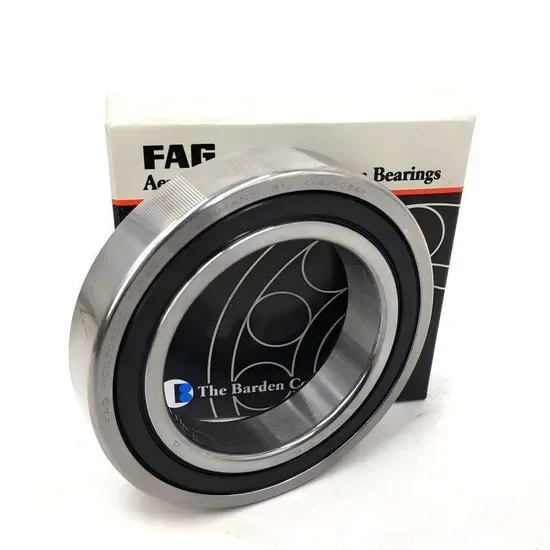
Description
Batch-Traceable Sourcing — Every FAG B71905-C-T-P4S spindle bearing ships with Certificate of Conformity tied to production lot numbers, supporting import audits and buyer verification across borders.
Technical Specifications
| Parameter | Value |
|---|---|
| Designation | FAG B71905-C-T-P4S |
| Bearing Type | Angular Contact Ball Bearing |
| Bore Diameter (d) | 25 mm |
| Outside Diameter (D) | 42 mm |
| Width (B) | 9 mm |
| Number of Rows | Single Row |
| Precision Class | P4S (ISO tolerance class 4 with enhanced running accuracy) |
| Contact Angle | 15° (C suffix) |
| Cage Material | Phenolic resin, outer-ring guided (T suffix) |
| Arrangement | Single bearing, universal pairing |
| Bore Type | Cylindrical |
| Origin | China |
| Weight | 0.040 kg |
Suffixes 19 and B in the designation string remain unverified against current manufacturer catalog editions and should be confirmed during the inquiry stage.
Application Suitability
| Industry | Typical Applications |
|---|---|
| Machine tool manufacturing | CNC milling spindle nose position, precision grinding wheel headstock |
| High-speed precision equipment | High-frequency motorized spindle front support, PCB drilling spindle |
| CNC machining centers | Vertical machining center spindle cartridge, lathe live tooling spindle |
What Happens When a P4 Spindle Bearing Arrives With the Wrong Contact Angle
A 15° bearing forced into a 25° preload stack will over-constrain within hours, not weeks.
I once watched a Dongguan CNC shop reject an entire spindle rebuild because the supplier matched the base designation but shipped 25° contact angle bearings where 15° units were specified. The spindle ran hot within days, chatter marks appeared on aluminum workpieces, and the operator blamed the machine. The root cause was a cross-reference error — someone substituted a contact angle variant without updating the preload calculation. [NEED_CITE: angular contact bearing preload mismatch consequences in spindle applications] In precision spindle work, a contact angle swap is never a drop-in replacement. The axial stiffness profile changes, the preload force redistributes unevenly across the ball set, and thermal growth compounds the error until the cage reaches its fatigue limit prematurely.
Matching the 25mm Spindle Envelope to Real Cutting Loads
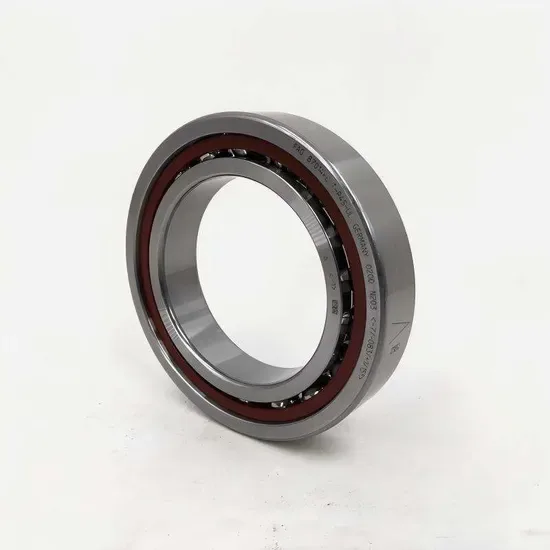
The FAG B71905-C-T-P4S angular contact ball bearing occupies the 25mm bore by 42mm OD envelope common in compact CNC spindles and high-speed motorized units. Its 15° contact angle positions it for applications where radial loads dominate and axial thrust from tool engagement stays moderate — think aluminum milling, PCB routing, or finish-grinding heads. We typically see this size paired in back-to-back or face-to-face arrangements, and our cross-reference checks confirm cage material, precision suffix, and contact angle alignment before any substitution reaches the quotation stage.
Thermal, Speed, and Contamination Realities at the Spindle Nose
At the speeds these 25mm-bore spindles operate, even small temperature differentials between the inner ring and shaft create interference-fit migration. The phenolic resin cage — indicated by the T suffix — keeps friction low and resists the centrifugal forces that would deform a stamped steel alternative at equivalent RPM. Oil-air or oil-mist lubrication is standard here; grease-packed sealed variants serve different duty cycles entirely. [NEED_CITE: phenolic resin cage performance limits in high-speed spindle bearings] Contamination control starts at assembly: a single metal particle trapped between ball and raceway in a P4-class bearing leaves an indentation that propagates into spalling within the first hundred hours of operation.
Reading the Suffix Stack on This Spindle Bearing
The C suffix locks the contact angle at 15°, optimized for radial-dominant load paths in precision spindle front positions. The T designation confirms a phenolic resin, outer-ring-guided cage — the standard choice for high-speed angular contact bearings in this size range, balancing low friction with adequate ball guidance at elevated RPM. P4S precision goes beyond standard P4 tolerance boundaries, adding tighter running accuracy limits that directly affect surface finish on machined parts. Together, these suffixes define a bearing built for situations where spindle runout translates directly into workpiece rejection. [NEED_CITE: ISO 492 tolerance class 4 running accuracy requirements for machine tool spindles]
The Downtime Math Behind a Wrong Suffix Swap
Installing a standard P5 angular contact bearing in a position engineered for P4S precision does not produce gradual degradation — it produces scrap parts and unplanned downtime. ISO 15243 classifies the resulting failure modes under geometric stress and material fatigue, both accelerated by the runout and vibration that lower-precision components introduce. [NEED_CITE: bearing failure classification per ISO 15243 in precision applications] Counterfeit bearings with soft inner rings and cloned QR codes add another failure vector: they may pass dimensional inspection at receiving but fail under thermal cycling because the case-hardening depth does not meet specification. The cost of one scrapped spindle rebuild dwarfs the savings from an unverified source.
How Verification Works Before This Bearing Leaves Our Warehouse
We source the FAG B71905-C-T-P4S angular contact ball bearing through authorized distributor channels, not gray-market aggregators. Each unit carries batch traceability documentation tied to the manufacturer’s production records. Our cross-reference database checks every substitution request against contact angle, cage material, and precision class simultaneously — not just the base number. Buyers receive origin documentation and HS code support for import compliance, and we guide verification through the brand’s official app QR pathway so receiving departments can confirm authenticity independently before the bearing enters inventory.
Documentation & Authenticity
- Supplier Certificate of Conformity referencing the FAG B71905-C-T-P4S batch and lot number for full production traceability
- Dimensional inspection report confirming P4S running accuracy tolerances on bore, OD, and radial runout before dispatch
- QR code verification pathway through the official FAG app, enabling receiving teams to confirm authenticity on arrival
- Country-of-origin documentation and HS code declarations supporting customs clearance for international spindle component imports
- Material certificate available upon request, confirming bearing steel grade and heat treatment compliance
Storage, Handling & Mounting
- Keep the FAG B71905-C-T-P4S in its original sealed packaging until mounting day; early exposure risks moisture contamination on the phenolic resin cage, which absorbs humidity differently than metal components
- Store flat in a temperature-stable environment; the 42mm OD and thin-section 9mm width make this bearing susceptible to distortion if stacked under heavier inventory
- Handle with lint-free gloves only — fingerprint residue on P4S-class raceways creates localized corrosion initiation points visible only under magnification after thermal cycling begins
- For paired spindle arrangements, maintain factory pairing marks and mounting orientation; the 15° contact angle requires correct axial loading direction during press-fit to avoid brinelling the raceway
- Confirm shaft and housing tolerances match P4 precision requirements before installation; an H5 shaft seat is typically minimum for this tolerance class to prevent inner ring creep under cutting loads
Ready to Verify This Bearing Against Your Spindle Spec
Share your application parameters — spindle speed, cutting load profile, lubrication method, and pairing arrangement — so we can confirm the FAG B71905-C-T-P4S angular contact ball bearing matches your requirements on contact angle, precision, and cage type. If you are working from an OEM equipment number, send it over and we will run the cross-reference check against our interchange database before quoting.
Frequently Asked Questions
Q: How do I verify the authenticity of a FAG B71905-C-T-P4S before installation?
A: Use the official FAG app to scan the QR code on the packaging, which links to production batch records. We also provide a Certificate of Conformity with lot traceability so your receiving team can cross-check documentation independently before the bearing moves to the spindle assembly area.
Q: What does P4S precision mean compared to standard P4 or P5 grades?
A: P4S indicates ISO tolerance class 4 with additional running accuracy specifications that tighten limits on radial runout and axial displacement beyond standard P4 boundaries. This matters in spindle applications where every micron of runout transfers directly to workpiece surface finish.
Q: Can I substitute a 25° contact angle bearing for this 15° C-suffix unit in my spindle?
A: Not without recalculating the entire preload arrangement. A contact angle change alters axial stiffness, load distribution across the ball set, and thermal growth behavior. We verify contact angle alignment as part of every cross-reference check before confirming interchangeability.
Q: What documentation do I need to import this precision bearing?
A: Country-of-origin certificates, HS code declarations, and commercial invoices with full designation and batch numbers are standard. We prepare origin documentation and import support paperwork as part of the shipment package, tailored to your destination country’s customs requirements.
Q: How do I identify counterfeit spindle bearings that pass casual inspection?
A: Beyond QR verification, check for soft inner rings by attempting a file test on a non-critical surface — genuine bearing steel resists filing while counterfeit case-hardened components yield. Cloned QR codes that redirect to unofficial verification pages are another red flag we train receiving teams to catch. [NEED_CITE: counterfeit bearing detection methods for precision angular contact types]
Secure Your Spindle Bearing With Full Documentation
Send us your OEM equipment number or spindle specification sheet, and we will return a verified cross-reference match with lead time and documentation package details.