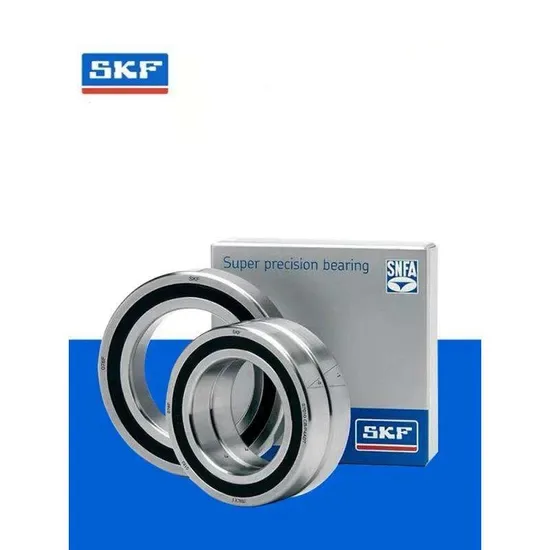
Description
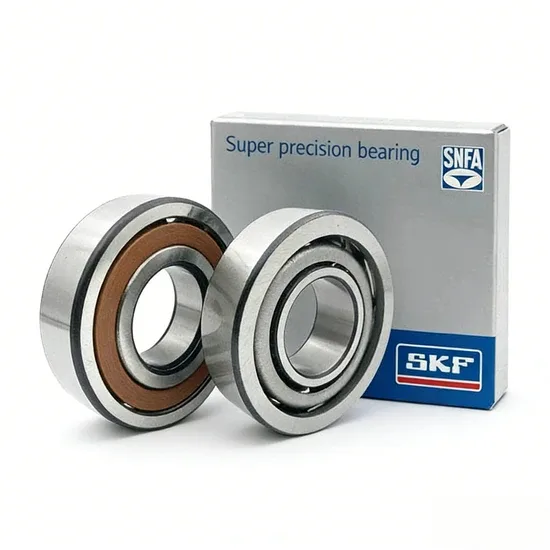
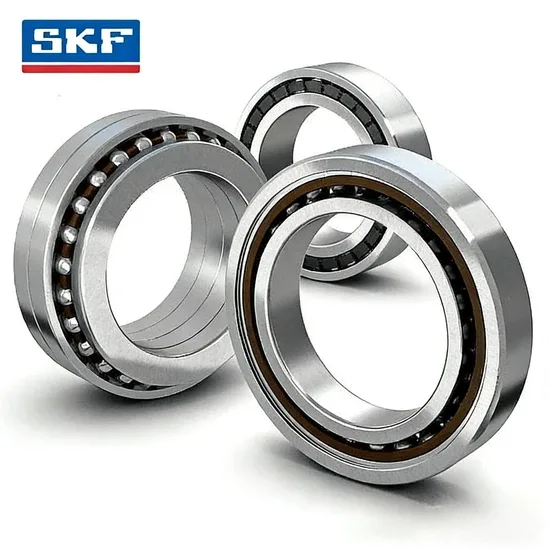
Authorized Channel Sourcing — SKF 7007 FE/HCP4ADDB angular contact ball bearings ship with batch-level traceability tied to the manufacturer’s production facilities.
Technical Specifications
| Parameter | Value |
|---|---|
| Designation | SKF 7007 FE/HCP4ADDB |
| Bearing Type | Angular Contact Ball Bearing |
| Bore Diameter (d) | 35 mm |
| Number of Rows | Single Row |
| Precision Class | P4A (ISO tolerance class 4 with enhanced running accuracy) |
| Contact Angle | 15° |
| Seal or Shield Type | Open |
| Arrangement | DB (Back-to-Back paired set) |
| Weight | 0.100 kg |
| Origin | China |
The FE suffix in this identifier remains unverified against the standard SKF suffix catalog; its exact functional meaning should be confirmed with the manufacturer before final procurement.
Application Suitability
| Industry | Typical Applications |
|---|---|
| Machine tool manufacturing | High-speed spindle main shafts, grinding wheel heads |
| Precision equipment | Optical measuring instrument rotary tables, CMM spindle drives |
| Industrial pumps | High-speed pump impeller shafts, multistage centrifugal pump guides |
| Robotics | Joint actuator shafts, articulated arm pivot assemblies |
What a Precision Mismatch Costs on a Spindle Rebuild
A single suffix letter can separate a spindle that runs cool for years from one that chatters within weeks.
I once watched a purchasing team match the base number 7007 for a CNC spindle rebuild and ignore everything after the dash. The replacement arrived as P0 grade with a stamped steel cage. Within seven days the spindle ran hot, chatter marks scored every workpiece, and the shop absorbed unplanned downtime that dwarfed the bearing cost many times over. That failure was not a material defect — it was a selection error, and it happens far more often than maintenance teams admit [NEED_CITE: rolling bearing failure mode classification per ISO 15243]. The SKF 7007 FE/HCP4ADDB angular contact ball bearing exists to eliminate exactly this kind of cross-reference trap.
Matching 15° Contact Geometry to Radial-Dominant Spindle Loads
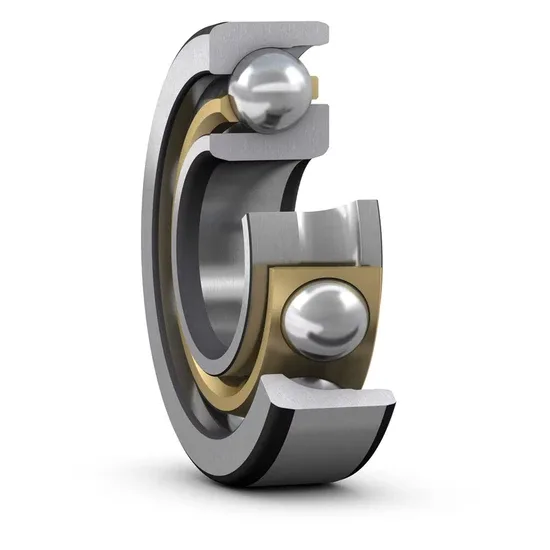
Spindle designers choose a 15° contact angle when the load spectrum is predominantly radial with only light axial thrust from tool clamping or preloading springs. Higher contact angles would generate unnecessary friction heat at the speeds these shafts typically reach. The SKF 7007 FE/HCP4ADDB angular contact ball bearing carries that 15° geometry paired with P4A running accuracy, keeping radial and axial runout within the tight envelope that precision grinding and milling demand. When a buyer asks us to cross-reference this model against an NSK or FAG equivalent, we align contact angle, cage material, and precision class together — not just the bore and outside diameter — so the substitute behaves identically under thermal growth.
Thermal Growth, Preload Drift, and the Open-Design Advantage
At sustained high speed, friction heat raises the inner ring temperature faster than the outer ring can dissipate it through the housing. That differential expansion shrinks internal clearance and pushes preload upward. A 15° contact angle limits how much axial force builds for a given thermal offset, but the open design is what really gives maintenance engineers room to respond: they can select an oil-air or oil-jet lubrication circuit tuned to their exact speed-temperature envelope rather than being locked into a factory grease fill. Sealed variants would trap heat and prevent relubrication entirely [NEED_CITE: bearing thermal management in high-speed spindle design]. Installation practices matter just as much — induction heating must stay below the temperature that would soften the raceway, and cold press-fitting risks brinelling the balls against the precision-ground raceways.
Decoding the Suffixes That Define Performance
The P4A tolerance class meets ISO 492 class 4 dimensional boundaries while adding stricter running accuracy limits than standard P4, which is why spindle builders specify it to hold workpiece surface finish under interrupted cuts. The DB back-to-back arrangement spaces the load reaction points apart, increasing the moment stiffness of the shaft system — essential when overhung cutting tools generate tilting forces. A 15° contact angle produces lower axial stiffness than a 25° or 40° alternative, but it also produces less friction heat, making it the default for high-speed, light-axial-load duty cycles. Open construction means no seals or shields to limit speed or trap contamination inside; the responsibility for external sealing shifts to the housing design.
When the Wrong Suffix Reaches the Machine Floor
A P5 bearing installed where P4A was specified will often pass a spin test on the bench yet generate measurable chatter under cutting loads. Similarly, swapping a back-to-back pair for a tandem set removes the moment-load resistance the spindle was designed around, accelerating raceway fatigue on one side. Counterfeit bearings compound the problem: soft inner rings that pass visual inspection but collapse under preload, and cloned QR codes that redirect to fake verification pages. ISO 281 life calculations assume correct geometry and material; feed the model a wrong precision class or arrangement, and the predicted L10 becomes meaningless long before the shaft stops turning [NEED_CITE: ISO 281 bearing life calculation assumptions].
How Verification Works Before Shipment
Every SKF 7007 FE/HCP4ADDB angular contact ball bearing we quote traces back to authorized distributor channels with documentation that follows the batch from factory gate to destination port. Our cross-reference database checks clearance, cage material, and precision suffix simultaneously, so an NSK or FAG interchange request will never match on bore alone. When a maintenance manager sends us an OEM equipment number, we pull the original specification and flag any suffix divergence before the purchase order is issued. Third-party dimensional and runout inspections are available to confirm P4A compliance independently, and country-of-origin paperwork arrives with the shipment to smooth customs clearance.
Documentation & Authenticity
- Supplier Certificate of Conformity tied to the specific batch lot of this SKF 7007 FE/HCP4ADDB set
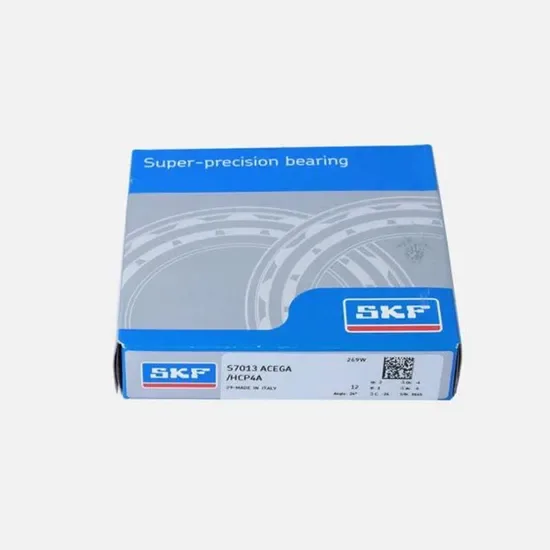
- QR code verification pathway through the SKF Authenticate app for origin confirmation
- Third-party runout inspection report confirming P4A running accuracy tolerances before dispatch
- Material certificate documenting raceway and ball steel grade from the manufacturer’s production facilities
- Country-of-origin documentation and HS code details prepared for import compliance
Storage, Handling & Mounting
- Keep the matched DB pair sealed in original packaging until the moment of installation; premature opening risks losing factory preload pairing marks
- Store horizontally in a climate-controlled area to prevent static deformation of the 35 mm bore inner rings
- Handle with lint-free gloves — fingerprint acids etch P4A-ground raceway surfaces and create corrosion initiation points
- Mount by induction heating of the inner ring only, monitoring temperature to preserve dimensional stability
- Apply the specified oil-air or oil-jet lubrication circuit immediately after mounting since this open design ships without factory grease fill
Request a Technical Quotation
Share your spindle speed, load spectrum, and operating temperature so we can verify that the SKF 7007 FE/HCP4ADDB angular contact ball bearing matches your application parameters. If you are replacing an existing part, send the OEM equipment number or the full designation printed on the old bearing — we will cross-reference clearance, cage, and precision together. Ask for the documentation package up front so you can confirm batch traceability and country of origin before committing to the order.
Frequently Asked Questions
Q: How do I verify SKF bearing authenticity after delivery?
A: Scan the QR code on the packaging using the SKF Authenticate mobile app. The app checks the code against the manufacturer’s database and flags cloned or duplicated labels. Keep the batch lot number from the box and match it to the Certificate of Conformity supplied with your shipment.
Q: Why must clearance, cage material, and precision suffix all align during cross-referencing?
A: Matching only the base number ignores the thermal and dynamic behavior the suffix defines. A 15° contact angle with a machined cage behaves very differently at high speed than a 25° variant with a stamped cage, even though both carry the 7007 designation. Cross-referencing without suffix alignment risks thermal binding or premature cage failure in the field.
Q: What does the P4A precision class mean compared to P5 or standard P4?
A: P4A meets ISO 492 class 4 dimensional tolerances and adds tighter running accuracy specifications than standard P4. This makes it suitable for spindle applications where even slight runout would mark the workpiece surface. It is a step below P2 (ABEC 9) but considerably tighter than P5 (ABEC 5).
Q: When should I choose a back-to-back DB arrangement over face-to-face DF?
A: DB places the load reaction points farther apart, increasing moment stiffness — the right choice when the shaft experiences tilting forces from overhung tools or pulleys. DF narrows the reaction points, offering better tolerance to misalignment but less resistance to moment loads.
Q: What does the FE suffix indicate on this bearing?
A: The FE suffix is not part of the standard published SKF suffix catalog for angular contact ball bearings and should be confirmed directly with the manufacturer or an authorized technical representative before finalizing the order.
Spindle Precision Starts With the Right Suffix
Send your application parameters or OEM part number today — we will return a cross-reference match with full documentation before you commit. Contact our engineering desk through the inquiry form on this page.