
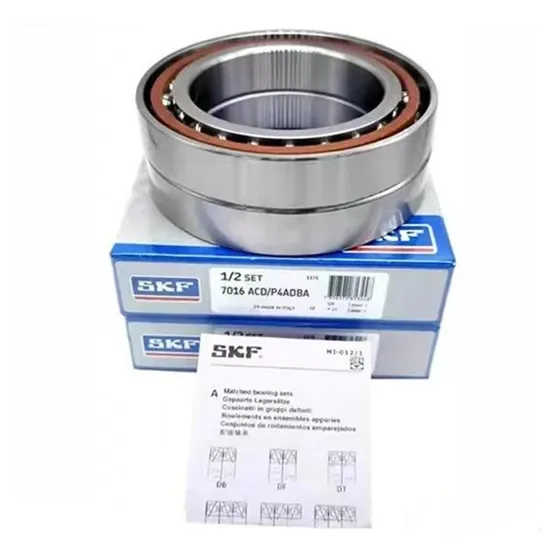
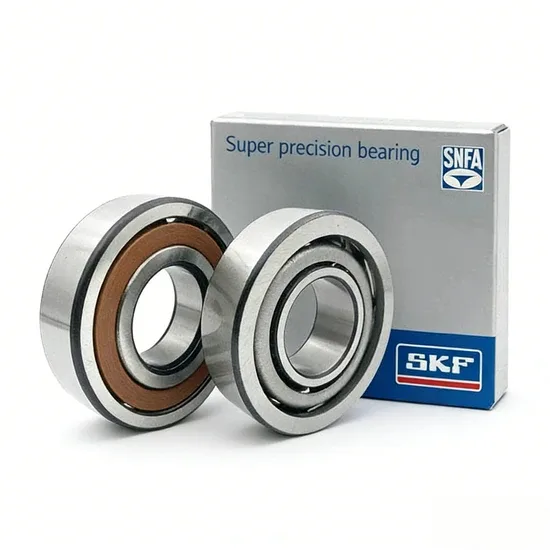
Description
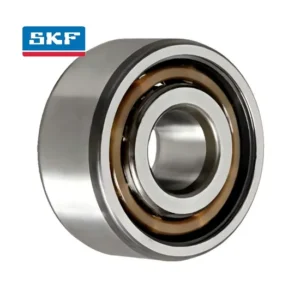
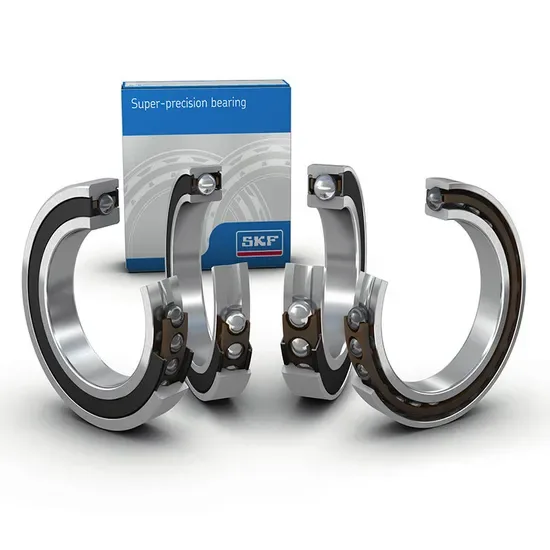
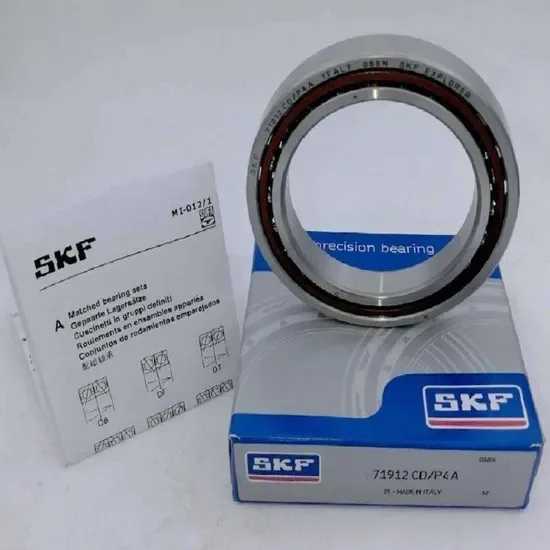
Authorized Distributor Channels — Every SKF 7011ACDGC/P4A angular contact ball bearing we source ships with batch-level traceability and verifiable documentation back to the manufacturer’s production facilities.
Technical Specifications
| Parameter | Value |
|---|---|
| Designation | SKF 7011ACDGC/P4A |
| Bearing Type | Angular Contact Ball Bearing |
| Bore Diameter (d) | 55 mm |
| Outside Diameter (D) | 90 mm |
| Width (B) | 18 mm |
| Contact Angle | 25° |
| Precision Class | P4A (ISO tolerance class 4 with additional running accuracy) |
| Arrangement | Universal matching, heavy preload (GC) |
| Number of Rows | Single Row |
| Weight | 0.100 kg |
| Origin | China |
The GC preload class and cage material designation require manufacturer catalog confirmation; the D suffix within ACDGC follows SKF’s standard ACD contact angle designation with optimized internal geometry.
Application Suitability
| Industry | Typical Applications |
|---|---|
| Industrial Machinery | CNC machining center spindle nose |
| Robotics | High-precision rotary axis joints |
| General MRO | Precision pump drive shaft support |
What Happens When a Spindle Bearing Suffix Gets Ignored
A matched P4A bearing swapped for a P0 substitute will fail before the first scheduled maintenance window.
Years ago, a CNC spindle builder received 7011-series angular contacts matched only on the base number. The supplier overlooked the P4A precision suffix and the GC heavy preload matching entirely. Within weeks, spindle vibration exceeded tolerance thresholds, the cage fractured under high-speed thermal cycling, and the entire production line went down. That kind of failure is not a rare anomaly — [NEED_CITE: bearing failure mode classification per ISO 15243 shows that incorrect specification accounts for a significant share of premature failures in precision spindle applications].
How This Bearing Serves High-Speed Precision Spindles
The SKF 7011ACDGC/P4A angular contact ball bearing is engineered for machine tool spindles where combined radial and axial loads demand both rigidity and running accuracy. Its 25° contact angle balances load capacity in both directions, while the GC universal preload matching eliminates axial play across back-to-back or face-to-face mounting pairs. When a maintenance engineer replaces a failed spindle bearing and specifies only "7011" without confirming the ACD contact angle, the GC preload, and the P4A tolerance class together, the replacement will almost certainly underperform against the original equipment requirement. We cross-reference every suffix against the application envelope before a single unit ships.
Spindle Load Profiles and Thermal Demands
Precision spindles experience continuous radial loads from cutting forces and axial thrust from tool engagement, with the SKF 7011ACDGC/P4A angular contact ball bearing absorbing both simultaneously through its optimized raceway geometry. Operating speeds in this application push thermal limits — the 25° contact angle generates higher axial rigidity at the cost of slightly elevated friction compared to a 15° design, which is the correct tradeoff for heavy cutting operations. Ambient temperature swings and internal heat generation both influence the effective clearance, making the GC heavy preload essential for maintaining stiffness as thermal expansion shifts the internal geometry.
Decoding the Suffix Architecture
The ACD designation specifies a 25° contact angle with optimized internal geometry that maximizes load distribution across the ball-raceway contact patch — this directly supports the high axial rigidity demanded by spindle nose positions. GC universal matching means two bearings can be mounted in any paired configuration (back-to-back or face-to-face) while the factory-set heavy preload maintains zero axial play and suppresses vibration at speed. The P4A class goes beyond standard ISO tolerance class 4 by adding stricter running accuracy requirements, [NEED_CITE: ISO 492 defines tolerance classes but P4A represents SKF’s extended specification for enhanced rotational precision], which directly translates to lower spindle runout at the tool tip.
The Hidden Cost of a Base-Number Match
Sourcing a bearing by its 7011 prefix alone and ignoring the ACDGC/P4A suffix stack routinely leads to unplanned downtime that dwarfs the price difference between a correct and incorrect unit. A standard clearance bearing installed where GC heavy preload was specified will exhibit axial float under cutting loads, producing chatter marks on workpieces and accelerating raceway fatigue. A P0-precision substitute in a P4A application will generate measurable spindle runout that compromises part tolerances across the entire production run. Counterfeit units with cloned markings and substandard inner ring hardness compound the risk — [NEED_CITE: counterfeit bearing exposure in industrial supply chains according to manufacturer industry alerts] — and void equipment warranties upon discovery.
Why Procurement Engineers Source Through Our Channel
We source the SKF 7011ACDGC/P4A angular contact ball bearing through authorized distributor channels with full batch traceability, not through unverified trading layers where product provenance becomes opaque. Every shipment includes documentation that traces back to the manufacturer’s production facilities, supporting import compliance and buyer verification. Our cross-reference database aligns clearance, cage material, and precision suffixes — not just base numbers — so engineers substituting across the SKF, NSK, FAG, TIMKEN, NTN, and KOYO range receive functionally identical replacements. We provide QR code verification pathways via the brand’s official applications so buyers can confirm authenticity independently before installation.
Documentation & Authenticity
- Supplier Certificate of Conformity covering the exact batch and lot numbers for each shipment
- Third-party runout inspection confirming P4A running accuracy thresholds before dispatch
- QR code verification pathway via SKF official apps for on-site authenticity confirmation
- Country-of-origin documentation prepared for import compliance at destination port
- Material certification with chemical composition and hardness data traceable to production melt
Storage, Handling & Mounting
- Keep the GC matched set sealed in original packaging until the moment of mounting; premature opening risks contamination of the precision-matched raceway surfaces on these P4A units
- Use clean lint-free gloves during handling — fingerprint residue on the 55 mm bore can introduce corrosion nuclei that compromise running accuracy over time
- Mount in paired configuration immediately after unsealing, aligning the factory preload marks; rotating one ring relative to its matched partner defeats the GC heavy preload setting
- Verify shaft and housing seat tolerances against P4A requirements before pressing the 90 mm outer ring; interference fits that exceed specification will collapse the internal clearance and cause thermal binding at speed
Requesting a Technical Quotation
Share your spindle application parameters — load spectrum, operating speed range, ambient and internal temperature envelope — so our technical team can confirm that the SKF 7011ACDGC/P4A angular contact ball bearing matches your specification completely. If you are replacing an existing unit, provide the OEM equipment number or the full designation printed on the current bearing side face so we can run a complete cross-reference verification including preload and precision alignment.
Frequently Asked Questions
Q: What happens if I substitute a standard precision 7011 bearing in place of the P4A version?
A: Standard precision (P0) bearings have wider dimensional and running accuracy tolerances. In a spindle application designed around P4A requirements, the substitution will produce measurable runout at the tool tip, leading to dimensional errors on machined parts and accelerated bearing fatigue from uneven load distribution.
Q: Can I pair these GC-matched bearings in any configuration?
A: Yes. The GC universal matching designation means two bearings can be mounted back-to-back, face-to-face, or in tandem without custom shimming. The factory preload is built into the width tolerances of each matched pair.
Q: Why does the 25° contact angle matter compared to a 15° alternative?
A: A 25° contact angle provides higher axial load capacity and rigidity at the cost of slightly increased friction. For spindle applications with significant axial thrust from cutting operations, the 25° ACD design delivers the stiffness needed to suppress vibration under load.
Q: How do I verify the bearing is genuine upon delivery?
A: Each unit carries traceable batch markings and can be verified through the QR code pathway via the SKF official application. We also supply Certificates of Conformity and material documentation with every shipment to support independent confirmation.
Get Your Spindle Back on Schedule
Submit your application parameters or OEM equipment number today and receive a confirmed quotation with lead time and documentation package details.