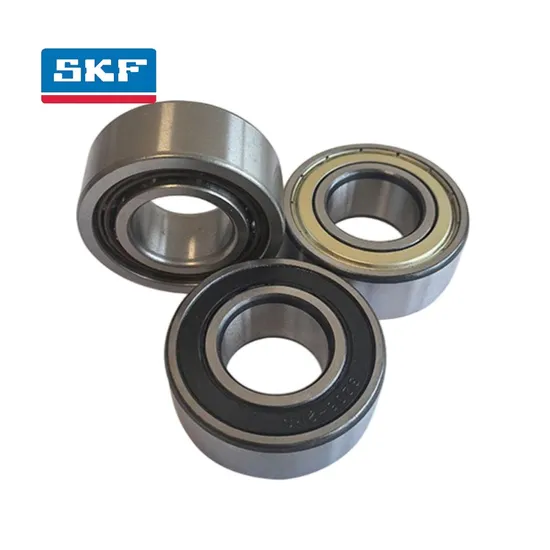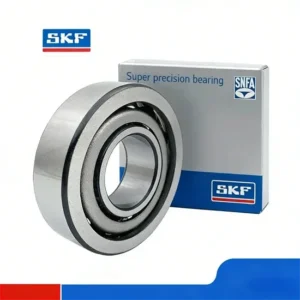

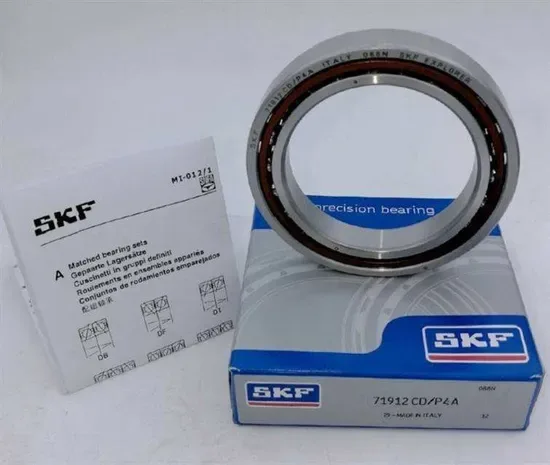
Description
Verified Sourcing Chain — Every SKF 7010 ACE/P4ADGB angular contact ball bearing we dispatch ships with batch-level traceability tied to authorized distributor invoices, ensuring the P4 tolerance certificate matches the physical lot in your hands.
Technical Specifications
| Parameter | Value |
|---|---|
| Designation | SKF 7010 ACE/P4ADGB |
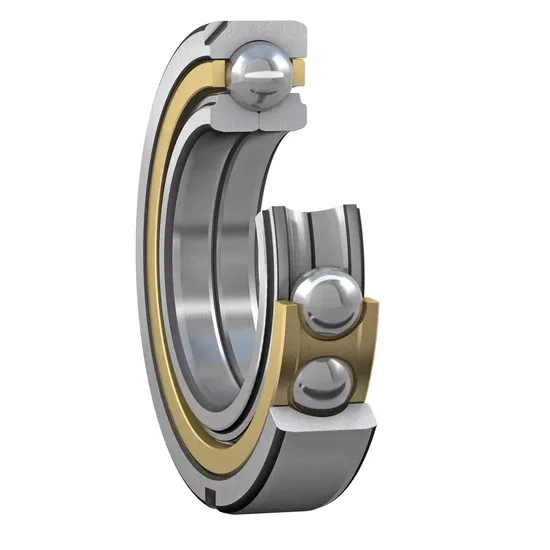
| Bearing Type | Single Row Angular Contact Ball Bearing |
| Bore Diameter (d) | 50 mm |
| Outside Diameter (D) | 80 mm |
| Precision Class | P4 (ISO tolerance class 4) |
| Cage Material | Brass |
| Contact Angle | 25° |
| Arrangement | Universal Matching, Moderate Preload (GB) |
| Number of Rows | Single Row (supplied as matched pair) |
| Origin | China |
Note: Suffix components ‘A’ and ‘D’ within the P4ADGB string require verification against the current SKF super precision catalog to confirm specific internal design or dimensional tolerance variations.
Application Suitability
| Industry | Typical Applications |
|---|---|
| Industrial Machinery | High-speed CNC milling spindle / precision grinding head |
| Robotics | Articulated joint actuator / high-precision rotary table |
| General MRO | High-speed pump drive shaft / turbocharger rotor support |
Spindle Runout and the 25° Contact Angle Advantage
Thermal growth in high-speed spindles demands a contact angle that balances axial rigidity with radial stability.
When procurement teams focus solely on the base 7010 designation, they often miss the critical ACE suffix. Installing a standard 15° (C) bearing in a high-speed machining center where a 25° angle is specified leads to excessive axial play under cutting loads, causing chatter marks on the workpiece and premature cage failure [NEED_CITE: angular contact ball bearing contact angle selection for machine tool spindles]. The brass cage and P4 precision of this SKF 7010 ACE/P4ADGB are not optional upgrades; they are baseline requirements for maintaining micron-level accuracy when the spindle reaches operating temperature.
Matching the Spindle Load Spectrum
High-speed spindles generate a complex load profile: constant radial force from belt or gear drive, combined with intermittent axial thrust during cutting. This SKF 7010 ACE/P4ADGB is engineered to handle that combined load without compromising rotational accuracy. The 25° contact angle provides a steeper load path, increasing axial stiffness compared to 15° variants, which is critical when the tool engages the workpiece. We recently supported a rebuild on a vertical machining center where the original equipment manufacturer specified this exact configuration to eliminate the vibration spike that occurred at 12,000 RPM with mismatched replacements.
Thermal Expansion and Preload Management
As spindle speed increases, friction heat causes the inner ring to expand more than the outer ring, effectively reducing internal clearance. If a bearing with standard clearance is installed where a preloaded pair is required, the thermal growth can lead to excessive preload, generating even more heat in a destructive feedback loop. The GB suffix on this unit indicates universal matching with moderate preload, meaning the bearings are ground so that when mounted back-to-back or face-to-face, they automatically achieve the correct preload without selective shimming [NEED_CITE: universal matching bearing preload adjustment mechanisms].
Decoding the Brass Cage and P4 Tolerance
The machined brass cage (indicated by the absence of a polyamide suffix like TN9) is essential for high-speed applications. Unlike polymer cages, brass offers superior thermal conductivity, dissipating heat away from the rolling elements, and maintains structural integrity if lubrication is temporarily interrupted. The P4 precision class ensures tighter dimensional and running accuracy than standard P5 or P0 grades, minimizing the runout that translates into poor surface finish on machined parts. The ACE designation further refines the internal geometry for optimized load distribution.
The Financial Impact of Precision Substitution
A common field error is substituting a readily available P5 bearing for a specified P4 unit to save lead time. While the dimensional envelope fits, the running accuracy difference is significant enough to cause vibration in precision grinding or high-speed milling. According to ISO 15243 failure classification, improper internal clearance or preload is a primary root cause of early fatigue and smearing on raceways [NEED_CITE: ISO 15243 rolling bearing damage and failure analysis]. The resulting unplanned downtime, scrapped workpieces, and emergency air freight for replacements far outweigh the initial savings on the bearing itself.
Traceability from Authorized Channels
We source this SKF 7010 ACE/P4ADGB through authorized distributor networks, meaning the Certificate of Conformity traces back to the manufacturer’s production facilities. Our technical team verifies that the clearance, cage material, and precision suffix align perfectly with your OEM equipment number before shipment. We provide complete cross-reference documentation so you can substitute confidently if lead times shift, ensuring the replacement matches the 25° contact angle and P4 tolerance exactly. This prevents the costly field failures that occur when only the base number is matched.
Documentation & Authenticity
- Supplier Certificate of Conformity (COC): Includes batch and lot numbers traceable to the original authorized distributor invoice for this specific P4 precision lot.
- Dimensional Inspection Report: Third-party runout and bore tolerance verification confirming compliance with ISO 492 class 4 requirements before dispatch.
- Country-of-Origin Documentation: Official paperwork supporting import clearance and customs compliance for international MRO procurement.
- QR Code Verification Pathway: Guidance on using official brand applications to scan the packaging and confirm authenticity of the brass cage and ACE internal design.
Storage, Handling & Mounting
- Matched Set Integrity: Keep the universal matched pair sealed in original packaging until the moment of mounting; breaking the seal early risks contaminating the factory-applied preservative and obscuring the alignment marks required for the GB preload setup.
- Clean Room Protocol: The P4 precision raceways are susceptible to microscopic debris; mounting must be performed in a clean environment using lint-free gloves to prevent indentations that cause vibration at high RPM.
- Mounting Temperature Control: If heating is required for the inner ring fit, use an induction heater with automatic demagnetization and monitor temperature closely to avoid exceeding the thermal limit of the brass cage or altering the preload setting.
- Axial Preload Verification: After mounting the back-to-back or face-to-face arrangement, measure the starting torque to confirm the moderate preload has been achieved correctly, ensuring the 25° contact angle is loaded as designed.
Engineering Selection and Availability
If your application involves unusual thermal gradients or non-standard spindle speeds, share the specific operating parameters so we can review the L10 life calculation and confirm if the moderate preload (GB) is optimal or if a light (GA) or heavy (GC) variant is required. Provide the OEM equipment number or the exact drawing requirement so we can cross-verify the suffix string and confirm the current batch availability and lead time for this specific precision class.
Frequently Asked Questions
Q: How do I verify the authenticity of the SKF 7010 ACE/P4ADGB upon receipt?
A: Genuine units feature specific laser marking on the inner ring and packaging QR codes that link to the manufacturer’s verification database. We provide the batch traceability documents that allow you to confirm the origin and authorized channel path.
Q: What does the GB suffix mean for installation?
A: GB indicates the bearing is part of a universal matched set with moderate preload. This allows you to mount them back-to-back, face-to-face, or in tandem without needing custom shims to achieve the required internal load, simplifying the spindle assembly process.
Q: Why is a brass cage preferred over polyamide for this application?
A: In high-speed spindle applications, brass cages handle higher temperatures and offer better heat dissipation. They are also less likely to fail catastrophically if lubrication starvation occurs, providing a margin of safety for expensive precision equipment.
Q: Can I substitute a P5 bearing if P4 is out of stock?
A: For precision spindles, substituting P5 for P4 is not recommended. The difference in running accuracy will likely cause unacceptable vibration levels and poor surface finish on the workpiece. We can check authorized channels for P4 availability or suggest a verified cross-brand equivalent that maintains the P4 tolerance.
Q: How does the 25° contact angle compare to 15° for my application?
A: A 25° angle (ACE) provides higher axial rigidity, which is essential for applications with significant thrust loads during operation. A 15° angle (CE) is typically used where radial loads dominate and maximum speed capability is the primary concern.
Secure Your Spindle Accuracy
Send us your equipment nameplate data or the exact OEM bearing designation today to receive a verified quote with full documentation and lead time confirmation.