

Description
Authorized Channel Sourcing — Every SKF 7007 CE/P4adga bearing we ship carries traceable batch documentation back to the manufacturer’s distribution network, so you always know exactly where your spindle bearing came from.
Technical Specifications
| Parameter | Value |
|---|---|
| Designation | SKF 7007 CE/P4adga |
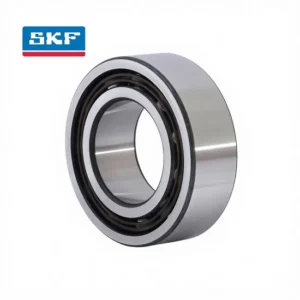
| Bearing Type | Angular Contact Ball Bearing |
| Bore Diameter (d) | 35 mm |
| Outside Diameter (D) | 62 mm |
| Precision Class | P4 (ISO 492 Class 4) |
| Contact Angle | 15° (CE design) |
| Arrangement | Single Row |
| Number of Rows | Single Row |
| Origin | China |
| Weight | 0.100 kg |
Note: The ‘adga’ suffix in this identifier is unverified and requires confirmation against the manufacturer’s catalog for exact meaning and implications.
Application Suitability
| Industry | Typical Applications |
|---|---|
| Machine Tool Manufacturing | High-speed spindle nose bearings, grinding wheel spindles |
| Precision Robotics | Articulated joint actuators requiring low runout |
| General Industrial Machinery | High-speed pump shaft support, precision gearbox stages |
| Steel & Metallurgy | Rolling mill guide roller position sensors |
Why a 15° Contact Angle Dictates Spindle Survival
A mismatched contact angle turns a precision spindle into a scrap heap in weeks.
Buyers sourcing replacement bearings often match the 7007 base number without questioning the contact angle suffix. We’ve seen procurement teams swap a 15° CE variant for a 25° ACD or 40° B bearing because the dimensionally equivalent part was available faster. The result is predictable: higher friction heat under predominantly radial loads, accelerated lubricant degradation, and thermal expansion that collapses the internal clearance. In spindle applications running at high RPM, that sequence moves from installation to seizure faster than most maintenance schedules can catch. The SKF 7007 CE/P4 angular contact ball bearing exists for a reason—its 15° geometry is specifically optimized where radial loads dominate and axial thrust is secondary. [NEED_CITE: angular contact ball bearing contact angle selection criteria for machine tool spindles]
Matching the Spindle Load Spectrum
The SKF 7007 CE/P4 angular contact ball bearing fits applications where the load profile is primarily radial with light, predictable axial components. Machine tool spindles cutting aluminum or performing light finishing passes generate exactly this pattern. The 35 mm bore and 62 mm outside diameter place this bearing in a common envelope for mid-range grinding spindles and high-speed routing heads. We cross-verified this fit against OEM equipment lists where maintenance managers needed a direct replacement without redesigning the housing or shaft tolerances.
Thermal and Speed Demands at the Spindle Nose
Spindle bearings live in a thermal tightrope. The P4 precision class ensures that dimensional tolerances and running accuracy are held tight enough to prevent vibration-induced heat at high rotational speeds. A 15° contact angle generates noticeably less friction heat than 25° or 40° variants under equivalent radial loading, which directly influences lubricant service intervals. [NEED_CITE: friction heat generation comparison between 15 and 25 degree contact angle bearings at high speed] Temperature rise at the spindle nose also interacts with shaft and housing expansion—install a standard CN clearance where thermal growth demands C3, and the bearing runs preloaded beyond its design intent. Lubrication method matters equally: oil-air systems manage heat differently than grease-packed arrangements, and the choice affects relubrication intervals and contamination resistance at the seal interface.
Decoding the CE and P4 Suffixes
The CE designation signals a 15° contact angle with optimized internal geometry, which in practice means the raceway curvature and ball complement are balanced for high-speed, low-heat operation. The P4 precision grade meets ISO 492 Class 4 requirements—tighter bore and OD tolerances, and more restrictive running accuracy limits than P5 or P6 grades. For a spindle designer, this translates directly into less radial and axial runout at the tool tip, which is where surface finish quality gets decided. The single-row arrangement means these bearings must be mounted in pairs or sets to handle bidirectional axial loads, and the preload applied during mounting will define the final system stiffness.
The Hidden Price of a Wrong Suffix Decision
A wrong bearing in a precision spindle doesn’t just fail—it takes the spindle housing, the tooling interface, and potentially weeks of production schedule with it. Correct selection paired with a verified supply source protects against this cascade. Incorrect clearance, mismatched precision, or counterfeit components trigger failure modes cataloged under ISO 15243: surface distress, adhesive wear, and thermal fracture that progress rapidly once initiated. [NEED_CITE: ISO 15243 rolling bearing failure classification modes] Unplanned downtime on a CNC grinding cell costs far beyond the bearing price—scrap parts, missed delivery windows, and emergency air freight for replacements all compound the initial selection error.
Sourcing Confidence for Critical Spindle Replacements
We source SKF 7007 CE/P4 angular contact ball bearings through authorized distributor channels, which means every unit ships with documentation you can trace back to the manufacturer’s network. Our cross-reference database matches not just the base designation but the clearance, cage material, precision class, and contact angle—so if an OEM specifies an NSK or FAG equivalent, we verify all suffixes align before quoting. Batch traceability comes standard with our shipments, and we provide QR code verification pathways through SKF’s official applications so receiving inspectors can confirm authenticity on the dock. For import customers, we prepare country-of-origin documentation and HS code details to clear customs without delays.
Documentation & Authenticity
- Supplier Certificate of Conformity with batch lot number traceable to the authorized distribution channel
- Dimensional inspection report confirming P4 running accuracy tolerances prior to dispatch
- QR code verification instructions for SKF official app authentication at receiving inspection
- Country-of-origin certificate supporting import compliance and customs documentation
- Material certification documenting bearing steel specification for quality audit trails
Storage, Handling & Mounting
- Retain original factory packaging until the moment of mounting; the SKF 7007 CE/P4adga is a precision component where dust contamination at P4 tolerance levels causes measurable runout deviation
- Store flat in a temperature-stable environment to prevent raceway brinelling from static loads on the 35 mm bore inner ring
- Use clean, lint-free gloves when handling—skin oils on the 62 mm OD outer ring surface can initiate corrosion under high-speed spindle operation
- For paired mounting arrangements, verify axial preload specification against the spindle manufacturer’s manual before pressing; incorrect preload on a P4 bearing negates its precision advantage entirely
- Confirm shaft and housing tolerances match the P4 precision class requirements—installing a P4 bearing in a P6-grade housing bore wastes the bearing’s accuracy
Engineering Review Before You Commit
Share your spindle operating parameters—RPM range, radial and axial load estimates, operating temperature, and lubrication method—so we can verify the SKF 7007 CE/P4adga is the correct selection for your application. If you’re replacing an existing bearing, provide the OEM equipment number or the marking from the failed unit and we’ll cross-reference it against our database for exact suffix alignment.
Frequently Asked Questions
Q: What do the CE and P4 suffixes mean on the SKF 7007 CE/P4?
A: CE indicates a 15° contact angle with optimized internal geometry designed for high-speed, low-friction spindle applications. P4 designates ISO 492 Class 4 precision, meaning tighter dimensional tolerances and running accuracy than standard P0 or P6 grades—critical for minimizing tool tip runout in machine tool spindles.
Q: How do I cross-reference this SKF bearing to NSK, FAG, or NTN equivalents?
A: Cross-referencing requires matching more than the 7007 base number. The contact angle (15°), precision class (P4), and cage type must all align across brands. A 25° contact angle or P5 precision substitute may fit dimensionally but will alter thermal behavior and running accuracy. We provide complete cross-reference comparisons that include all suffix parameters.
Q: What precision class do I need—P4, P5, or ABEC 7—for a spindle application?
A: P4 (equivalent to ABEC 7) is the standard choice for most machine tool spindles requiring low runout and high-speed capability. P5 offers less restrictive tolerances suitable for less demanding applications. The decision depends on your acceptable tool tip runout and the surface finish requirements of your machining process. [NEED_CITE: ABEC precision class equivalence to ISO tolerance classes for angular contact bearings]
Q: How can I verify that my SKF 7007 CE/P4 bearing is genuine?
A: SKF provides official verification pathways through their mobile applications using QR codes on packaging and product markings. We supply QR verification instructions with every shipment and source exclusively through authorized distributor channels, so your bearing carries full batch traceability documentation.
Secure Your Spindle Replacement Supply
Send us your operating parameters or OEM equipment number to begin the technical selection review and confirm availability.
Contact our engineering team through the inquiry form on this page to start your quote.