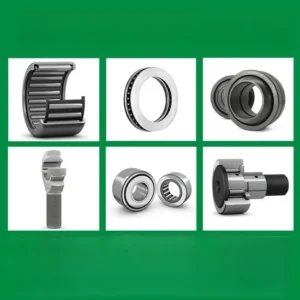
Description
Authorized Channel Traceability — Every INA NKS40-XL we ship traces back through documented distributor invoices, so procurement teams can match batch codes against factory records without relying on middleman claims.
Technical Specifications
| Parameter | Value |
|---|---|
| Designation | INA NKS40-XL |
| Bearing Type | Needle Roller Bearing |
| Bore Diameter (Fw) | 40 mm |
| Outside Diameter (D) | 55 mm |
| Width (B) | 22 mm |
| Weight | 0.13 kg |
| Style | Without Outer Ring, Without Inner Ring |
| Load Direction | Radial |
| Material | Bearing Steel |
| Type | Open |
| Bore Type | Plain |
| Seal or Shield Type | Open |
| Arrangement | Single Row |
| Origin | To be confirmed at inquiry |
Note: The XL suffix is not independently verified against the current INA catalog; confirm application-specific suitability before ordering.
Application Suitability
| Industry | Typical Applications |
|---|---|
| Electric Motors | Motor shaft support where envelope height is constrained |
| Industrial Gearboxes | Intermediate shaft radial support in helical gear units |
| Material Handling | Conveyor roller journals in continuous-run transfer lines |
| Automotive Powertrain | Transmission auxiliary shafts and rocker arm pivots |
| Textile Machinery | Yarn guide roller spindles under moderate radial loading |
What Happens When Needle Geometry Drifts Off-Spec
A substitute bearing that "fits" can still destroy the shaft it rides on within months.
I once watched a maintenance crew pull a cam shaft from a packaging line after only eleven weeks of run time. The needle rollers on the replacement bearing had microscopic flat spots from improper grinding — they were dimensionally correct on paper, but under magnification the brinelling was obvious. The INA NKS40-XL needle roller bearing occupies a tight 40×55×22 mm envelope, which means any roller geometry error concentrates stress on a very small contact patch [NEED_CITE: needle roller bearing contact stress distribution and edge loading risks]. Counterfeit or poorly reconditioned units pass basic caliper checks yet fail catastrophically once the shaft is under production load.
Matching the NKS40-XL to Shaft-Direct Mounting Environments
This bearing runs directly on the shaft journal — there is no inner ring to absorb surface imperfections. That means the shaft must be ground to the correct hardness and finish before the INA NKS40-XL needle roller bearing ever touches it. In gearbox applications we have supplied for, maintenance teams that skipped the shaft surface check saw spalling appear on the journal within the first oil change interval. When the housing bore serves as the outer raceway, its roundness and surface finish carry the same requirement. We cross-check housing bore tolerances against INA published limits before confirming interchange options.
Radial Load, Speed Envelope, and Thermal Drift
The 40 mm bore and 22 mm width give this needle roller bearing a compact profile that handles significant radial load for its size, but the open-type design places lubrication responsibility entirely on the surrounding system. At sustained speeds, oil mist or circulating oil must reach the roller-cage interface without pooling and overheating [NEED_CITE: needle roller bearing lubrication requirements for open-type configurations at sustained speeds]. Temperature rise also affects the effective clearance between the rollers and the shaft journal; a shaft that expands more than the housing can turn a running clearance into an interference fit. Procurement engineers ordering replacements should confirm whether the original equipment designer specified a particular clearance group or whether standard production tolerances are adequate for the actual operating temperature range.
Reading the Cage and Roller Interface
Without an outer ring, the cage in the NKS40-XL is the only component keeping the needle rollers evenly spaced and aligned. A stamped steel cage works well at moderate speeds and loads, but if the application involves shock loads or frequent reversals — common in material handling indexing stations — cage pocket wear accelerates. The bearing steel rollers must maintain their crown profile to avoid edge loading on the shaft and housing raceways. When we receive inspection requests, we look at cage pocket elongation and roller end geometry under magnification before clearing a batch for shipment. These details are invisible to a quick visual check but define whether the bearing survives its first month or its first year.
The Hidden Cost of an Unverified Replacement
Installing an unverified needle roller bearing rarely shows immediate symptoms. The shaft turns freely by hand, the housing slides on without force, and the machine restarts on schedule. But ISO 15243 classifies the failure modes that follow — surface fatigue from roller flat spots, adhesive wear from cage breakdown, and eventually shaft scoring that requires a full journal regrind [NEED_CITE: bearing failure modes per ISO 15243 classification]. The cost of the bearing itself becomes trivial compared to unplanned downtime on a critical line, warranty disputes with the equipment OEM, or the lead time on a replacement shaft that is no longer stocked.
How We Reduce That Risk at the Procurement Stage
Our sourcing model works through authorized distributor channels rather than single-brand agency agreements, which means we pull INA NKS40-XL needle roller bearing stock from suppliers whose invoices we can trace back to the manufacturer’s regional warehouse. Each shipment carries a Certificate of Conformity tied to the production batch. When buyers need to confirm interchange with another brand, we match not just the bore, OD, and width, but also cage type, clearance group, and roller profile — a three-axis comparison that prevents the common mistake of swapping in a dimensionally identical bearing that fails because its internal geometry targets a different load-speed combination. We also provide country-of-origin documentation so import compliance teams can clear customs without delays or re-inspection fees.
Documentation & Authenticity
- Supplier Certificate of Conformity linking each INA NKS40-XL batch to its production lot for downstream traceability
- Material certificate confirming bearing steel composition and heat treatment condition of the needle rollers
- Dimensional inspection report verifying Fw 40 mm, D 55 mm, and B 22 mm against ISO 492 tolerances before dispatch
- Country-of-origin documentation prepared for import filing, including HS code references for needle roller bearings
- QR code verification pathway through INA official digital tools so receiving inspectors can authenticate markings on arrival
Storage, Handling & Mounting
- Keep the 40×55×22 mm open-type bearing sealed in its original anti-corrosion wrapping until the moment of mounting; exposure to humid shop air will stain the unshielded needle rollers within days
- Handle with lint-free gloves to prevent fingerprint acid etching on the cage and roller surfaces, which becomes a fatigue initiation point under radial load
- Verify shaft journal hardness and surface roughness against INA specifications before pressing the needle roller assembly onto the 40 mm journal; the shaft itself is the inner raceway
- Apply the specified lubricant immediately after mounting since the open-type construction provides no factory grease fill; delayed lubrication risks dry-start scoring on the roller ends
- Store horizontally in climate-controlled inventory to prevent cage distortion — vertical stacking of small needle bearings can deform the stamped cage pockets over time
Starting the Specification Conversation
Share your operating parameters — shaft speed, radial load spectrum, operating temperature range, and lubrication method — so we can confirm whether the NKS40-XL is the correct fit or whether a sealed or caged variant better suits the application. If you are replacing an existing bearing, send us the OEM equipment number or the markings on the unit being removed, and we will run a cross-reference check against the full INA needle roller range. We can also provide a documentation package preview so your import and receiving teams know exactly what accompanies the shipment.
Frequently Asked Questions
Q: How can I confirm that the INA needle roller bearing I received is genuine?
A: Genuine INA products carry batch markings that can be cross-referenced through the manufacturer’s official digital verification tools. We provide a Certificate of Conformity with every shipment and guide receiving inspectors through the QR or batch-code check process before installation.
Q: What should I consider when cross-referencing the NKS40-XL to another brand?
A: Beyond matching Fw 40 mm, D 55 mm, and B 22 mm, you must confirm that the substitute uses the same cage material and roller profile. A dimensionally identical bearing with a different cage design may fail prematurely under shock loads or high-speed conditions.
Q: Does the XL suffix change how I install or maintain this bearing?
A: The XL suffix should be verified against the current INA product catalog to confirm its exact meaning for this bearing series. We recommend requesting the manufacturer’s technical data sheet before finalizing installation procedures.
Q: What lubrication approach is recommended for the open-type NKS40-XL?
A: Because the bearing ships without factory grease or seals, the lubrication method — oil bath, oil mist, or manual grease application — must be defined by the system design. Operating speed and ambient temperature determine whether oil or grease is appropriate and the required replenishment interval.
Q: Can I use this bearing if my shaft journal is not hardened?
A: The shaft serves directly as the inner raceway in this design. If the journal is not hardened and ground to specification, needle rollers will indent the softer shaft surface, leading to premature vibration and failure.
Get the NKS40-XL Specification Package
Send us your application parameters or OEM part number, and we will return a cross-reference confirmation with full documentation details.
Contact: sales@jxt-bearing.com