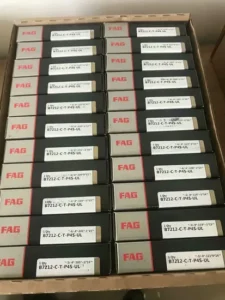


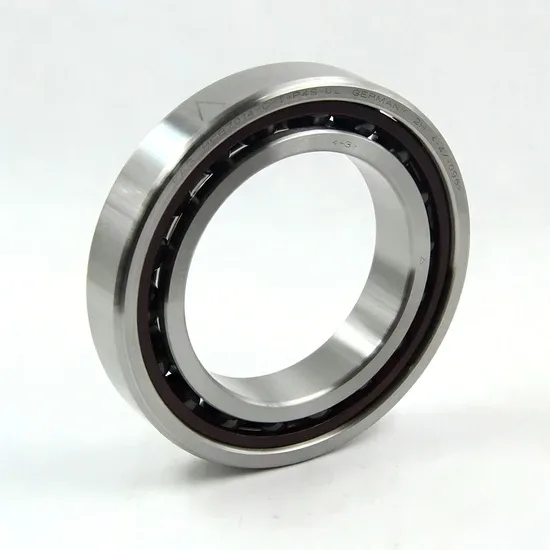
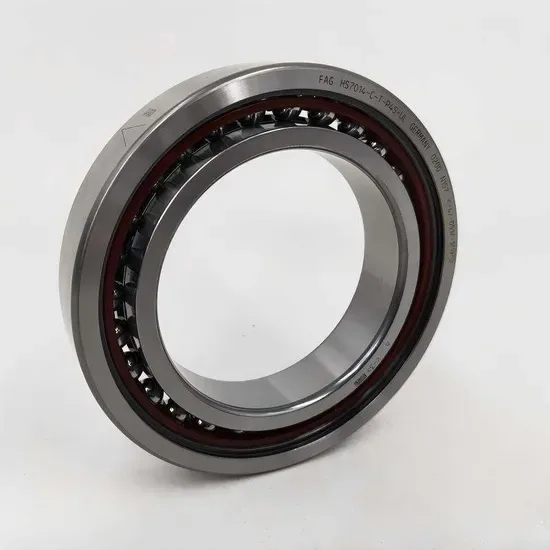
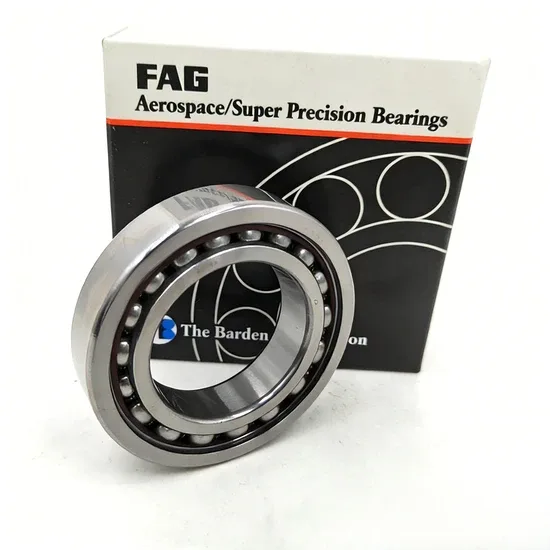
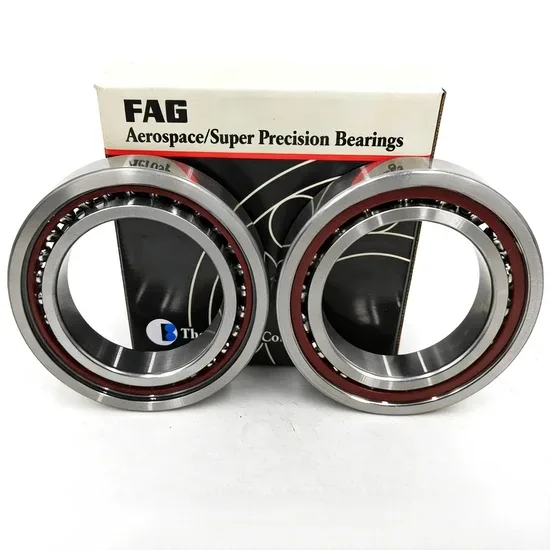
Description
Authorized Channel Traceability — Every FAG XC7002-C-T-P4S angular contact ball bearing we supply ships with batch-level documentation traceable back to the manufacturer’s authorized distributor network, ensuring full supply chain transparency for precision spindle applications.
Technical Specifications
| Parameter | Value |
|---|---|
| Designation | FAG XC7002-C-T-P4S |
| Bearing Type | Angular Contact Ball Bearing |
| Bore Diameter (d) | 15 mm |
| Outside Diameter (D) | 32 mm |
| Width (B) | 9 mm |
| Weight | 0.030 kg |
| Cage Material | Phenolic resin (fabric-reinforced) |
| Contact Angle | 15° |
| Precision Class | ISO tolerance class 4 (P4S) |
| Number of Rows | Single Row |
| Bore Type | Cylindrical |
| Origin | China |
Note: The "XC" and "T" suffixes in this designation require verification against the current FAG catalog to confirm specific variant attributes; all other suffixes have been decoded per standard FAG nomenclature.
Application Suitability
| Industry | Typical Applications |
|---|---|
| Machine tool manufacturing | High-frequency grinding spindle nose bearing |
| Precision equipment | Coordinate measuring machine rotary table support |
| Robotics | Joint actuator harmonic drive shaft support |
| High-speed pump assembly | Impeller shaft radial-axial locating position |
When a Suffix Mismatch Wrecks a Spindle Rebuild
The FAG XC7002-C-T-P4S angular contact ball bearing carries a 15° contact angle and P4S precision class — change either suffix and you are mounting a fundamentally different component. A P0 grade substitute will pass dimensional gauging but introduce runout that shows up as chatter marks on finished workpieces within the first hour of spindle operation [NEED_CITE: precision class effect on spindle runout and surface finish]. We have seen procurement teams match the 7002 base number, overlook the C contact angle, and install 25° variants that generated excess friction heat and seized under continuous duty. The cost is never just the bearing — it is the scrapped batch, the missed shipment, and the credibility damage with your customer.
How This Bearing Earns Its Place in a Grinding Spindle
At 15 mm bore and 32 mm outside diameter, the FAG XC7002-C-T-P4S angular contact ball bearing fits the compact envelope typical of high-speed internal grinding spindles. The 15° contact angle delivers predominantly radial load capacity while maintaining enough axial stiffness to handle thrust from wheel dressing cycles. Phenolic resin cages are standard in this size range for spindle duty because they run cooler and lighter than brass alternatives at speeds approaching the grease limit. Our cross-reference process verifies that any substitute from another brand matches not just the envelope dimensions but also the cage material, contact angle, and P4S running accuracy before we confirm interchangeability.
Thermal Growth and Lubrication in Continuous Spindle Duty
Grinding spindles run at elevated speeds for hours, and the heat generated at the contact ellipse changes the internal clearance dynamically. A 15° contact angle produces less friction heat than higher-angle designs under radial-dominant loads, but thermal expansion of the shaft still compresses the bearing internally. Oil-air or oil-mist lubrication is typical here, providing both cooling and a thin film that prevents metal-to-metal contact at the ball-race interface. The phenolic cage is compatible with these lubrication methods but has an upper temperature boundary; exceeding it causes the resin to degrade and cage pockets to wear unevenly [NEED_CITE: phenolic cage temperature limits in high-speed spindle bearings]. Proper preload setting at assembly — usually light preload for this size — compensates for thermal growth without over-stressing the raceways.
Decoding What the Suffixes Actually Control
The "C" in this designation specifies the 15° contact angle, which balances radial capacity with moderate axial stiffness — appropriate for spindle positions where radial cutting forces dominate. The phenolic resin cage (indicated by the cage code in this series) reduces centrifugal load on the outer raceway compared to brass, allowing higher speed capability before cage-guided skidding occurs. The P4S precision class meets ISO tolerance class 4 requirements for bore, outside diameter, and width tolerances, with added running accuracy specifications that control inner and outer ring radial runout to levels necessary for vibration-free spindle rotation. Single row angular contact bearings like this one must be mounted in opposition to another bearing to absorb bidirectional axial loads, and the matched pair preload must be set during assembly.
The Hidden Ledger of Wrong-Spec Replacements
Installing a bearing that matches only the base number but carries the wrong clearance, cage, or precision grade does not fail immediately — it fails at the worst possible time. ISO 15243 classifies the resulting damage patterns: smearing from inadequate preload, cage fracture from speed overload, and raceway spalling from thermal compression [NEED_CITE: bearing failure modes per ISO 15243 classification]. Unplanned downtime on a production grinder costs far more than the bearing itself — lost throughput, emergency freight for replacements, and potential scrap of in-process workpieces. Genuine FAG XC7002-C-T-P4S angular contact ball bearings sourced through authorized channels eliminate the counterfeit risk that introduces soft inner rings and cloned markings into the supply chain.
What Verification Looks Like on Our End
We source the FAG XC7002-C-T-P4S angular contact ball bearing through authorized distributor channels, not open-market brokers, which means every shipment carries traceable batch documentation. Our cross-reference database aligns clearance, cage material, and precision class simultaneously — not just the base designation — so interchange decisions are technically sound. Before release, we confirm country-of-origin documentation for your import compliance and can arrange third-party dimensional inspection to verify running accuracy against P4S requirements. For buyers concerned about counterfeit exposure, we provide the QR code verification pathway through the manufacturer’s official application so you can authenticate each bearing independently upon receipt.
Documentation & Authenticity
- Supplier Certificate of Conformity linked to the specific production batch of your FAG XC7002-C-T-P4S order
- QR code on packaging scannable via the official FAG application for independent authenticity confirmation
- Country-of-origin certificate supporting customs clearance and import duty classification
- Material certificate confirming bearing steel grade and heat treatment compliance
- Third-party runout inspection report validating P4S running accuracy prior to dispatch
Storage, Handling & Mounting
- Retain the factory-sealed packaging until the moment of mounting; the phenolic resin cage in this P4S bearing absorbs moisture if exposed to humid shop air, affecting dimensional stability
- Store flat in a temperature-controlled environment away from direct sunlight to prevent resin cage degradation before installation
- Use clean lint-free gloves when handling the 15 mm bore and 32 mm OD surfaces; fingerprint residue on precision-ground raceways initiates corrosion under oil film
- Mount using controlled induction heating of the inner ring only, monitoring temperature to stay within phenolic cage thermal limits
- Set preload against the mating bearing using the manufacturer’s specified force-displacement curve for this contact angle and precision class
- If the spindle design uses oil-air lubrication, verify nozzle alignment delivers mist directly to the cage-ball interface without pooling
Starting the Technical Conversation
Share your spindle speed range, load spectrum, and lubrication method so we can confirm the FAG XC7002-C-T-P4S angular contact ball bearing matches your application parameters — or identify a more suitable variant. If you are replacing an existing bearing, provide the OEM equipment number and the marking on the bearing currently installed so we can run a full cross-reference check including suffix alignment. We will respond with a quotation covering lead time, minimum order quantity, and the documentation package available for your shipment.
Frequently Asked Questions
Q: What does P4S precision mean compared to standard P4?
A: P4S meets ISO tolerance class 4 for dimensional accuracy on bore, outside diameter, and width, with additional running accuracy specifications that tighten radial runout limits beyond standard P4. This is critical for spindle applications where vibration directly transfers to workpiece surface finish.
Q: Can I substitute a 25° contact angle bearing for this 15° design?
A: Not without engineering review. A 25° bearing (typically marked AC or ACD) generates higher axial stiffness but also higher friction heat under the same radial load. In a spindle designed around 15° contact geometry, the thermal growth mismatch can eliminate internal clearance and cause seizure.
Q: How do I verify the bearing is genuine upon delivery?
A: Scan the QR code on the packaging using the official FAG application. Authentic products link to the manufacturer’s database showing batch and production details. We also supply Certificate of Conformity documentation for independent verification.
Q: What cage temperature limits apply to phenolic resin?
A: Phenolic resin cages perform well at spindle speeds but have upper continuous temperature boundaries lower than brass or steel cages. Exceeding these limits causes resin softening and uneven pocket wear. Your lubrication system must maintain cage temperature within safe margins during continuous operation.
Q: Are the XC and T suffixes standard FAG designations?
A: These specific prefix and suffix elements require confirmation against the current manufacturer catalog for their exact meaning in this product variant. We verify all suffix definitions with authorized technical channels before confirming suitability for your application.
Confirm Your Spindle Bearing Specification
Send us your application parameters or OEM part number, and we will return a technically verified recommendation with full documentation scope and delivery timeline.