


Description
Verified Supply Channel — Every HCB7209-C-T-P4S-UL we source ships with full batch traceability through authorized FAG/INA distributor networks, backed by documentation that matches the spindle builder’s compliance requirements.
Technical Specifications
| Parameter | Value |
|---|---|
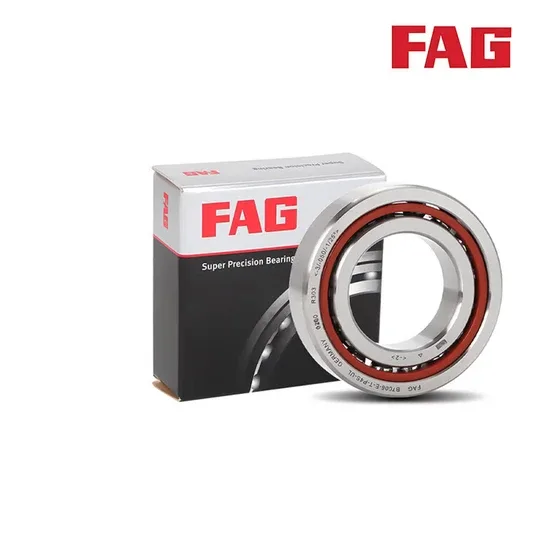
| Designation | FAG HCB7209-C-T-P4S-UL |
| Bearing Type | Angular Contact Ball Bearing |
| Bore Diameter (d) | 45 mm |
| Outside Diameter (D) | 85 mm |
| Width (B) | 19 mm |
| Weight | 0.363 kg (per unit) |
| Precision Class | P4S (ISO 492 class 4 with enhanced running accuracy) |
| Contact Angle | 15° (suffix C) |
| Arrangement | Universal matching, light preload (suffix UL) |
| Number of Rows | Single |
| Origin | China |
Note: The HCB and T suffixes in this identifier could not be fully cross-referenced against the current manufacturer catalog; verification with FAG application engineering is recommended before final specification lock-in.
Application Suitability
| Industry | Typical Applications |
|---|---|
| Machine tool manufacturing | High-frequency motorized spindle front bearing position |
| Precision equipment | Coordinate measuring machine rotary table axis |
| Industrial pumps | High-speed centrifugal pump shaft support |
What Happens When P4S Precision Meets a Spindle That Demands It
A 15° contact angle with universal light preload keeps the thermal signature low enough to hold micron-level workpiece tolerances across an eight-hour shift.
I once traced a spindle vibration issue back to a bearing where the base designation matched perfectly, but the supplier had substituted a P5 tolerance class for the specified P4S. The runout difference was invisible to the naked eye but catastrophic for surface finish on hardened steel workpieces. Cross-reference errors involving precision suffixes and preload designations account for a significant share of premature spindle failures that get misdiagnosed as lubrication problems [NEED_CITE: rolling bearing failure mode classification per ISO 15243].
Matching Spindle Load Profiles to the HCB7209-C-T-P4S-UL
Motorized spindles in machining centers generate predominantly radial cutting forces with moderate axial thrust during drilling cycles. The 15° contact angle on this HCB7209-C-T-P4S-UL angular contact ball bearing produces lower friction torque than 25° or 40° alternatives, which directly reduces heat generation at the raceway contact patch. When a grinder builder we supplied switched from a B-suffix 40° bearing to the C-suffix variant at the same preload, their spindle thermal growth dropped enough to eliminate a mid-shift compensation routine. That substitution only works because the axial load remained well within the bearing’s capacity — a calculation we walk through during every technical review.
Thermal Growth and Preload Stability Under Continuous Duty
Spindle housings expand as internal friction and cutting heat accumulate, altering the interference fit and effective preload on the bearing pair. A universal light preload (UL designation) gives the HCB7209-C-T-P4S-UL enough margin to absorb thermal expansion without crossing into excessive contact stress on the ceramic balls. At sustained speeds approaching the grease speed limit, the 15° contact angle generates less heat than higher-angle variants, which in turn reduces the thermal gradient between inner and outer rings. This matters because uneven expansion is what pushes a bearing from its designed operating clearance into a thermally bound condition — a failure mode that ISO 281 life calculations do not fully capture when temperature differentials exceed the modeled assumptions [NEED_CITE: thermal binding failure mechanism in high-speed spindle bearings].
Decoding the Suffix Stack That Defines Performance
The P4S precision class goes beyond standard P4 dimensional tolerances by adding tighter running accuracy limits — the parameter that directly governs spindle runout at the tool tip. The UL arrangement code means this bearing leaves the factory measured and sorted so that any two units can be paired back-to-back or face-to-face with a predictable, light preload value, eliminating the custom grinding of spacer sleeves that older spindle designs required. The 15° C contact angle balances axial rigidity against friction: it provides enough thrust capacity for typical drilling and tapping loads while keeping the ball-raceway sliding velocity low enough to preserve grease life in sealed-for-life spindle cartridges.
The Downtime Math Behind a Suffix Substitution
A procurement team once saved a few percent on unit price by accepting a standard P0-grade substitute for a specified P4S spindle bearing. The spindle passed initial run-in, but within six weeks the shop was seeing chatter marks on finished surfaces and scrapped a batch of aerospace fittings. The root cause was radial runout exceeding the toolholder compensation range — a problem that ISO 15243 classifies under geometric deviation rather than material fatigue [NEED_CITE: ISO 15243 geometric deviation failure category]. By the time the correct bearing was sourced and installed, the unplanned downtime and scrap cost had eclipsed the original savings many times over.
What Our Technical Review Catches Before Shipment
We source the HCB7209-C-T-P4S-UL through authorized FAG/INA distributor channels, which means every unit carries batch-level traceability back to the manufacturer’s production facilities. Our cross-reference database flags not just the base number but the full suffix string — contact angle, precision class, preload designation, and cage material — so substitution proposals are evaluated against the complete specification. When an OEM equipment number is provided, we verify the original bearing’s suffix configuration and confirm whether the replacement matches on all parameters that affect fit and function. Each shipment includes documentation packages that support import compliance and buyer-side incoming inspection.
Documentation & Authenticity
- Supplier Certificate of Conformity referencing the HCB7209-C-T-P4S-UL batch and lot number for full supply chain traceability
- QR code verification pathway via the FAG/INA official application to confirm genuine origin before installation
- Third-party runout inspection report confirming P4S running accuracy limits prior to dispatch
- Country-of-origin documentation prepared for customs clearance in destination markets
- Material certificate covering ring and ceramic ball specifications for incoming quality audits
Storage, Handling & Mounting
- Keep the UL-matched set in original sealed packaging until the moment of mounting to preserve factory preload pairing marks and prevent contamination of the precision-ground raceways
- Store below 25°C in a humidity-controlled environment; thermal cycling can cause condensation inside the packaging and compromise the anti-corrosion coating on the steel rings
- Use lint-free gloves when handling the 45 mm bore to prevent fingerprint acids from initiating corrosion on the P4S-finished inner ring surface
- For back-to-back pairing of universal matched units, align the V-marks on the outer ring faces per the manufacturer’s arrangement diagram before applying the spindle lock nut
- Confirm residual preload after mounting by measuring bearing temperature during the first thirty minutes of run-in; a rapid spike above the modeled thermal equilibrium suggests the interference fit is over-compressing the light preload configuration
Request a Technical Review
Share your spindle operating parameters — sustained speed, radial and axial load spectrum, housing material, and lubrication method — so we can verify that the HCB7209-C-T-P4S-UL suffix configuration matches your application. If you have the OEM equipment number or the original bearing drawing, send it over and we will run a full cross-reference check covering clearance, contact angle, and precision class alignment.
Frequently Asked Questions
Q: What does the UL preload designation mean compared to GA or GB?
A: UL is FAG’s universal matching code for light preload, functionally equivalent to what other manufacturers label as GA. It provides enough axial stiffness for precision spindle applications while keeping friction heat low enough for sustained high-speed operation. Medium (GB) or heavy (GC) preload would increase rigidity but at the cost of higher operating temperature and reduced grease life.
Q: How does P4S precision differ from standard P4?
A: P4S meets all ISO 492 class 4 dimensional tolerances and adds tighter running accuracy limits — specifically radial and axial runout. This extra control is what allows the bearing to maintain sub-micron tool tip positioning in precision spindle applications where standard P4 runout would produce visible surface finish defects.
Q: Can I substitute a 25° contact angle bearing for this 15° C-suffix unit?
A: A 25° AC-suffix bearing would increase axial rigidity but generate more friction heat at the same speed, potentially pushing the spindle past its thermal equilibrium point. The substitution should only be made after recalculating the thermal balance and verifying that the housing and lubrication system can handle the additional heat. We recommend running the application parameters through a selection review before approving any contact angle change.
Q: How do I verify the bearing is genuine upon receipt?
A: Each bearing carries a QR code that can be scanned through the FAG/INA official application to confirm production batch, origin, and specification match. We also supply batch-level traceability documentation and can arrange third-party dimensional inspection if your incoming quality protocol requires independent verification.
Q: What cross-reference checks should I perform before substituting another brand?
A: Beyond the base designation 7209, you must confirm that the replacement matches on contact angle (15° / C), precision class (P4S or equivalent such as P4A), preload designation (light / UL / GA), and cage material. A mismatch on any of these parameters can alter thermal behavior, runout, or preload stability in the assembled spindle.
Confirm Your HCB7209-C-T-P4S-UL Specification
Send us your spindle parameters or OEM drawing number, and we will return a complete suffix verification and cross-reference comparison within one business day.