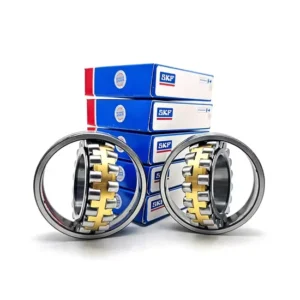

SKF
SKF Spherical Roller Bearing 24030-Cc-C3 W33 for Power Machine
Spherical Roller Bearings
View DetailsAuthorized SKF Distributor Ball, roller, needle, thrust and mounted bearings for industrial buyers worldwide

Authentic
ISO 9001
24h Reply
<p><strong>SKF 23052-Cc- W33 Spherical Roller Bearing</strong> — Double-row self-aligning structure accommodates shaft misalignment under heavy radial loads. The W33 outer ring lubrication groove and holes enable efficient relubrication in dusty cement plant and crusher environments. Chrome Steel Gcr15 construction delivers high fatigue strength for continuous heavy-duty operation.</p> <ul> <li><strong>Scan each package QR code via the official SKF app to confirm batch authenticity before installation.</strong></li> </ul>
Cross-Reference Alignment Verified — We validate dimensional and load equivalencies across global catalogs before dispatching your SKF 23052-Cc- W33.
| Parameter | Value |
|---|---|
| Designation | SKF 23052-Cc- W33 |
| Bearing Type | Spherical Roller Bearing |
| Arrangement | Double Row, Self-Aligning |
| Material | Chrome Steel Gcr15 |
| Cage Material Options | Steel Cage / Brass Cage / Nylon Cage |
| Precision Class | P0 P2 P4 P5 P6 |
| Lubrication Feature | Outer ring lubrication groove and holes (W33) |
| Origin | Jiangsu China |
The Cc suffix remains unverified and requires manufacturer catalog confirmation prior to final selection.
| Industry | Typical Applications |
|---|---|
| Cement Manufacturing | Rotary kiln support rollers, clinker cooler exhaust fans |
| Mining & Aggregates | Heavy-duty vibrating screens, primary jaw crusher toggle plates |
| Steel Production | Continuous casting machine segments, rolling mill guide rollers |
Thermal expansion combined with particulate ingress causes internal clearance collapse long before the raceway reaches its calculated fatigue limit.
When I was conducting failure analysis at an Indonesian cement plant, a rotary kiln support roller seized catastrophically during peak production. The root cause was not inadequate static load capacity, but insufficient internal clearance to accommodate extreme thermal gradients and fine clinker dust infiltration. Selecting the correct SKF 23052-Cc- W33 spherical roller bearing requires anticipating these exact operational extremes rather than just matching basic dimensions. Misjudging the thermal expansion profile leads to premature rolling element skidding, severe raceway spalling, and ultimate structural failure [NEED_CITE: rolling bearing failure mode classification per ISO 15243]. Understanding the precise interaction between ambient heat, frictional heat, and housing constraints is absolutely vital for long-term reliability in these punishing environments.
Sourcing the right SKF 23052-Cc- W33 spherical roller bearing goes beyond simply matching the bore diameter and outside diameter from a printed catalog. Our engineering team carefully cross-references your specific equipment OEM requirements against multiple global manufacturer databases to ensure the internal geometry and cage design perfectly suit your plant’s unique operational profile. We regularly consolidate mixed-brand project orders, ensuring every single unit meets the exacting demands of heavy industrial machinery without forcing you to coordinate with dozens of fragmented suppliers. This comprehensive technical alignment guarantees that the bearing you receive is genuinely optimized for the specific shock loads and misalignment inherent in your facility.
Cement and crushing environments subject heavy equipment to immense radial loads coupled with severe, unpredictable thermal cycling. As ambient and operational temperatures rise continuously, the inner ring expands progressively, reducing the critical internal clearance. If the lubrication pathway becomes blocked by fine abrasive dust, the resulting friction generates localized hotspots that rapidly accelerate lubricant degradation and cage wear. Proper relubrication intervals and highly effective sealing arrangements are absolutely critical to prevent particulate contamination from compromising the rolling contact zones [NEED_CITE: impact of solid contaminants on bearing fatigue life per ISO 281]. Ignoring these environmental factors inevitably transforms a minor maintenance oversight into a complete mechanical seizure.
The double-row, self-aligning arrangement of the SKF 23052-Cc- W33 spherical roller bearing inherently compensates for shaft deflections and housing misalignments that are exceptionally common in heavy structural frameworks. The W33 designation indicates an outer ring lubrication groove and holes, which directly channel fresh grease into the load zone, effectively flushing out degraded lubricant and microscopic wear debris. Depending on the specific vibration and speed profile of your vibrating screen or kiln, the bearing is available with steel, brass, or nylon cage options. Brass cages typically offer superior resistance to high-vibration shock loads, while steel cages provide a balanced approach for standard heavy-duty applications. Selecting the appropriate precision class ensures optimal load distribution across both roller rows, preventing edge loading that drastically shortens service life.
Specifying a standard clearance bearing for a high-temperature kiln application inevitably results in unplanned downtime and catastrophic equipment damage. When internal clearance completely vanishes, the rollers skid rather than roll, generating immense frictional heat that can literally weld the rolling elements to the raceway. This severe failure mode instantly voids warranty coverage and forces emergency replacement procedures that halt entire production lines for days. Aligning the internal geometry with the actual thermal and load boundaries prevents these devastating operational interruptions [NEED_CITE: economic impact of unplanned downtime in heavy manufacturing]. The true cost of a mismatched bearing is never just the replacement part; it is the massive revenue lost during the forced shutdown.
We rigorously verify the W33 lubrication groove machining quality and dimensional tolerances against official specifications before any shipment leaves our consolidation facility. Our technical team provides extensive cross-brand equivalent model consultation, ensuring you receive the exact internal clearance and cage configuration required, even if the original OEM part number has been officially superseded. We supply complete traceability documentation for every single unit, guaranteeing genuine origin and uncompromised metallurgical integrity. Furthermore, our flexible consolidation services allow you to mix this specific model with other critical maintenance spares in a single container, optimizing your procurement logistics and significantly reducing overall sourcing costs.
To facilitate accurate technical review for the SKF 23052-Cc- W33 spherical roller bearing, please provide your equipment’s detailed radial and axial load profiles, operational speeds, and expected thermal gradients. Sharing the specific OEM equipment model numbers allows our engineering team to perform precise cross-reference verifications and confirm the optimal internal clearance class for your exact application. Supplying this comprehensive operational data ensures we deliver a configuration that reliably withstands your specific environment, eliminating the guesswork from your critical maintenance planning.
Q: How do I verify the authenticity of this specific spherical roller bearing?
A: We provide comprehensive traceability documentation, including original manufacturer batch codes and material test certificates. You can cross-reference the physical dimensions, specifically the W33 outer ring lubrication groove machining, against official catalog data. Our team also guides you through using official authentication tools to confirm the metallurgical integrity and genuine origin of every unit before installation.
Q: What does the W33 suffix mean for my relubrication schedule?
A: The W33 suffix designates an outer ring lubrication groove with holes that channel grease directly into the rolling elements. This feature is crucial in dusty cement or mining environments, as it allows fresh lubricant to flush out contaminated grease and abrasive particulates. It enables more effective relubrication without disassembling the housing, significantly extending service intervals and protecting the raceways.
Q: How should I choose the right clearance class for high-temperature kiln applications?
A: High-temperature environments cause the inner ring to expand more than the outer ring, reducing internal clearance. If the clearance collapses, the bearing will overheat and seize. You must calculate the thermal gradient between the shaft and the housing to select an appropriate clearance class, such as C3 or C4. Providing your exact operational temperatures allows us to recommend the correct internal geometry.
Q: What are the common failure modes in cement plant vibrating screens?
A: Vibrating screens subject bearings to high cyclic shock loads and severe misalignment. Common failure modes include cage fracture, roller skidding, and premature raceway spalling caused by inadequate internal clearance or lubrication starvation. Ensuring the bearing features a heavy-duty cage design and utilizing the W33 lubrication groove for consistent grease replenishment are critical steps to mitigate these specific failure mechanisms and maintain continuous operation.
Spherical Roller Bearings
View DetailsMining and Vibrating Screen Bearings
View DetailsSpherical Roller Bearings
View DetailsSpherical Roller Bearings
View DetailsSend us your inquiry with model number and quantity. Our technical team will respond within 24 hours with pricing, availability and delivery terms.
100% Authentic
Authorized distributor
Fast Delivery
Global logistics network
Full Documentation
Certs, datasheets & more
Expert Support
10+ years experience